
Savannah, Georgia. January 22, 2015. Simon Hopkinson is an English food writer and former chef about whom I’ve blogged before (see February 21, 2008). I’m not surprised to read on Wikipedia that Richard Olney, Jane Grigson, and Elizabeth David were the major influences on his writing style. Add Elizabeth Schneider and Karen Hess to the mix and you have my favorite six culinary authors.
I’m not familiar with all of Hopkinson’s books but I do find myself from time to time pulling his Roast Chicken… and his Second Helpings… from the shelf to peruse. It’s great bedside material. He admits on the one hand to being “possessed of the eternally pedantic palate;” on the other, of being quite fond of those “bouncy little cubes” of “jelly” (what we mostly refer to as “Jello” here in the States), even when the bounce landed them in his beloved dog’s basket: “Although a red cube of jelly covered in corgi hairs was not part of the plan, it represented only a minor setback. A brief rinse under a warm tap soon put paid to any unwanted garnish.”
Much of the foods he describes, and the language he uses, is purely British. And while Waitrose Food Illustrated, the magazine from the upscale English grocer, declared his first book to be “the most useful cookbook of all time,” his prose is as down-to-earth as his deceptively simple recipes: “The mixed-up vocabulary of an eight-year-old can do anything it likes: with that certain deadly accuracy, fluff and mush surely makes flush, does it not?” His essay on Duck begins, “Now, here’s a thing. Aylesbury duck.” On Cabbage, his first pronouncement is that he “cannot recall ever disliking cabbage, even as a nipper.” And on Salt, he declares, “I simply don’t understand this recent thing with salt.”
The books are arranged by ingredients, with an essay and collection of recipes on each of some 40 of his favorites – Chicken, Rabbit, Cilantro, Linguine, Peas, Saffron, Parmesan, Lettuce, Rhubarb, Quail, and others not so well-known or -loved on this side of the ocean, such as Hake, Liver, Brains, Grouse, Custard, Suet, Skate, Smoked Haddock, Kidneys, and, yes, Jelly. Not the other half of a peanut butter sandwich, but various congealed dishes that for some reason here command neither the cachet nor the esteem they do in Europe.
I’ve always loved the consistency of congealed dishes, from tomato aspic and boeuf en daube glacé to the various congealed salads my mother loved to serve as side dishes. I don’t have the sweet tooth that my mother did, so I don’t use her recipes that call for lemon, lime, or black cherry Jello®, but I do make my own versions occasionally. Her black cherry salad called for two cans of black cherries, a box of black cherry Jello®, and chopped celery and nuts. I just omit the Jello® and use some flavorless gelatin.
So it was with nostalgic pleasure that I recently re-read Hopkinson’s chapter on Jelly, in which he includes recipes for Jellied Chicken Consommé, the French classic Jambon Persillé, and Red Grapefruit and Blood Orange Jelly with Champagne (which he admits is “as far away from a packet of Chivers as is possible to imagine.”) Ah, consommé! One of my favorite dishes in the world and so rare to find in restaurants these days. I remember when I was young, every southern town of any size had a hotel with a dining room, with white tablecloths and livered waiters, homemade pickles and bread, and, always, a consommé offered to begin the meal. Chef Frank Ruta, a former White House chef and owner of Washington, DC’s fabled Palena (now closed; Ruta is now chef at the Georgetown hotel, Capella), is one of the few chefs who have consistently offered the crystal clear, intensely flavored broths.
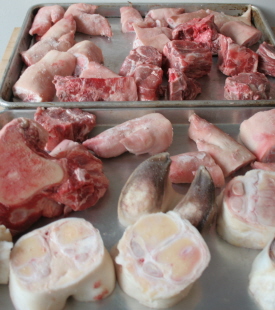 If you follow the links above, you’ll find my detailed instructions for preparing Daube Glacé. I have used both cow and pig feet to render my gelatin. Hopkinson says that he has “never actually made a sweet jelly using the old way of simmering a chopped-up calf’s foot, as this truly seems just that little bit too much of a fagaroony [whatever that is]…. Even the hungriest of infants would flush out that fugitive flavour – and possibly in less time than it would take them to spend a penny.” One of his “top ten favourite things to eat, period,” is Jambon Persillé, that “jewel of the charcutier’s art: pink nuggets of ham, rivulets of green-flecked jelly and a few cornichons on the side for essential pucker and crunch.” Of course he uses a split pig’s trotter with the ham, and he uses “a ruminant’s foot” for a “properly made beef consommé,” but in the fruit-based jelly he offers, he calls for sheet gelatine (the English spelling), which is all but impossible to find in America.
David Lebovitz’s excellent blog has tackled sheet vs. powdered gelatin and I highly recommend that you read it if you want to use continental recipes that call for the sheets.
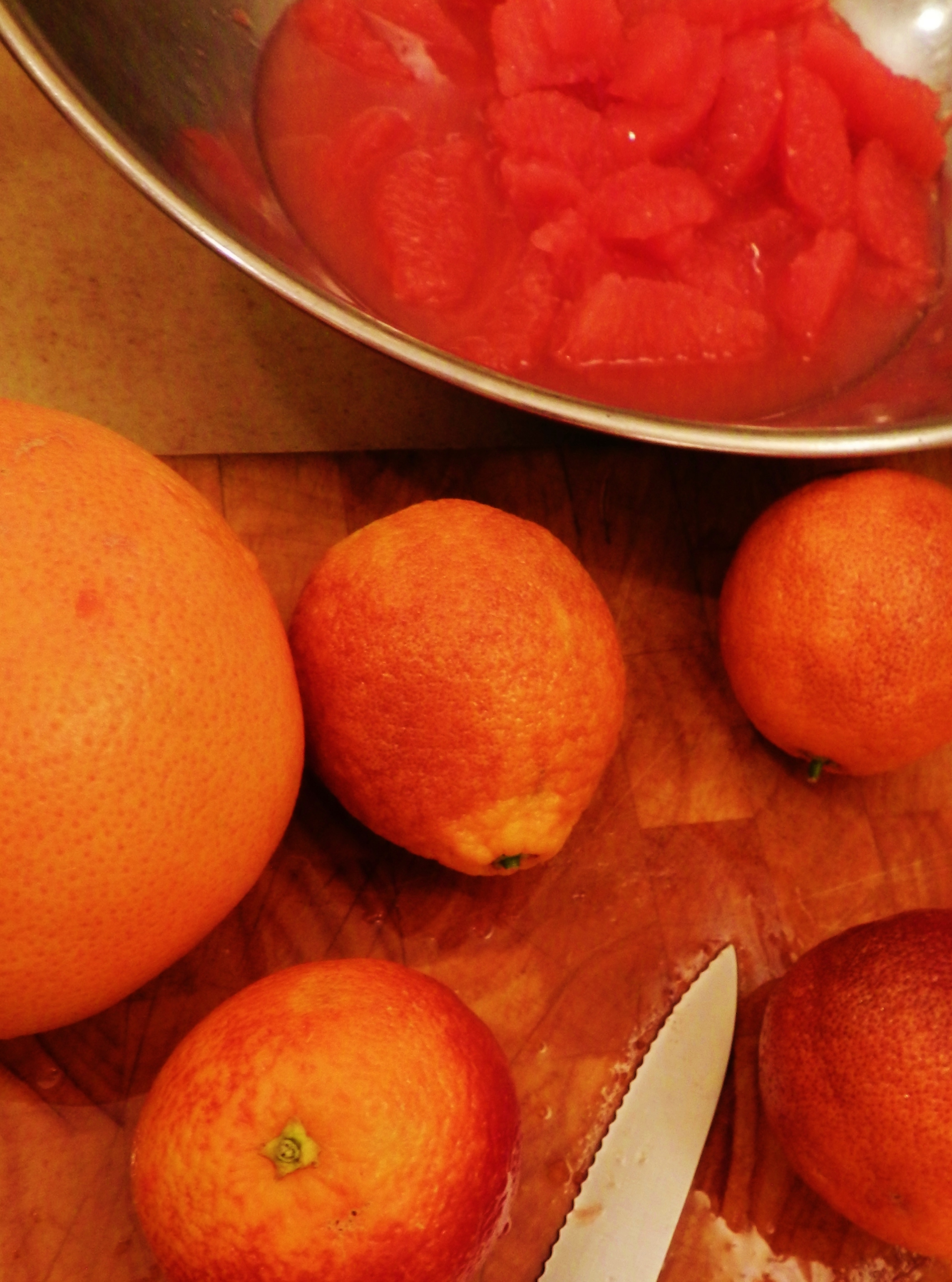 Hopkinson’s grapefruit and orange jelly calls for 4 red grapefruit, 5 blood oranges, 5 sheets gelatine, 225 ml freshly squeezed orange juice (strained through a fine sieve), and 250 ml Champagne. Since I live just a few miles up the road from Florida, fresh produce is trucked in on a daily basis, for both the small and large grocers. I can buy just-picked crookneck squash and green beans, never refrigerated, throughout the winter. Further, Publix, the largest employee-owned grocery chain in the US, was founded 85 years ago in Florida, where it is still based. I have no problem finding citrus of all kinds. I can only imagine that the grapefruits that Hopkinson gets in England are much smaller than these Florida beauties, because his recipe calls for adding freshly squeezed orange juice to the juice that remains after sectioning the citrus, for a total of 250 ml, and my grapefruits yielded more juice than that. In the end, I added no orange juice other than the juice from the blood oranges after sectioning. I also did not splurge on Champagne, but substituted the lovely New Mexican sparkler, Gruet (use their rosé if you can find it), though I think any dry white wine with forward fruit flavors would work well in this. You need something to round out the grapefruit. And, finally, Hopkinson says that he wouldn’t turn down “a small, punctured can of Carnation to pour over it,” but I used a dollop of crème fraîche. He also lines his mold with plastic wrap, but that makes for a sloppy presentation. It’s not necessary.
Red Grapefruit and Blood Orange Gelatin, adapted from a recipe by Simon Hopkinson
It’s best to let this chill for 8 hours or overnight. Plan ahead.
4 red grapefruit
5 blood oranges
1-1/2 envelopes unflavored gelatin
Sparkling wine, chilled
Crème fraîche, optional
Section the grapefruit and oranges as shown in this video of mine, cutting away all of the white pithy material and squeezing the juice from the remaining pulp after sectioning the fruit.
Sprinkle the gelatin slowly into a medium bowl onto a small amount of cold or room temperature water, stirring with a rubber spatula, and scraping down the sides of the bowl, making sure that all the gelatin dissolves. Strain off the juice from the citrus sections and add it to the gelatin water, stirring well. If the gelatin is not completely dissolved, heat the mixture gently over very low heat until it is. Strain the liquid again into a 2-cup measuring cup and add the wine until the measuring cup is filled to the 2-cup mark. Stir gently but firmly. If you are using sparkling wine, it will bubble quite a bit.
 Rinse a glass loaf pan with cold water and pile the fruit sections into it. Add the liquid and gently disperse the sections around. Place the pan in the refrigerator for an hour. Remove from the refrigerator and if desired you may disperse the sections around again if necessary. Cover with plastic wrap, but do not let the wrap touch the surface. Refrigerate for 8 hours or overnight. Chill a platter big enough to hold the unmolded jelly.
To unmold, dip the entire pan down in hot water for a few seconds to loosen it all around. Place a chilled platter on top of the pan and invert. The jelly should release itself.
To serve, dip a serrated knife into hot water and slice servings carefully. Garnish with crème fraîche if desired.
Makes 6 to 8 servings.