
May 11, 2014 Chengdu, Sichuan, China
There are several species of the genus Trapa that are called water chestnuts, but I refer to Eleocharis dulcis, the crunchy, slightly sweet corms that we all know from Chinese restaurants in America, where canned ones are often paired with snow pea pods, and from cocktail parties, where they appear wrapped in bacon (called “rumaki,” it’s a mock Polynesian appetizer probably invented by Trader Vic). I was shocked to pick up the 2nd Edition of the Oxford Companion to Food (2006), a nearly 1000-page encyclopedia that is generally regarded as definitive, and to find no mention of Eleocharis under the entry for water chestnut (which is neither a nut nor a chestnut). I jumped to conclusions and did some sloppy reading and writing before Anne Mendelson pointed out to me that I had missed their entry, “Chinese water chestnut,” that distinguishes it from the Trapa varieties. Common names are always problematic. Eleocharis is a type of water grass that emerges from these corms. 
Here in Chengdu, women sit on stools at their pop-up stands, peeling them with a Chinese chef’s knife, which, though similar in looks to a cleaver, is actually a razor-sharp tool that they use with uncommon dexterity to accomplish everything from chopping to delicate splitting of scallions. Their stands, such as they are, might be equipped with an electronic scale, or they might simply have a primitive balance beam scale made with sticks and string. They quickly shave the fresh, moist chestnuts of their brown outer skin and place them in plastic bags before weighing. I pay about 20 kuai — $3.50 – for a jin, 500 grams (a little more than a pound).
If you have only had canned water chestnuts – pleasant enough, more crunch than taste – then you will be amazed at the depth of flavor of fresh ones. They taste a bit like apples or Jerusalem artichokes. Surprisingly sweet (hence the Latin, dulcis), they remind me of sugarcane and fresh coconut as well. Interestingly, though I often see them on the streets, I have not encountered them in restaurants here (perhaps they are too expensive/too timing consuming to prepare?). Fuchsia Dunlop does not mention them in her book of Sichuan cooking, but I see them being sold not only by street vendors, but also in supermarkets, so home cooks are certainly using them. As in English, they have several common names in China, but locally they are called ma-ti (“horse hoof” – ma tai in Cantonese), which perhaps refers to their shape but could also refer to the fact that they are often covered in mud.
Because of their sweetness, water chestnuts often find their way into desserts and sweet drinks. Bruce Cost gives a recipe for “Coconut ‘Crème Brulée’” in his Asian Ingredients. They are also dried and ground into a flour that can be used as a thickener, like cornstarch. Made into a paste, it has many uses in traditional Chinese medicine; it is fed to children who have swallowed coins. Amazingly, they can be enjoyed, as Elizabeth Schneider notes in her remarkable Vegetables from Amaranth to Zucchini, “at any stage from raw to long-cooked. Boil, steam, braise, sauté, or chop and add to ground seafood or meat to bake, fry, or use as stuffing. In [her] experience, there is no reason to be concerned about overcooking….
“Chinese water chestnuts are available irregularly year-round, primarily in Asian markets” in the States and in Europe. Unpeeled, they will keep up to two weeks in a bowl of water in the refrigerator. Because of how they are grown, they are often coated in mud. You can scrub them gently or you can soak them overnight , as Elizabeth notes, “and they’ll clean themselves.” But you will have to peel them and remove any discolored spots. Sometimes they ferment, but the smell and taste is not horrible. Buy more than you think you will need. Shiu-ying Hu, in her incomparable Food Plants of China, writes, “It is worthy of note that Chinese farmers …often eat the fresh products by rinsing off the mud and peeling the skin with their front teeth. From such an unhealthy practice, they are often infected by the liver fluke because the free-swimming stage of the parasite may be attached to the scales of the corms.” Thoroughly washed and skinned, fresh water chestnuts pose no threat.
Shiu-ying describes their fascinating cultivation that is intertwined with fish, mulberries, and silkworms. During the wet season, which begins in March, water chestnuts and fish are raised simultaneously, the plants providing shelter to the fish whose waste in turn fertilizes the plants. (I began seeing the water chestnut peelers on the streets about a month ago, in April. Perhaps I will begin to see the chestnuts in restaurants as the season progresses.) In November when the dry season begins, the fish are harvested, the water is drained, the chestnuts are gathered, and the mud of the fish pond is added to the banks of mulberries, which are pruned to the ground for the winter. The new mulberry growth in the spring is the favored food of silkworms, whose pupae are then used to feed the new crop of fish.
In Southeast Asia, water chestnuts appear in all manner of salads. I like to boil them for just a minute or two, cool them, and pair them with asparagus, or with roasted peppers. Some street vendors here skewer them raw and keep them wet and sell them as both appetizers and after-dinner refreshments. Shiu-ying suggests simply serving them raw with toothpicks at parties. Boiled, they are sometimes offered as snacks at tea houses, either hot or cool. Boiling actually helps keep them crisp.
Slipped into lemon-grass- and chili-seas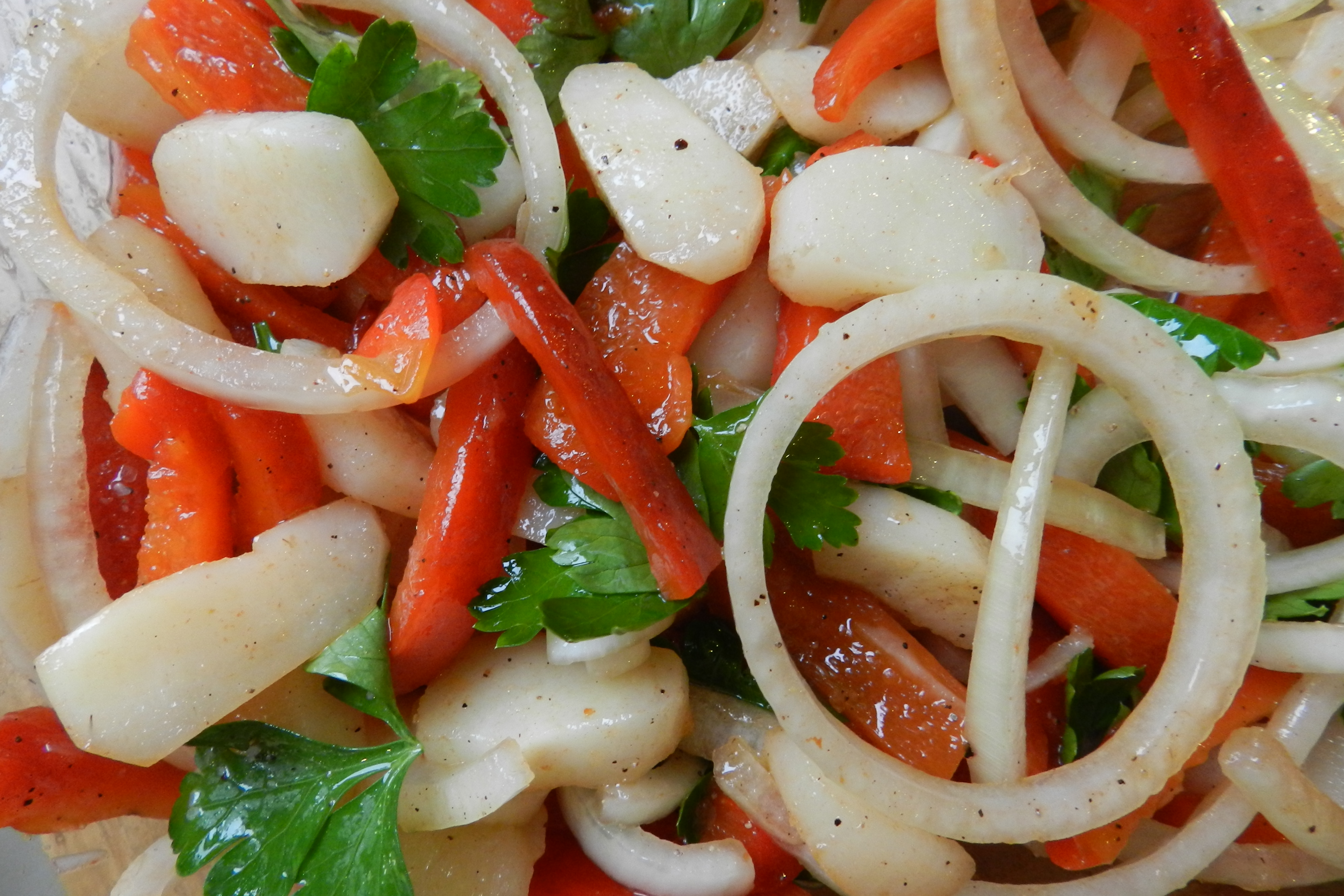 oned broth, they enliven soups with their crunch. Add coconut milk, lime, and scallops or shrimp. Wrap poached, chilled water chestnuts in prosciutto or smoked salmon slices. Stir-fry them with green beans. Add them to any kind of salad. They are so much better than the canned. In the photo at left, I have paired them with roasted peppers, blanched onions, parsley, olive oil, balsamic vinegar, and salt and pepper. Delicious!