
Carrie Hessler-Radelet, the Acting Director of Peace Corps, was in China recently, and she and Mikel, in addition to meeting with officials in Beijing and here in Chengdu, toured several of the locations here in China where Peace Corps has volunteers, ending their tour here with banquets at Yu’s Family Kitchen and the Peace Corps office, and one final informal supper here chez nous.
Condé Nast Traveler recently called Chengdu “the San Francisco of Asia,” not because of the fog here, but because of its cuisine. In 2005, UNESCO initiated its Global Alliance’s Creative Cities Network, a program that recognizes cities that are considered excellent centers of arts and crafts, design, literature, music, film, media arts, and gastronomy. The recognition is meant to help these places preserve and enhance their cultural heritage; an increase in tourism has followed each designation. Some 30 cities worldwide have been added to the roster; another 20 are under consideration; the program is ongoing.
Some of the cities I had never heard of. Icheon, South Korea, for example, was chosen not just for its ceramics production, according to UNESCO’s website, but because “The city has developed a strong link between traditional crafts and contemporary industry by combining cultural and aesthetic uniqueness with cutting-edge science and technology and demonstrating the impact of traditional craft knowledge to contemporary needs.”
Others I knew of, but not for the reasons cited by the Alliance. Saint-Étienne, France, was chosen because of its “outstanding history of industrial modernity. Saint-Étienne, land of creators and inventors, is a city under constant transformation, driven by a dynamic which links arts and industry.”
I have a master’s degree in film, and I had no idea that Bradford, England, another designee, is “home to some of the earliest pioneers of cinema and the celebrated location of many classic films. Bradford can trace a proud and accomplished film heritage. Having been the birthplace of a range of international film talent, the city now plays host to one of the most diverse film festival programmes in Europe.”
But perhaps most surprising to me, after 30 years as a food and travel writer, are the following Cities of Gastronomy: Popayan, Colombia; Östersund, Sweden; Zahle, Lebanon (no surprise there: I personally think Lebanese food is as good as it gets); Jeonju, South Korea; and, you guessed it, Chengdu, where I currently live. Not Paris or Barcelona or Bangkok or New Orleans; no Fes or Bologna or Ghent or Lima. No San Francisco, Tokyo, or Mumbai. Instead, the five cities so far designated all seem to be outposts of regional fare unaltered by modern trends. Whereas the criteria for the other categories seem to be as much about modernity as anything, the gastronomy of the chosen cities is described with words such as “authenticity,” “heritage,” “long-lasting tradition,” “sustainable,” and “unique.” UNESCO declares, “Chengdu is acknowledged for its reputation as a historical city of gastronomy and birthplace of many culinary traditions. The unique culinary culture manifests local culture and demonstrates the preservation and cultivation of gastronomic creativity. The most outstanding feature of Chengdu cuisine is the great variety of flavors, based on five elements, namely sweet, sour, bitter, spicy and salty.” They could have added “umami.”
As one of the breadbaskets of this vast nation, Sichuan, with its subtropical climate, is known as “the land of plenty.” Perhaps best known for its hot and spicy fare, particularly its “hot pot” and “mapo tofu,” the region’s cuisine has always absorbed the techniques and ingredients of its immigrants. Mikel lived in Sichuan 27 years ago, before the Tiananmen Square incident of 1989, and he has been amazed at the changes in diet here since modernization brought ingredients such as the potato. Before we arrived, he told me categorically that they did not eat them when he lived here before. Now you would think that they have been here forever. And though some culinary historians believe that there were other traditional “hot and spicy” seasonings before the arrival of chilies in the late Ming period (sixteenth century), it wasn’t until the early nineteenth century that their cultivation became common in Sichuan, according to Fuchsia Dunlop, the highly praised culinary scholar whose book on Sichuan fare is one of a handful in English on the vast topic. I am reminded that Italian and Spanish cuisine did not include tomatoes, peppers, or chocolate prior to Columbus’s voyages.
Perhaps what most distinguishes Sichuan fare, though, are the cooking techniques. Dunlop devotes 8 pages in her Land of Plenty to cutting skills: “There are nine different ways of cutting scallions alone.” She also describes the 56 different Sichuanese cooking methods, including “small-frying” (marinated and starch-coated meats fried in hot oil until the pieces separate), “dry-frying” (slivers of foods cooked in a very hot wok with little oil over a medium flame), “dry braising,” “homestyle braising,” “du” (simmering in a small amount of liquid until the food loses its own water and absorbs the flavors of the sauce, as in ma po dou fu), and “qiang, a type of frying that begins by sizzling dried chilies and Sichuan pepper in a little oil until the oil is fragrant and spicy, and then tossing [in] other ingredients.” Bon Appetit’s Andrew Knowlton, writing in May 2012, also noted “raw-frying, cooked-frying,…and something called ‘explode-frying.’”
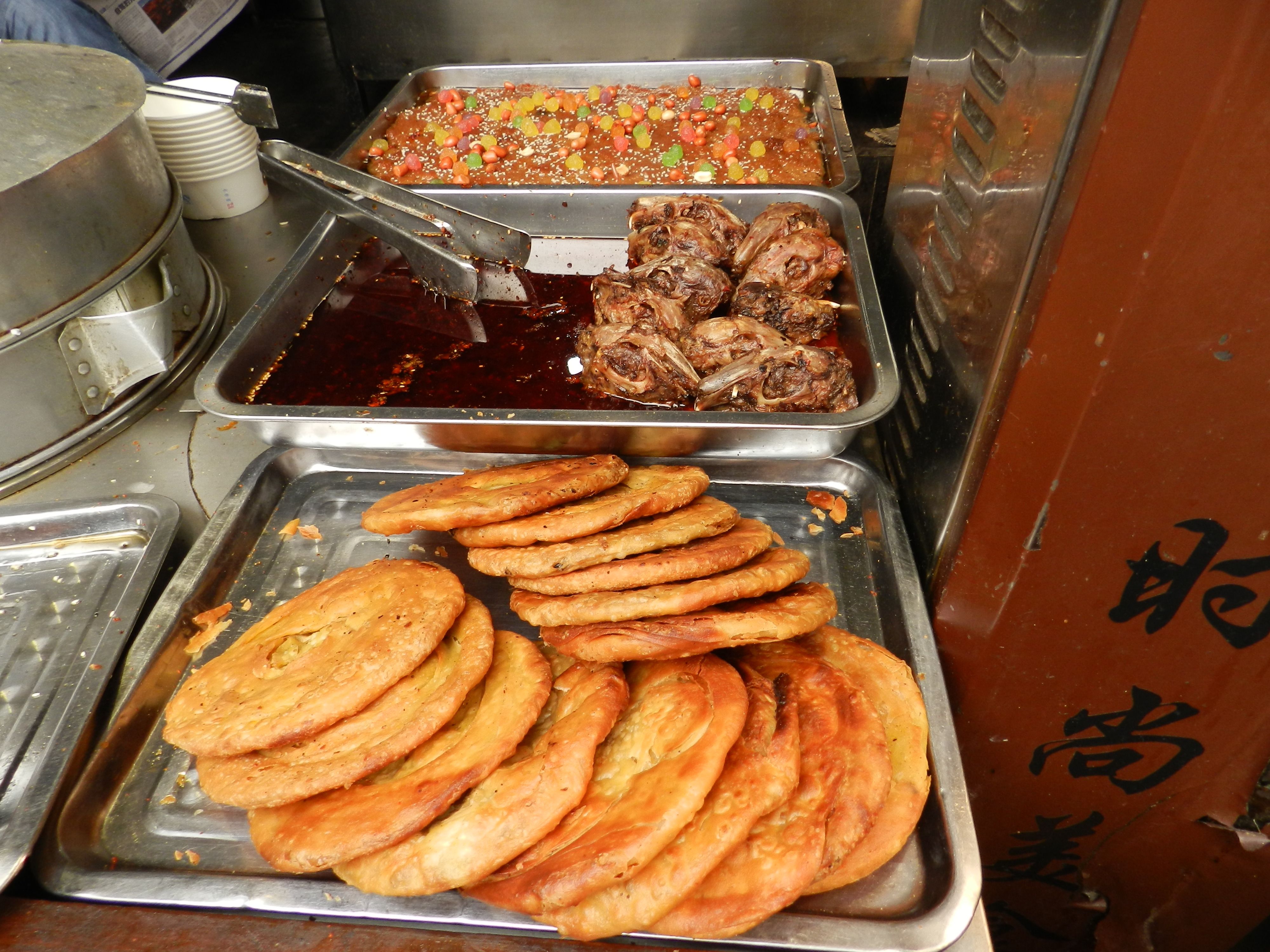
Knowlton had taken Danny Bowien, chef at San Francisco’s wildly popular Mission Chinese Food, with him to the region whose cuisine had made him famous – in spite of the fact that he had never been here. Through bottles of local beer and baijiu (the high-octane local liquor that makes homemade Bulgarian rakia taste good), Knowlton and Bowien plowed through dozens of dishes the city is best known for – mapo tofu, hot pot, twice-cooked pork, dan-dan noodles – as well as the offerings of the ubiquitous street vendors and “fly” restaurants. Knowlton, and many others before and since, claim that the term refers to the restaurants’ less-than-hygienic status, but I personally think that it refers to their come-and-go nature and their semi-legal status. I have seen several favorites of mine disappear overnight in the 7 months that I have been here. And as for the hygiene, well, perhaps that’s why I prefer the student dining hall on campus of Sichuan University (where I was, until this week, a full-time student), the various lamian (hand-pulled noodle) shops invariably run by Muslims and usually spotlessly clean, and the Cantonese restaurants (real chairs instead of stools and much more elegant fare). Rabbit heads, duck intestines, whole turtles, every part of the pig, bloody eel, and tons of “gourmet powder”—MSG—are common at these places. There are shops selling steamed buns on very nearly every block, even in the financial district. Men and women on three-wheeled bikes peddle noodles, loquats, corn on the cob, pancakes and omelets (and several items in between), flatbreads, and grilled skewers of everything from corn kernels (each kernel individually skewered!) to bits of lamb (nearly impossible to find in shops, I always buy fresh lamb when I see it, usually from Muslim street vendors). They also visited Yu’s Family Kitchen.
Knowlton declared, “Yu Bo is to Sichuan cooking what Ferran Adrià is to Spanish cuisine: an infinitely creative chef who stretches the boundaries of tradition.” Frankly, I wasn’t sure I wanted to attend the banquet. I ate at El Bulli 20 years ago and hated it … the mushroom foams with fish, the weird caviar-like balls of jellied olive oil, the bizarre textures created not in a kitchen but in his “molecular gastronomy” laboratory…. I know, I know, I’m not supposed to say this. I’m supposed to have considered myself lucky to have secured a reservation and dined in this temple of gastronomy. But that type of cooking is just not my cup of tea. I like to dine with friends over lovingly prepared fresh and local foods, not feel as though I’m watching the world’s best actors try to reinterpret Macbeth as a reality tv show. And, besides, in addition to the many flavors and cooking techniques of Sichuan cuisine, it is also known for its vast array of textures. It hardly needs any more. “Kou gan,” or mouth feel, is every bit as important as flavor, color, and fragrance to the Sichuanese. We Americans love the crunch of fried foods, the chewiness of good bread and steaks, and the rich, tongue-coating consistency of ice cream; but we shy away from the rubbery, slithery, and silky textures that play off the other physical qualities of foods here. Dining here is already a shared experience of taste, smell, appearance, and mouth-feel. Most restaurant tables are either small enough so that everyone can share or they have lazy susans in the middle. We order at least one dish for each diner, plus usually one more “for the table.” Since we nearly always dine in groups, there is always variety: something green, something in red oil, something chewy, something cold, something hot, something spicy (both ma, the numbing spice, and la, chili hot), a soup, plus either rice or noodles (and sometimes both). There are usually bones to suck on, peanuts and fermented black beans to nibble on, garlic shoots or yardlong beans with their bright just-picked crunch, some fish, some chicken, and, surely, some pork. There are rubbery wood ear mushrooms, and either cucumbers or stalk lettuce. There is always something bitter and something sweet. There are steamed dishes and stir-fries, dumplings and fried foods. Not just something for everyone, but everything for everyone. Did I really want to have all this reinterpreted by some young whippersnapper chef?
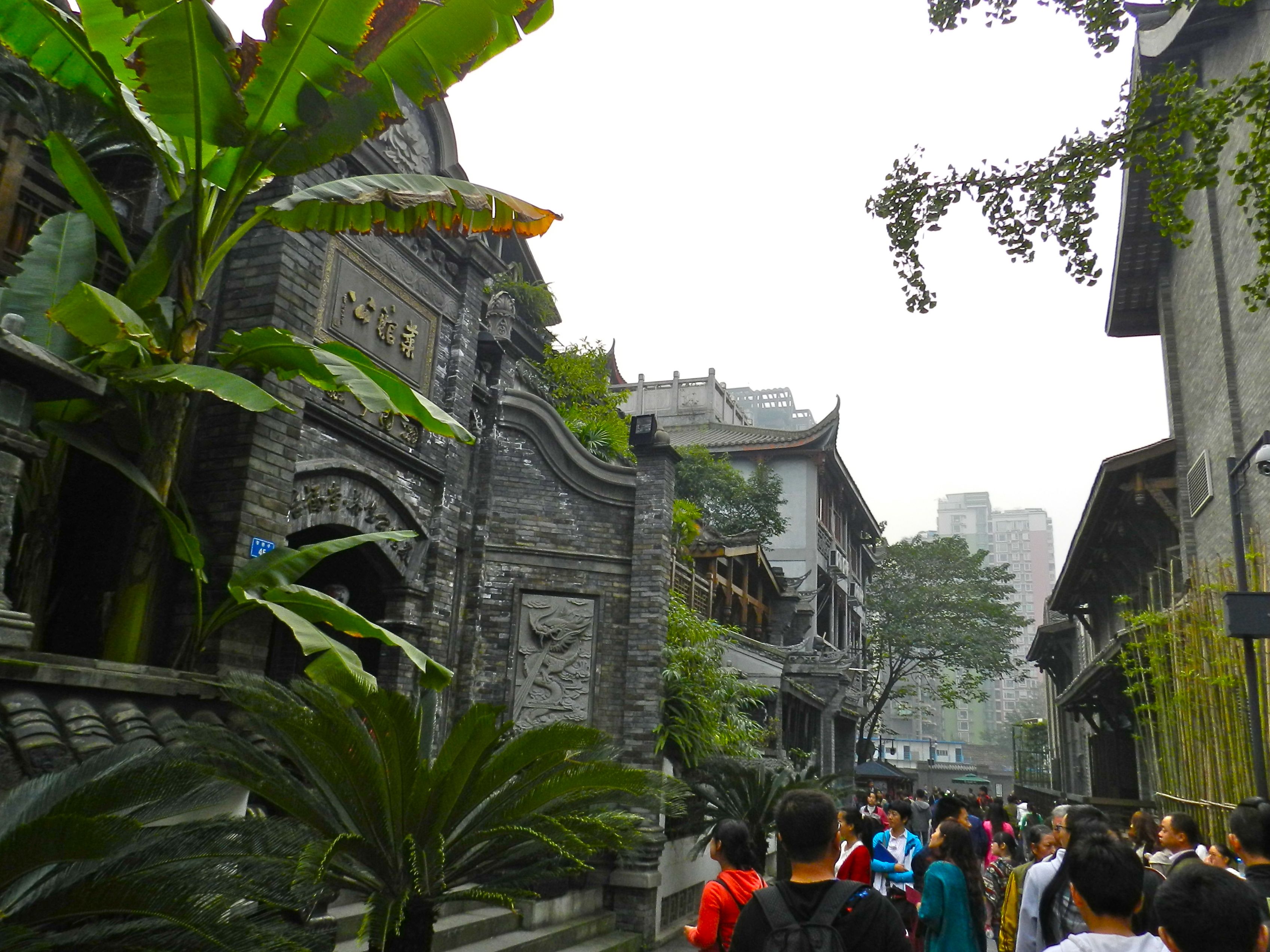
Yu’s, I had heard, was the first restaurant opened in the trendy, tourist-packed Wide and Narrow Alley District, one of several reproduction old villages in Chengdu (see photo at top of page). Another strike against it, I was afraid. Mikel and I had eaten in one of the fanciest restaurants in town, also in this Disney-like recreation, and while the food was tasty and the service sublime, it had been outrageously expensive by Chengdu standards and much of the presentation was just pretentious and silly (think dry ice volcanoes!). But, my friend Xie Xiaoyu, who lived in the States for 20 years, is a concert pianist, and who knows good food and wine, encouraged me to join them for the feast. “I think you will like it,” he said. 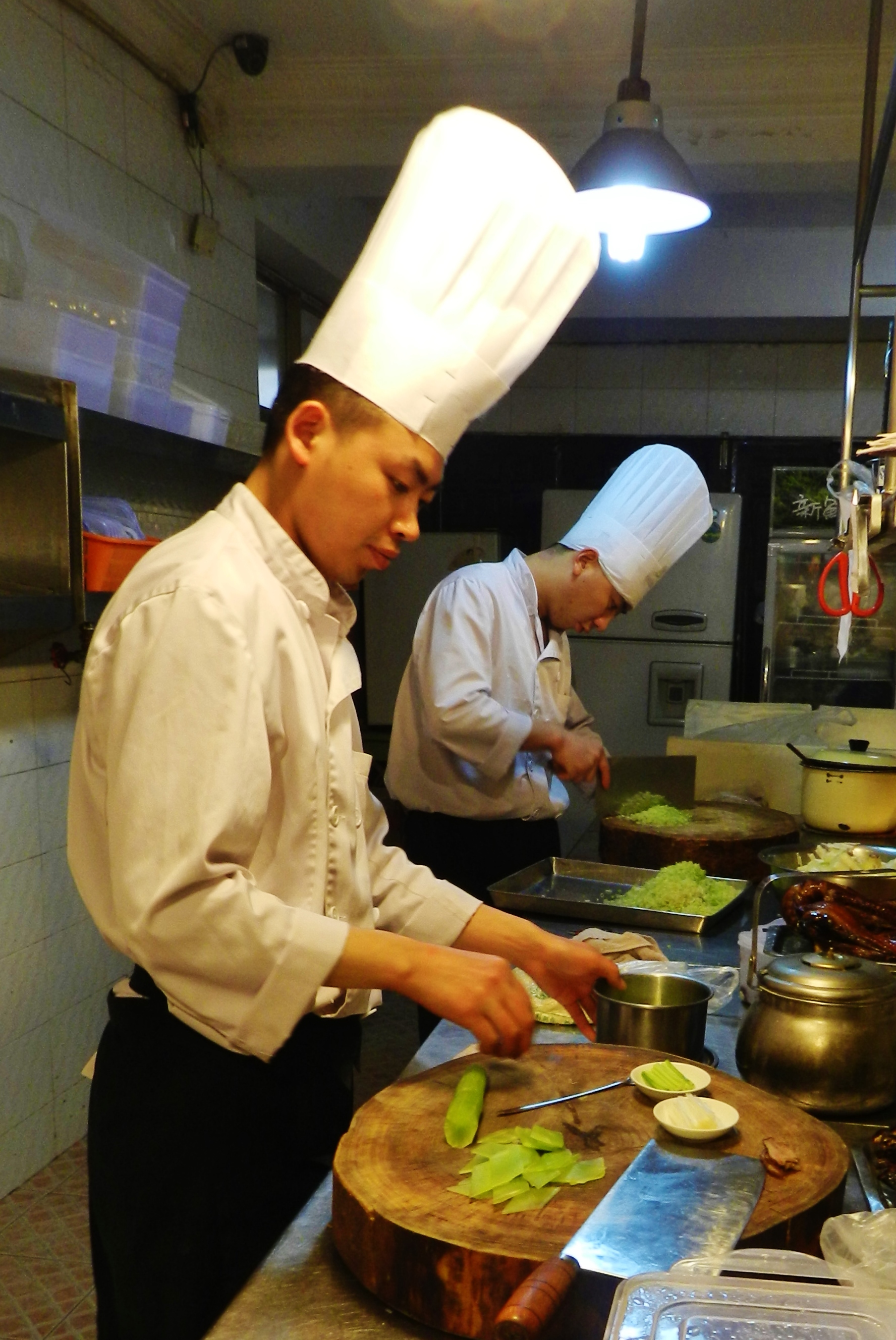
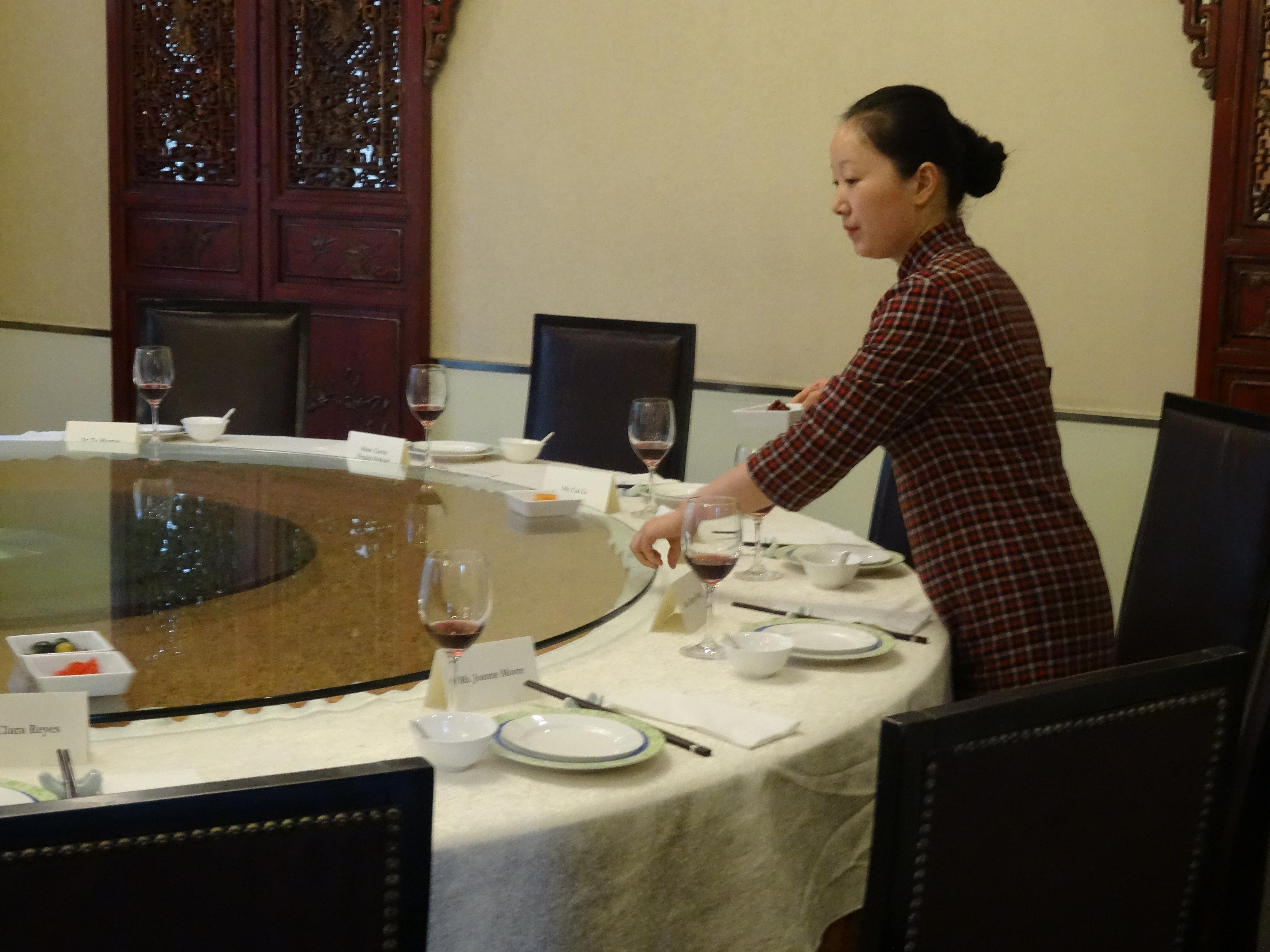
Boy, did I ever! It didn’t hurt that we entered the establishment NOT from the Narrow Alley, but from a rear service door. We walked through the kitchen, where four or five chefs were working on our luncheon, dozens of bowls lined up to be filled with the 16 or so courses to come. There were some tiny tips of bamboo shoots sizzling in a wok. From the kitchen, we entered a charming courtyard surrounded by six private dining rooms. It was noon in the middle of the week, but outside our dining room, with its large circular table set for 14, I could hear the chatter of the hawkers on the tourist side. In addition to those hot dishes, there were an additional 16 cold dishes that our server, who did all the serving and clearing and wine-pouring (I chose a cru Beaujolais from his cellar of mostly big, older Bordeaux – the wine of choice in China), explained in very good English.I didn’t take notes, but I did take photos. I’ll try to walk you through the meal.
The cold dishes, she explained, were all vegetarian, though we may not believe her upon tasting. There were slivers of fried mushroom that tasted like ham; “thousand-year-old” quail eggs, fresh red peppers, celery in mustard oil, winter melon with sesame seeds, lotus root cooked in cashew water (a revelation!), stalk lettuce (also known as celtuce, it’s a lettuce grown for its thick stem which is cut in ribbons, cooked quickly — if at all — and generally served with roasted sesame oil), and wood ear mushrooms.
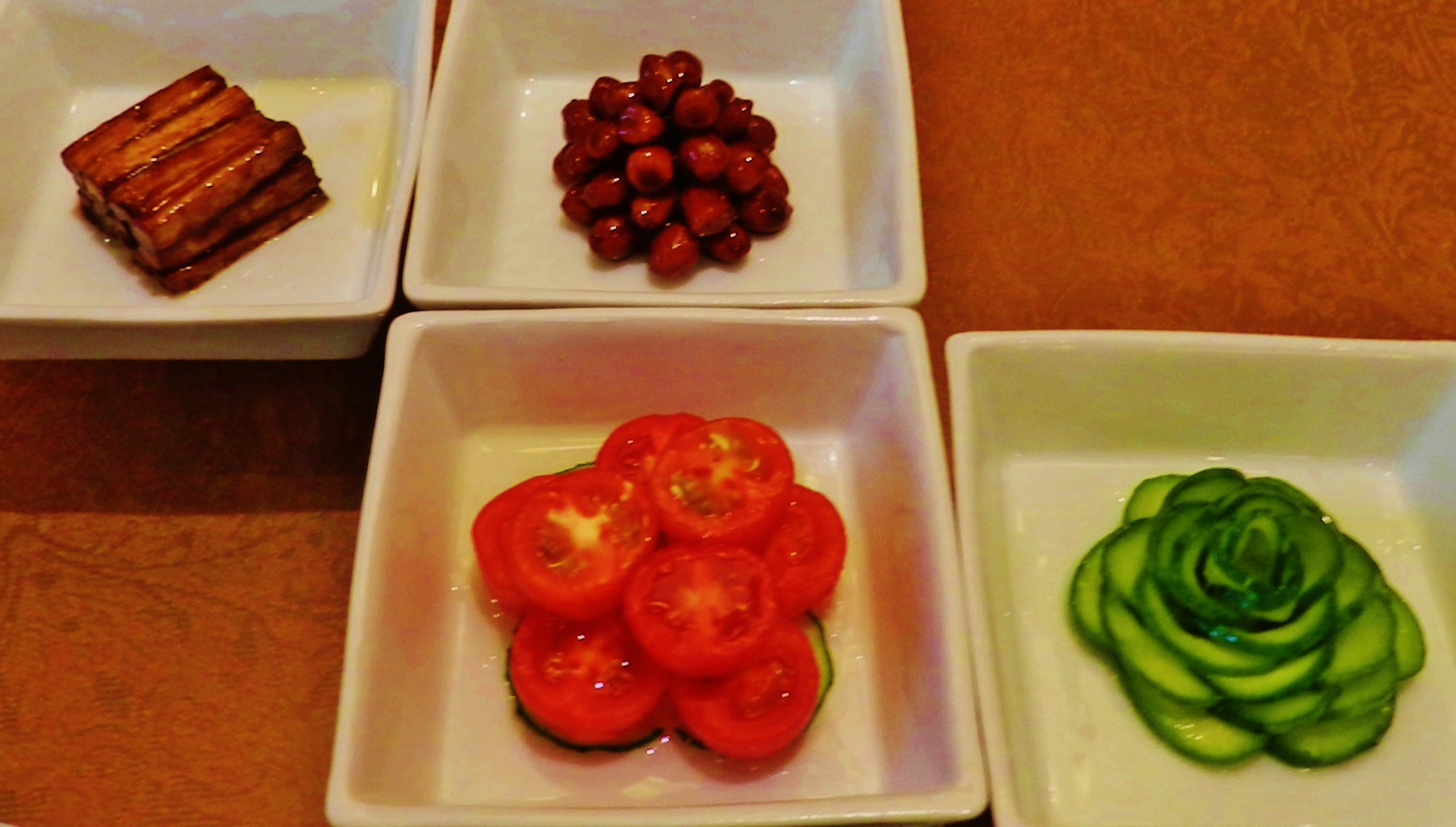
Yu Bo prides himself on the quality of his ingredients, many of which are grown and/or sourced just for him. On the left, the first of the local cherry tomatoes were served simply with a drizzle of excellent olive oil (another fairly new ingredient here that has taken the region by storm. Supermarkets have shelves lined with oils from Spain, Portugal, Greece, Italy, and Tunisia.) Peanuts were glazed in a tamarind reduction. Bamboo shoots were in a mild soy concoction. Cucumbers had fresh garlic and a splash of rice vinegar, a dish you find throughout the region. 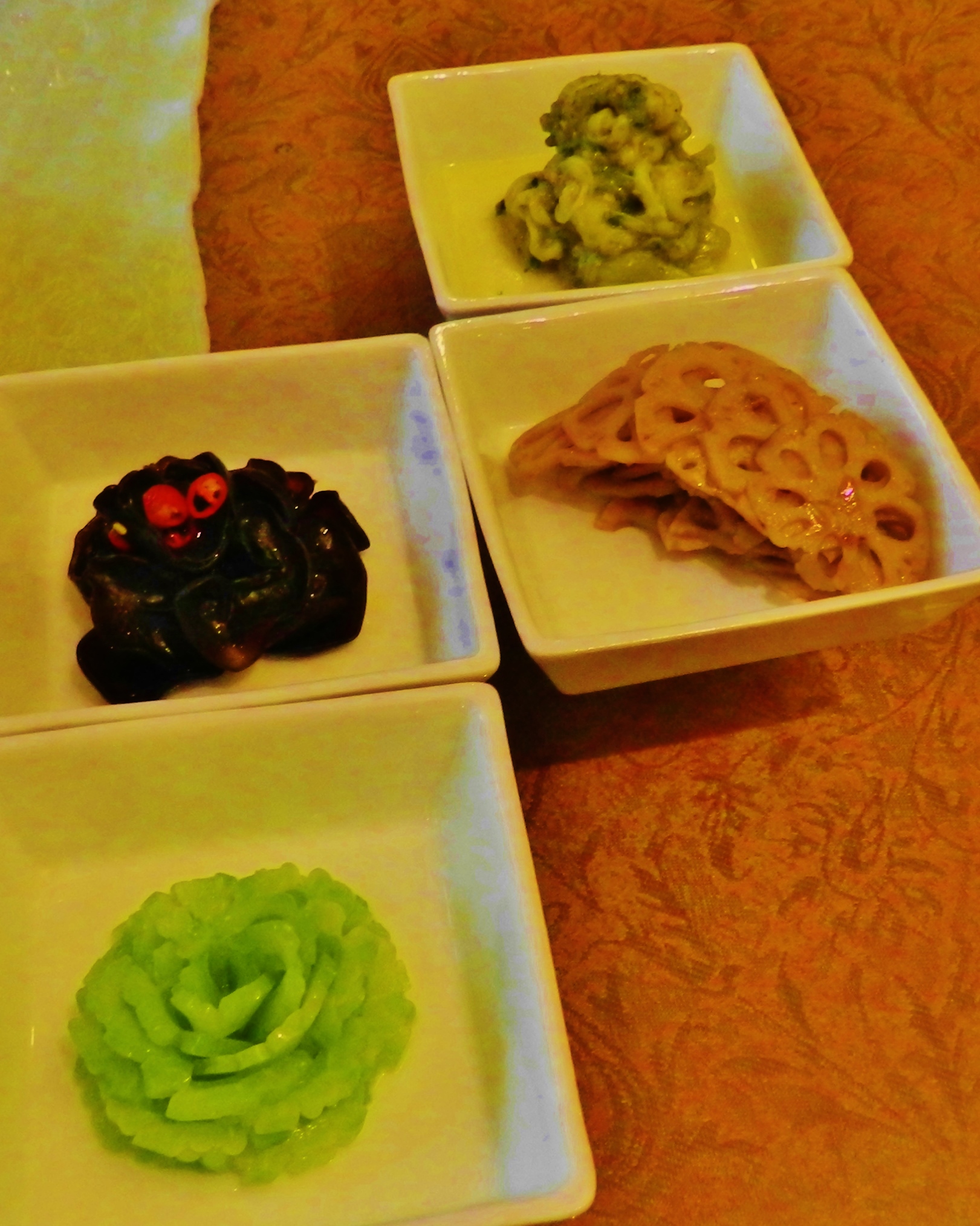 The steamed eggplant in the top of the photo at right was sublime; the wood ear mushrooms, lotus, and winter melon, divine.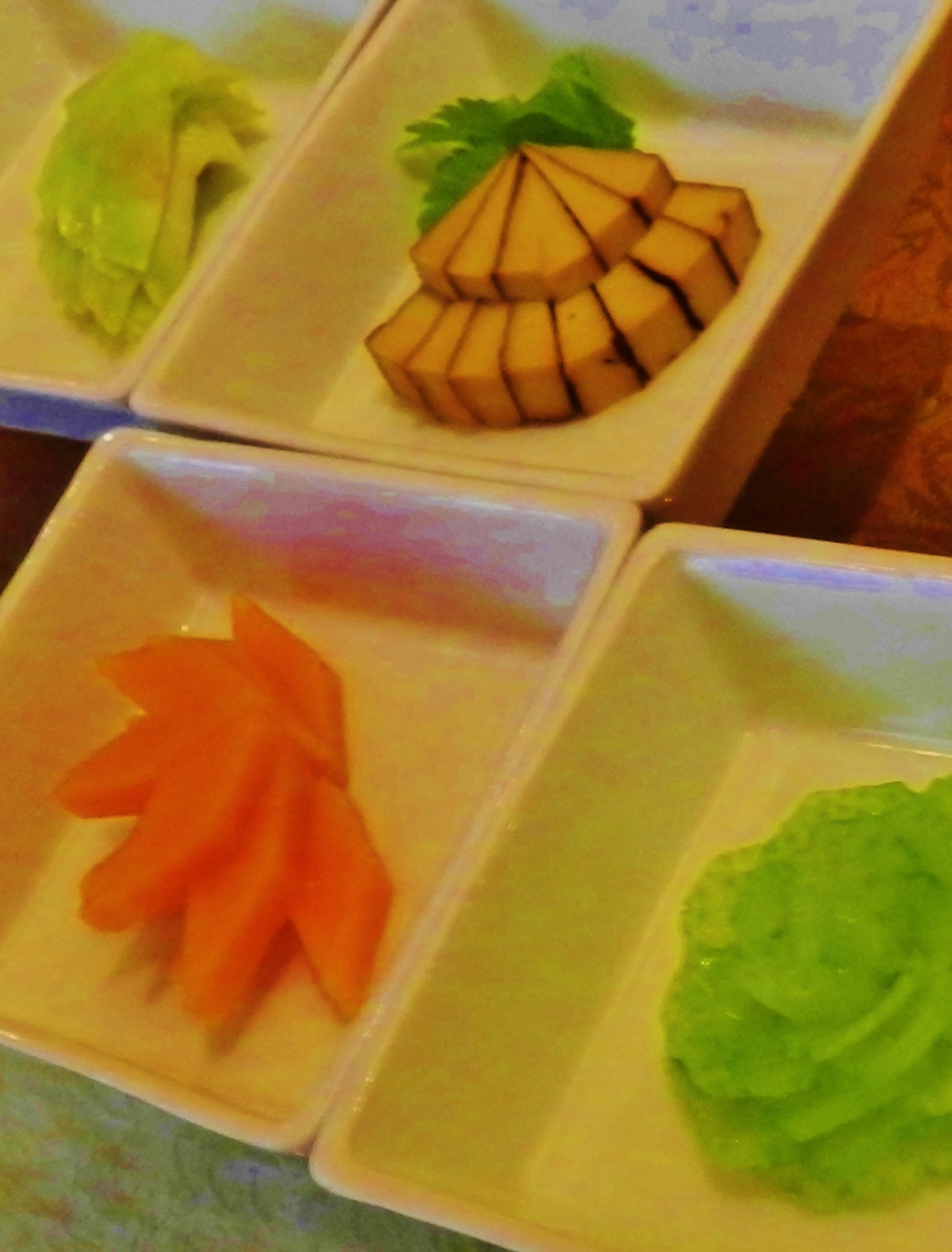
The smoked tofu was tender; the squash, fragrant. Everything tasted of itself and of the seasoning used in the dish; never did the two flavors mask each other. The fried slivers, below, were the ham-tasting mushrooms. Behind them, the eggs.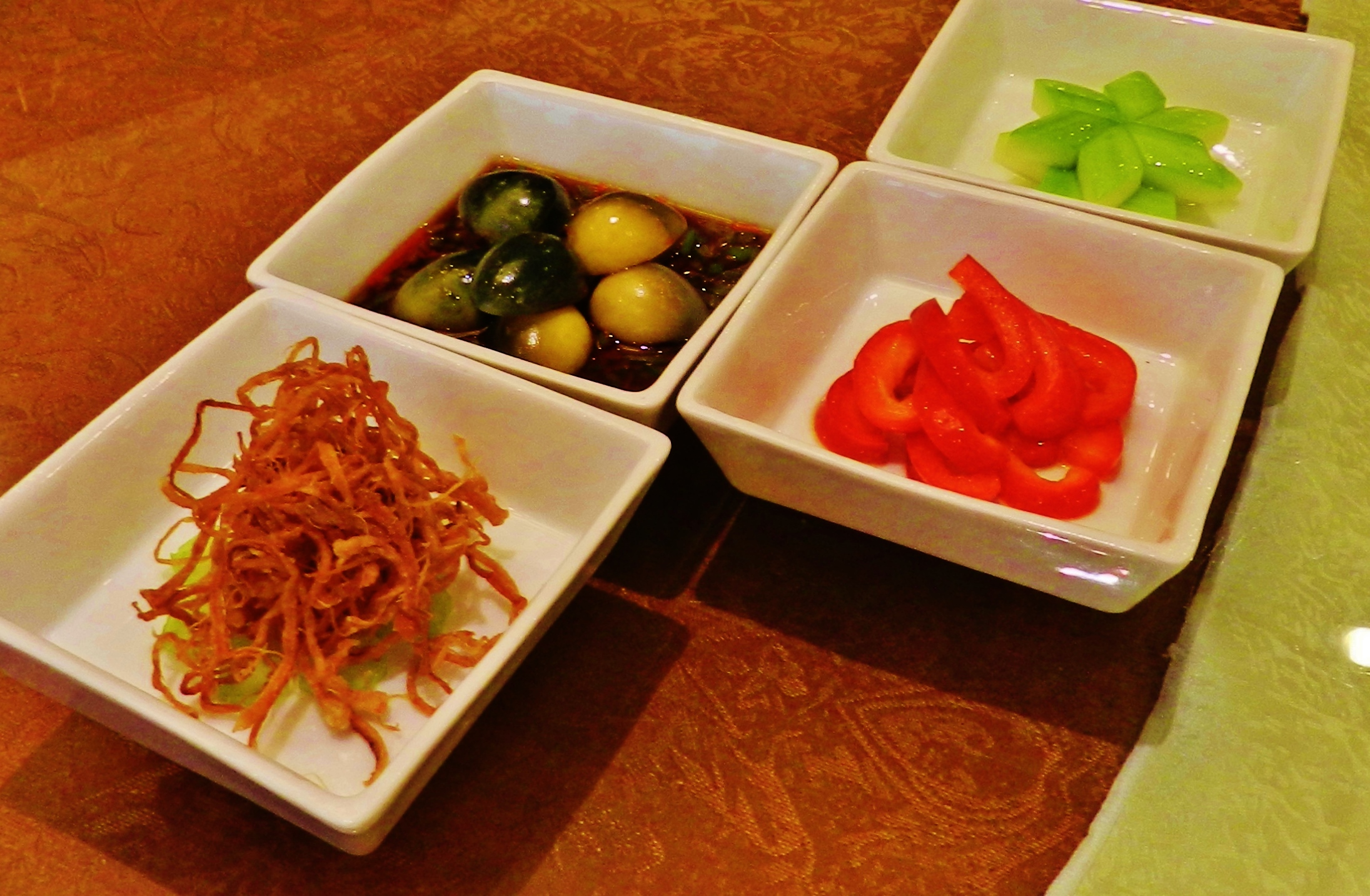
We nibbled and toasted the Peace Corps and the Department of Education and Sichuan University (where the PC offices are), and then the real fun began, beginning with Yu’s most famous dish, his maobi (ink brushes) made of spun dough — a traditional Sichuan street food — filled with barbequed pork — a takeoff on the usually heavy, steamed pork buns sold everywhere in China. 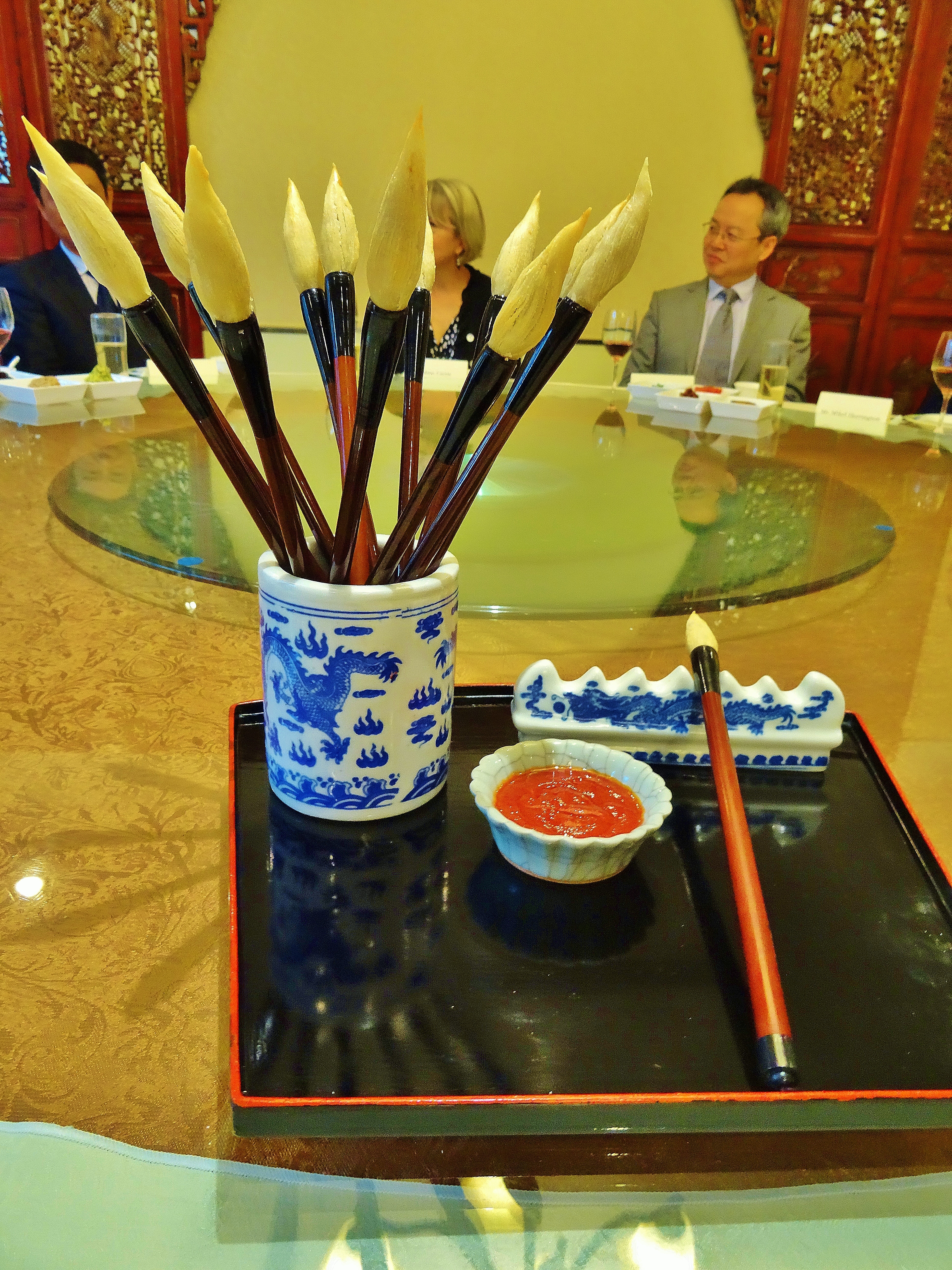 You dip the bristles of the brush in the tomato-pepper “ink” before gobbling them down in a couple of bites. Red ink was always reserved for the royal family; each dish had historical, literary, or cultural elements to it as well as the culinary tradition behind it. Yu rarely reinvents dishes; he strives to present the true flavors, textures, and aromas of the finest Sichuan cooking. In fact, before the brushes arrived, our first course was a slice of local black truffle on a vegetable fritter that tasted like the ever-popular street food pancake, the jianbing. Filled with all manner of vegetables, meats, and mushrooms, the pancake is one of my favorite breakfasts. The truffle was a welcome substitution for the often bland mushrooms. I’ve read that many of the truffles t
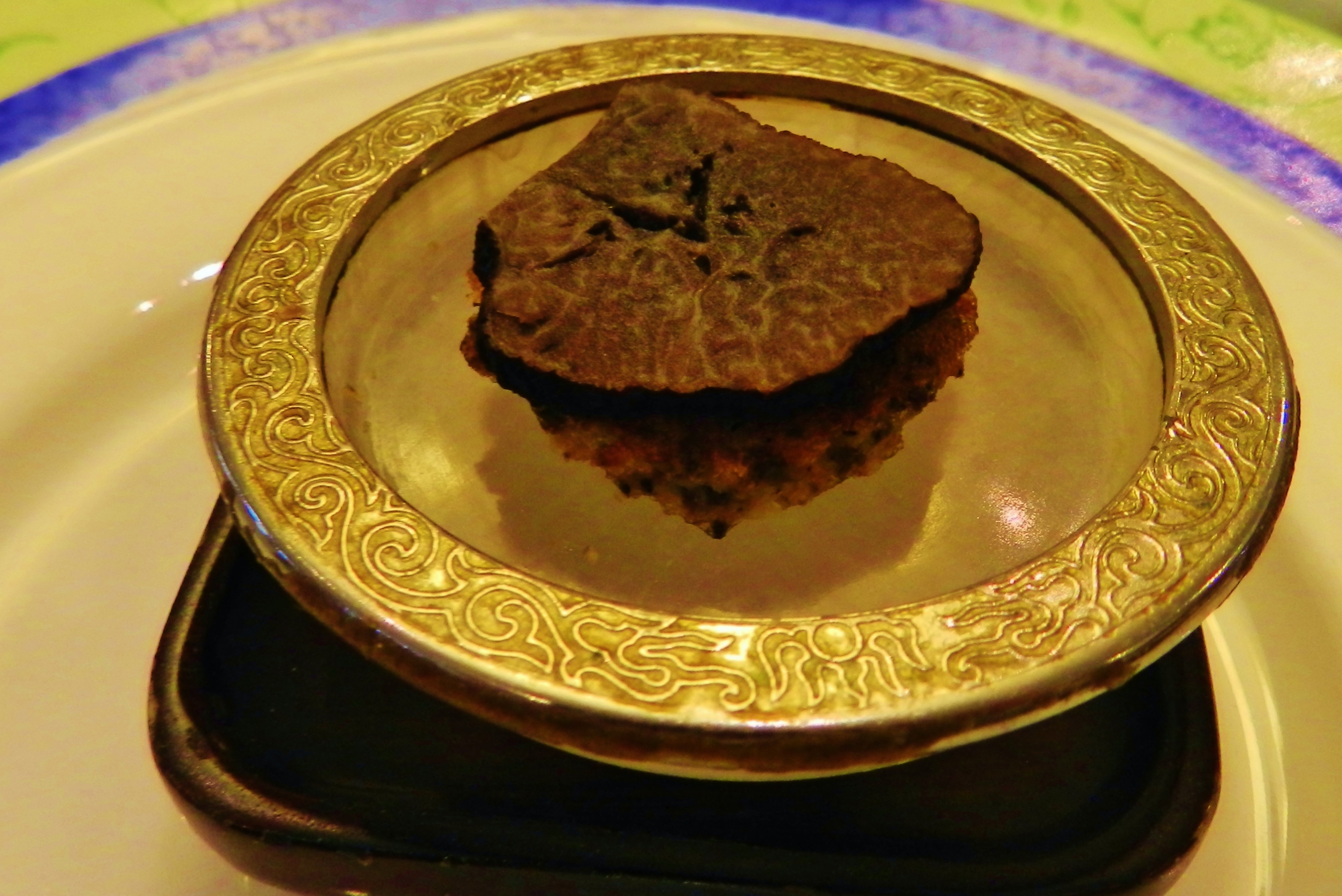 hat claim to be from France are in fact from China, but I had never tasted one until this meal. It was fresh and firm and quite tasty, but, I must admit, nothing like the black truffles of Périgord.
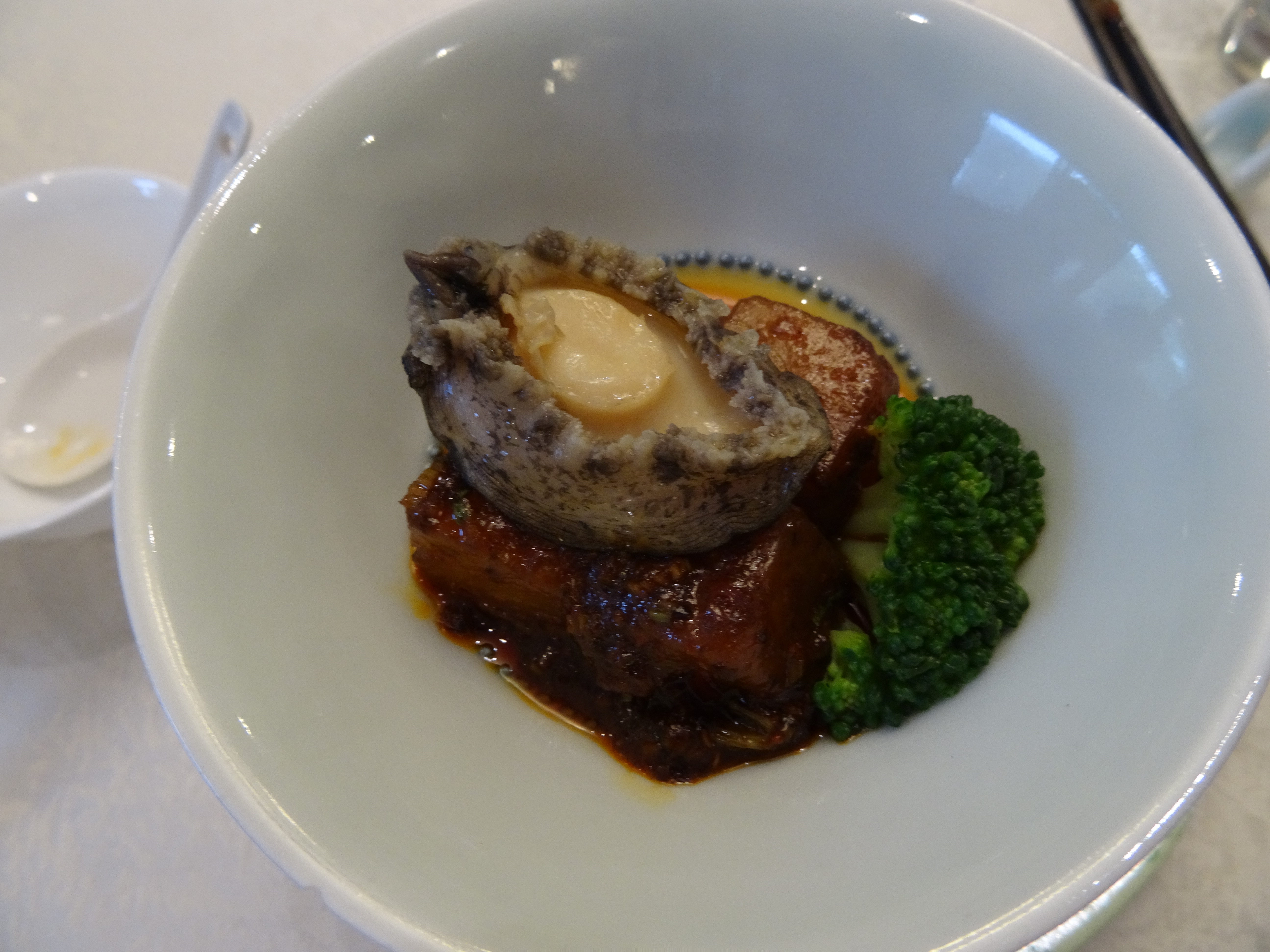
I was using two cameras and no notebook, and the meal was such fun that I hated to keep turning on the cameras. But I wasn’t using flash and everyone was having a good time, and several other folks were taking photos as well. After the truffles and brushes, the best abalone I’ve ever eaten arrived on a rice custard with a broccoli floweret. Abalones are raised here and they are seldom bigger than a few inches long. Absolutely tender, with none of the funk of whelks and periwinkles, it all but melted in my mouth (see photo, below).
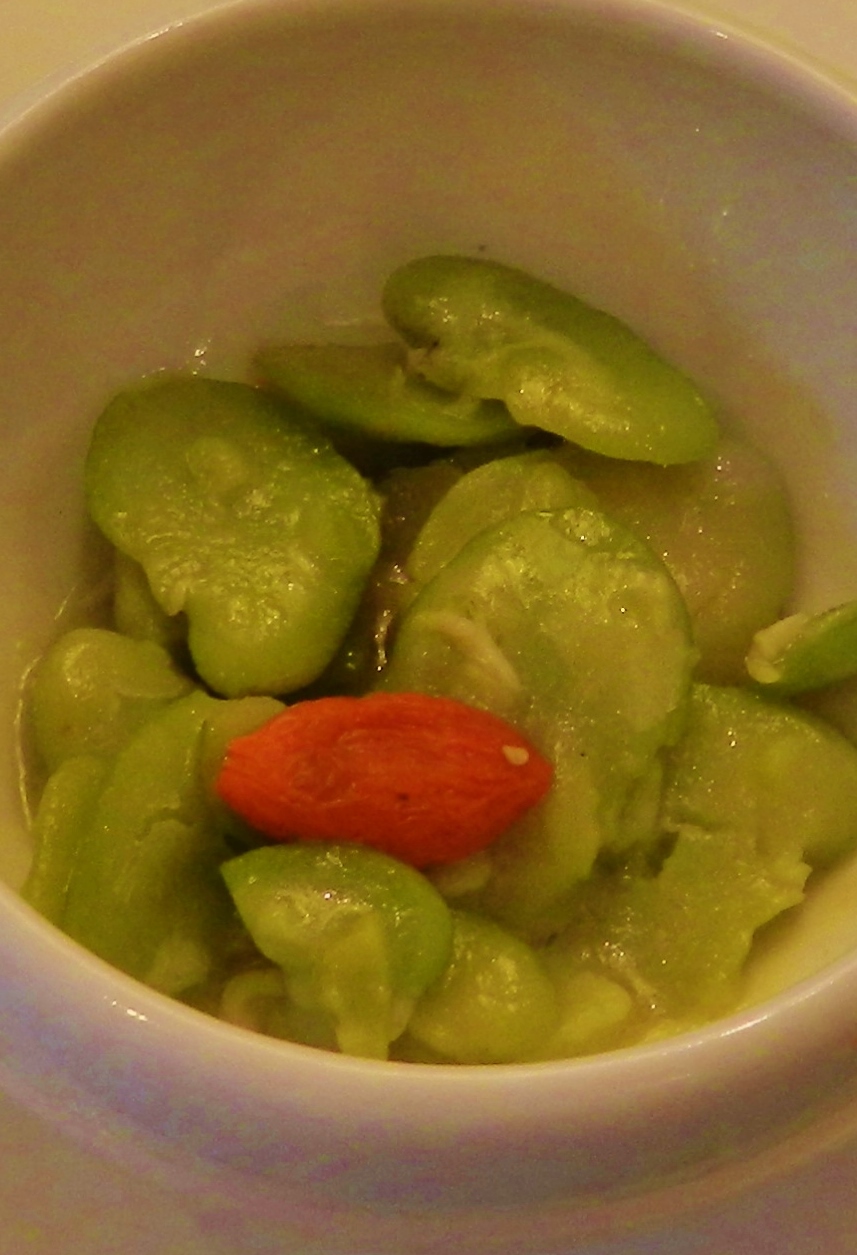
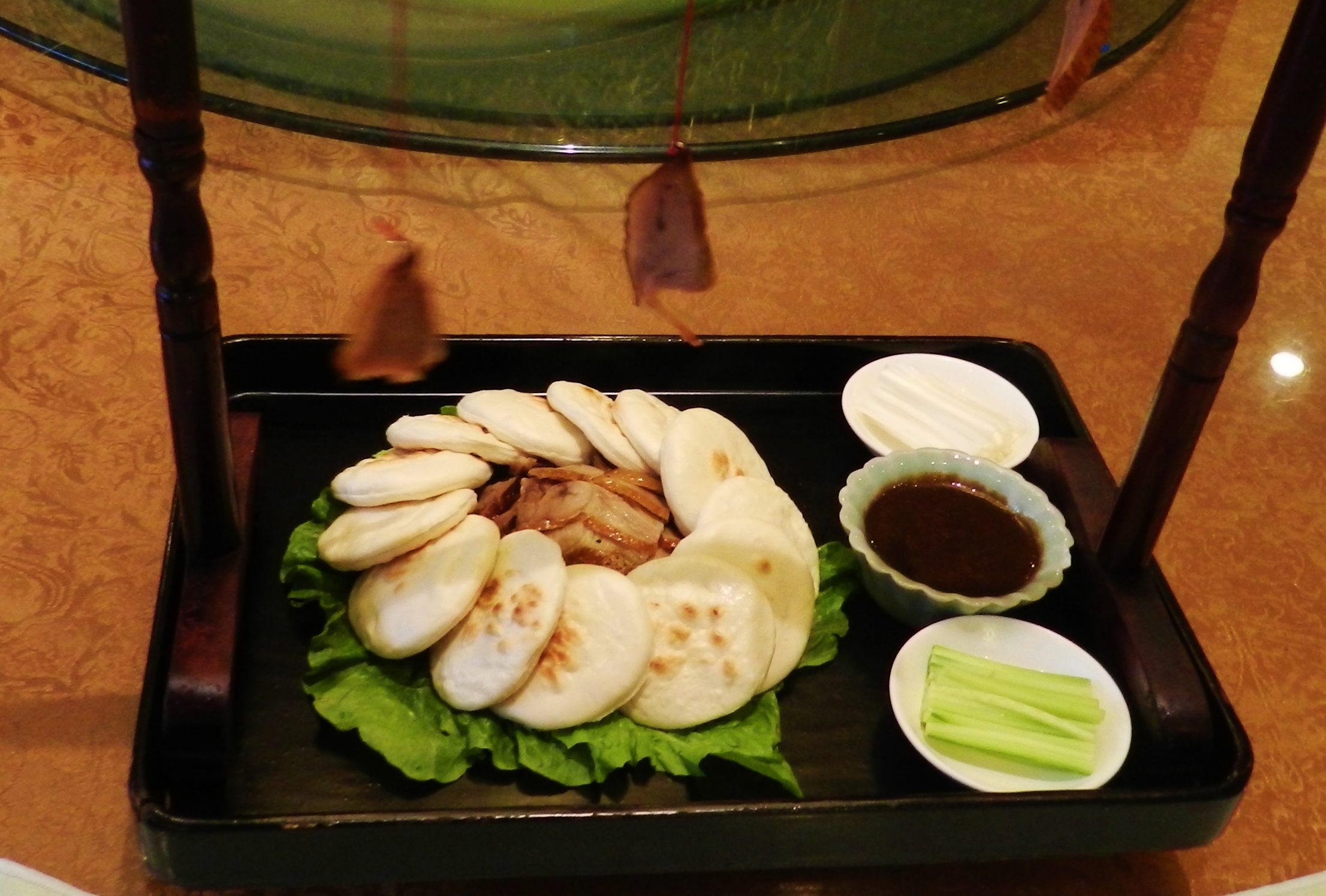
A dish of just-shelled and barely cooked fava beans arrived punctuated with the distinct fragrance of goji, and at some point soon thereafter I noticed that there was a dish of the tender young bamboo shoots I had seen cooking in the kitchen now sitting next to my plate. There were several soups and I honestly don’t remember exactly what the flavor of the broth was in a few of them, but each of them was perfect. One of the real crowd-pleasers was his take on Peking duck. In lieu of the pancake, he made individual flatbreads for each of us to fill with his smoked duck and the usual celery, scallions, and dipping sauce (see photo, above).
One of the soups included a type of potato carved into the character for “longevity.” Another soup included glass noodles which could have been made from sweet potatoes. A mushroom soup featured three varieties of local mushrooms separated in the broth by delicate pasta layers. Yet another, near the end of the meal, had bright leafy greens in it. Our server called it “cabbage,” but the words for all the leafy greens are so confusing and similar in Chinese that even the Chinese find the names baffling; it certainly wasn’t any cabbage I’ve ever had. The pumpkin soup was perhaps my favorite.
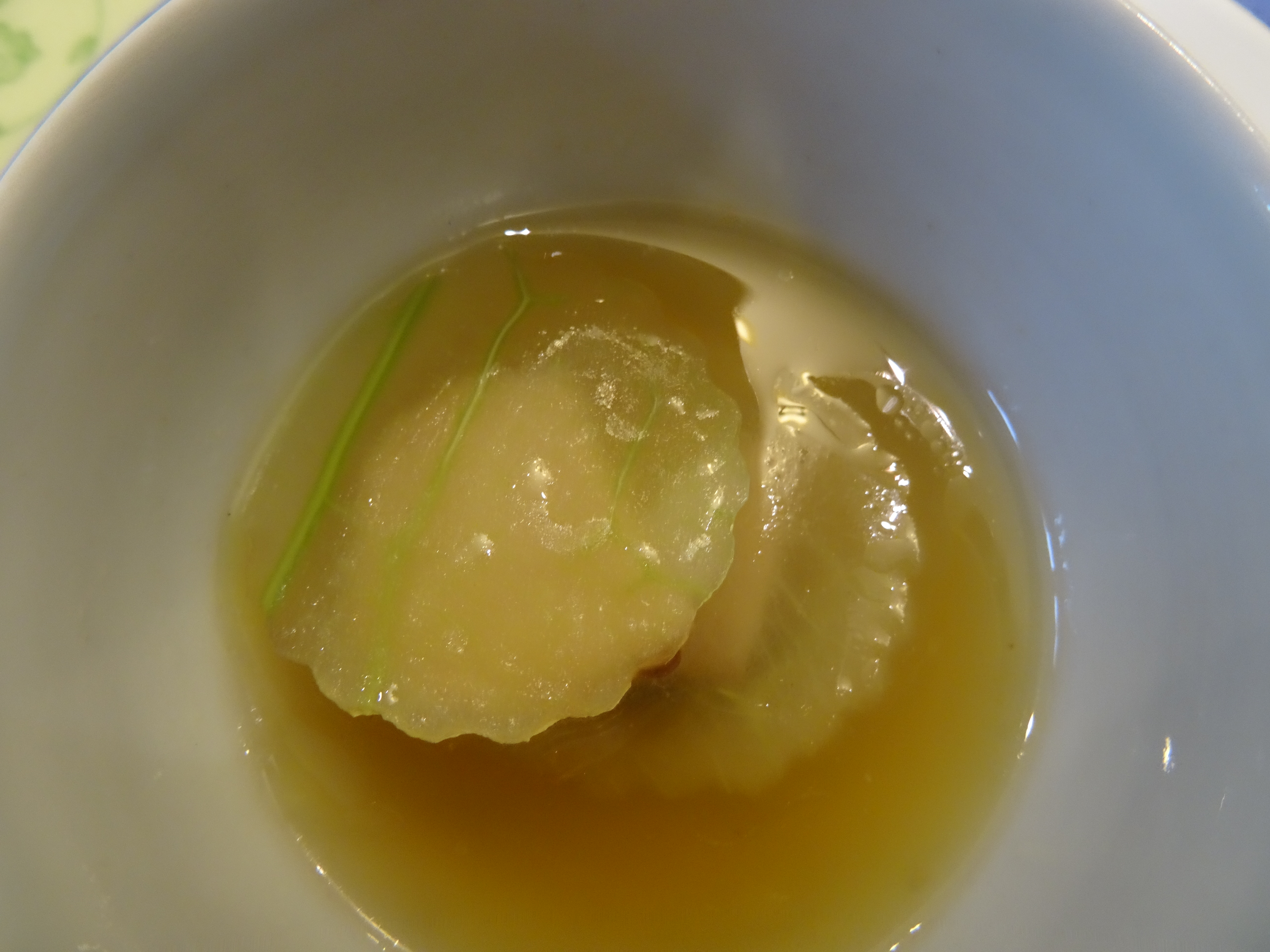
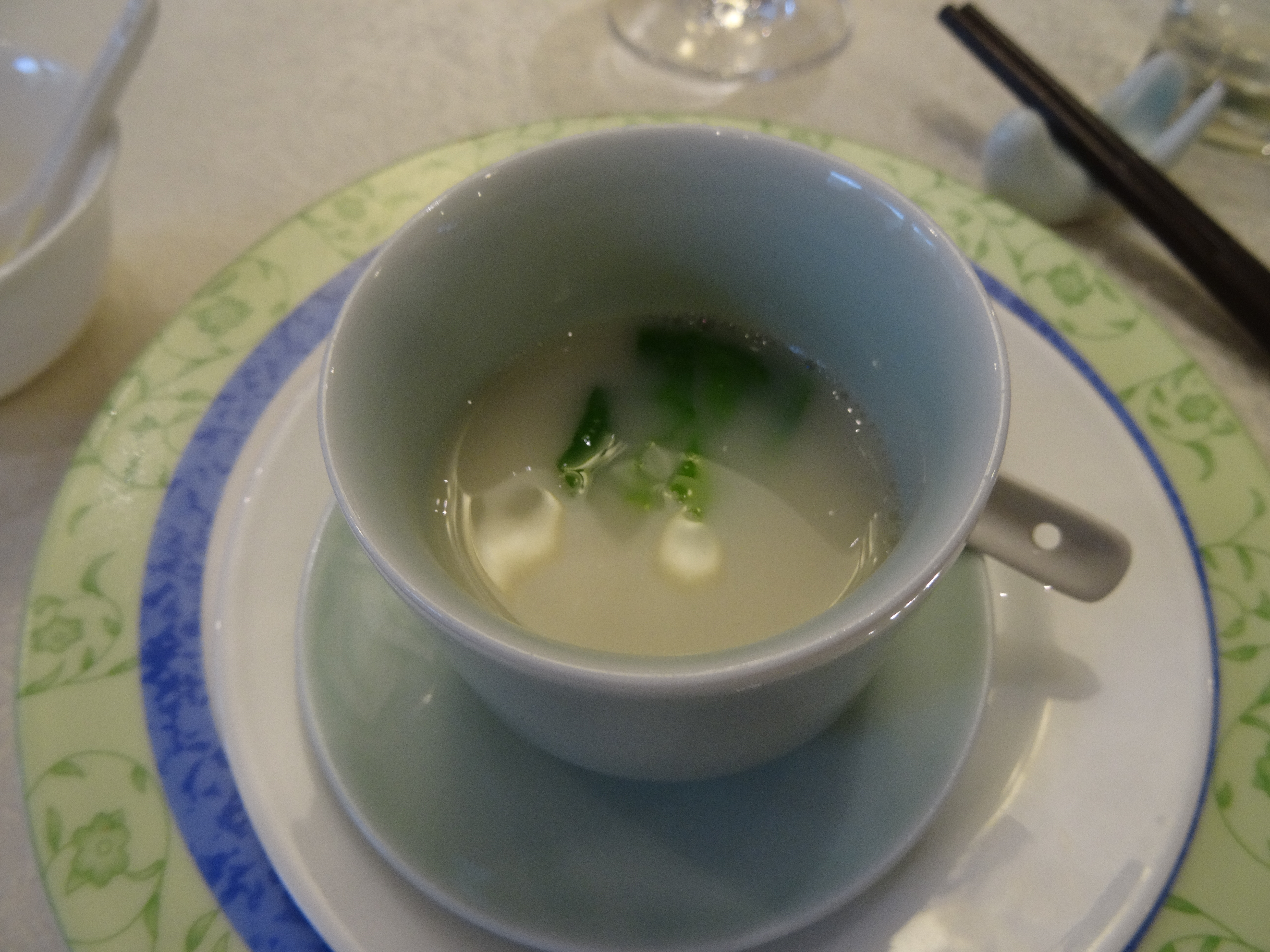
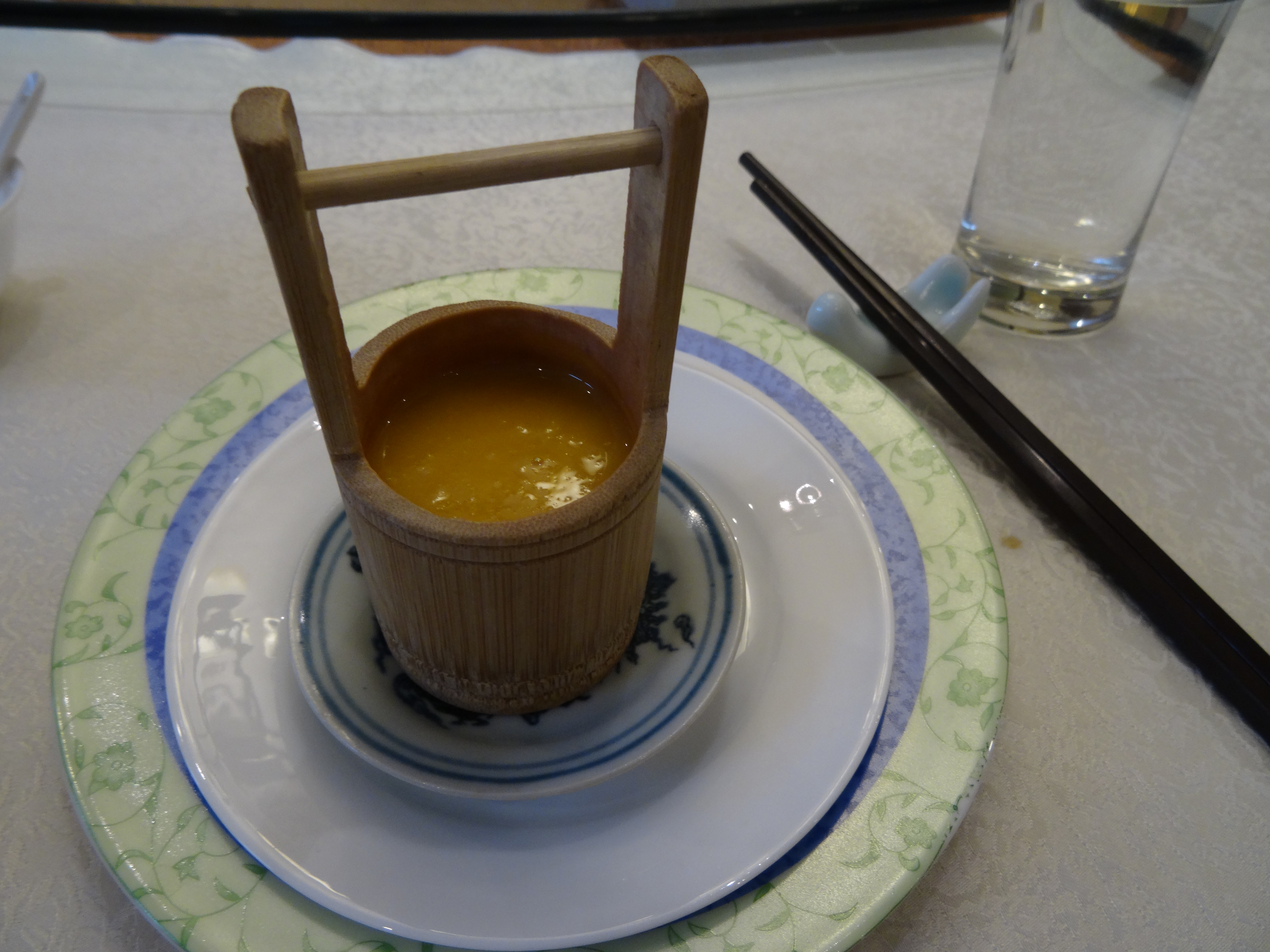
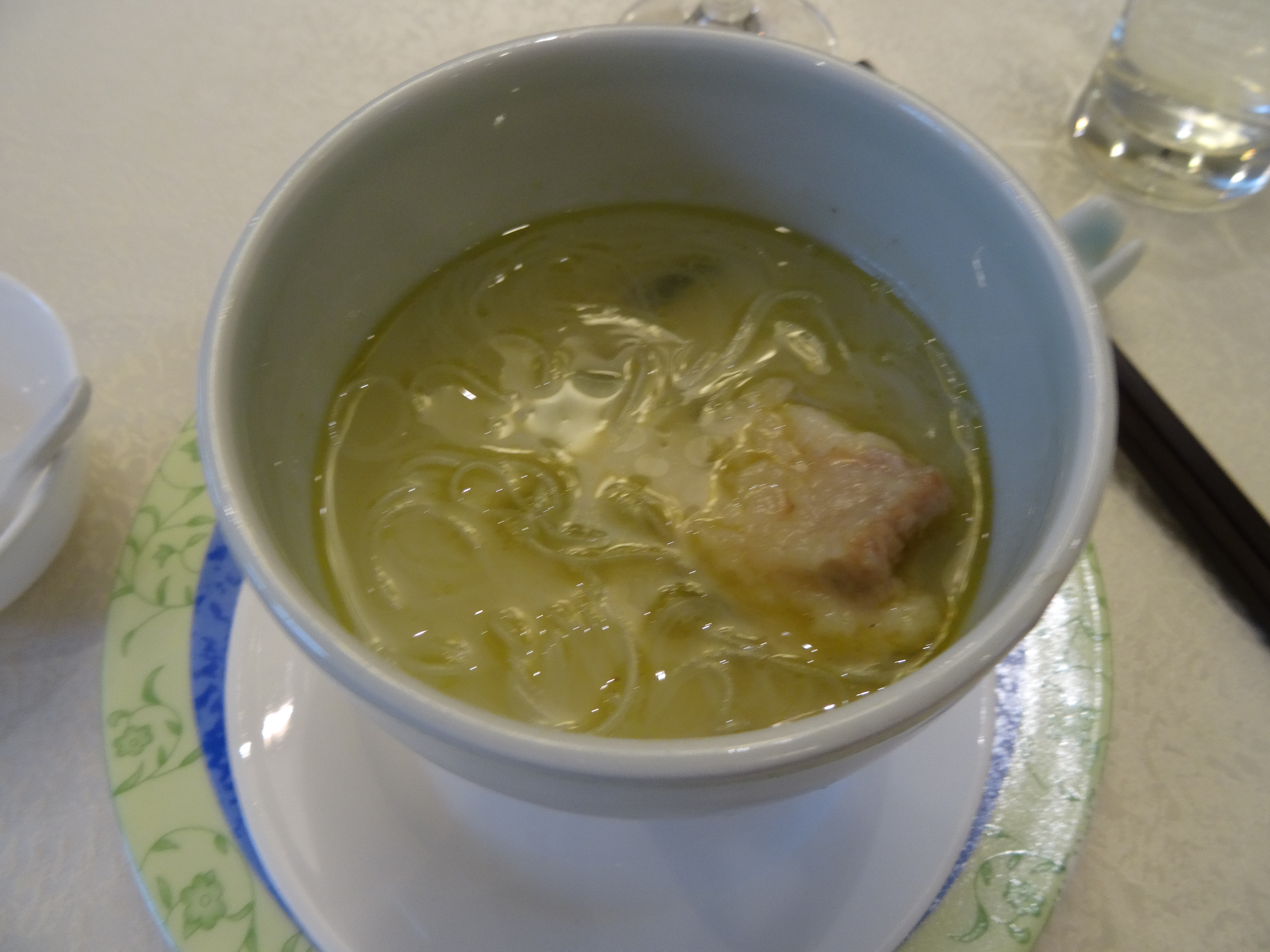
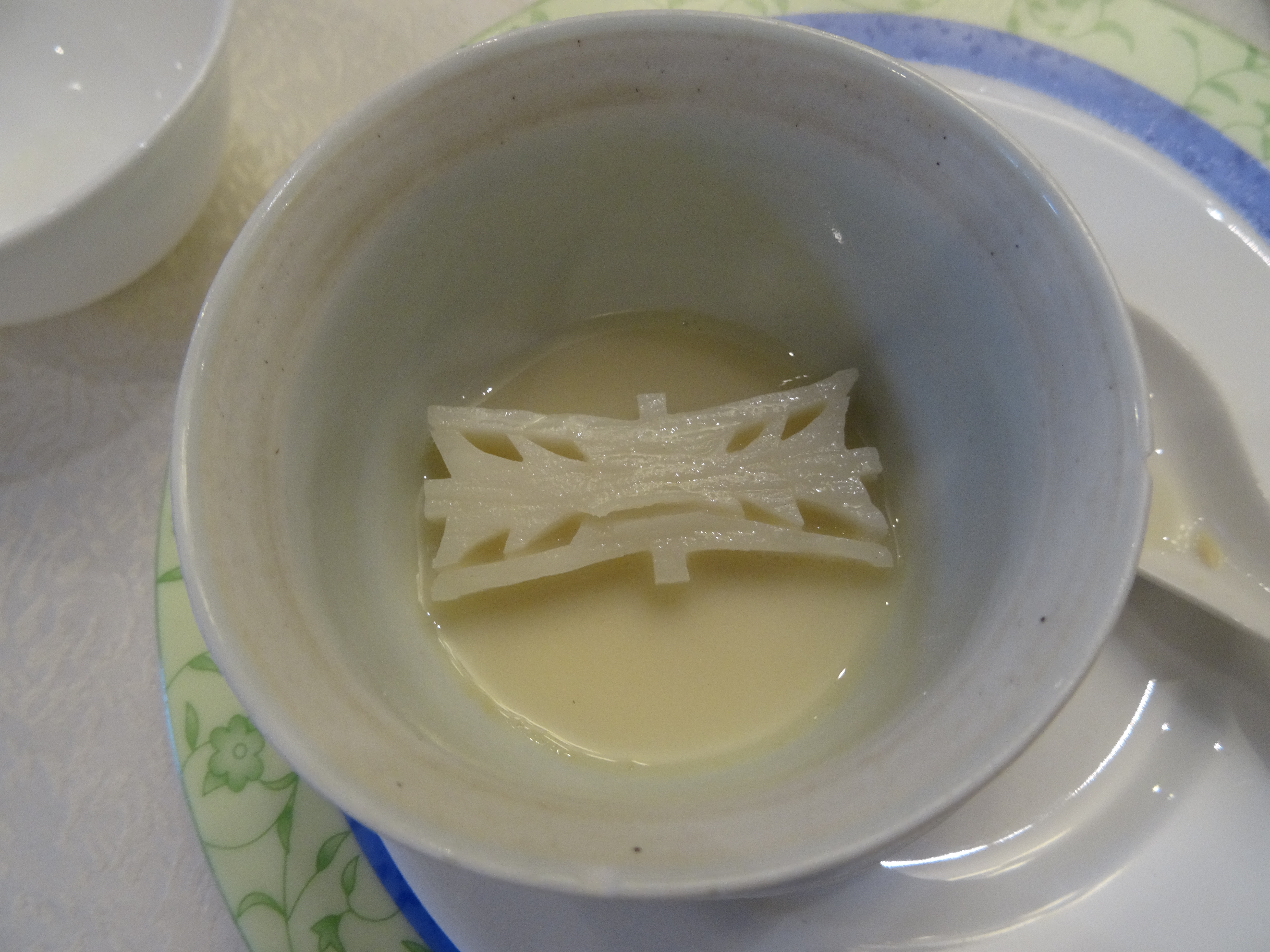
There were several breathtaking flavors: a custard made with eggs and reduced chicken stock was topped with little morsels of chicken in that same stock, reduced to a glaze. A shrimp was peeled, butterflied, dusted in pea flour, and fried. It was topped with dried peas, fried and combined with a brightly flavored sweet and sour sauce. Home-smoked fish was served with another traditional street food, a fried dough. My absolute favorite dish was a perfect piece of cod, with fresh chilies and a delicate oil.
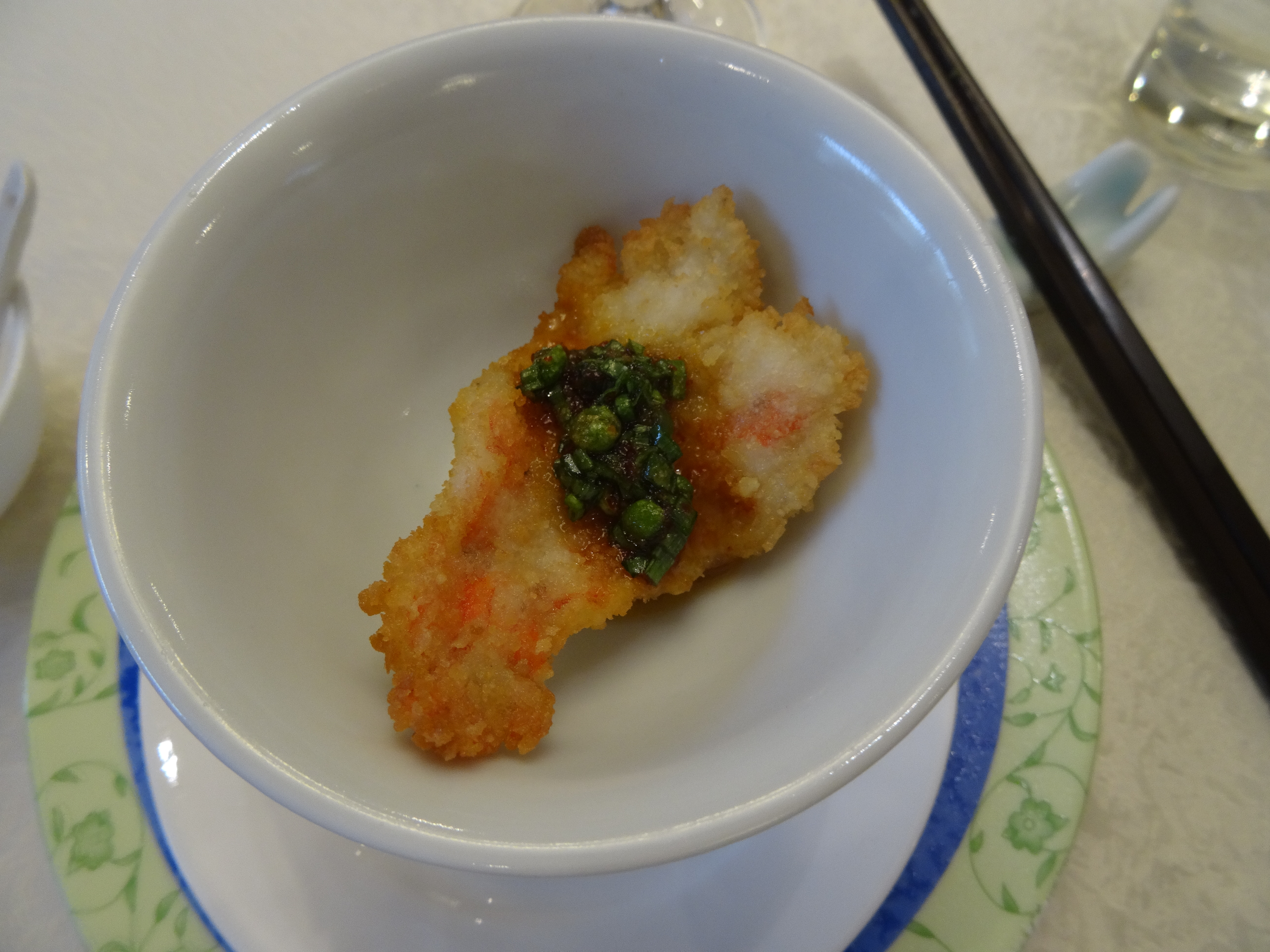
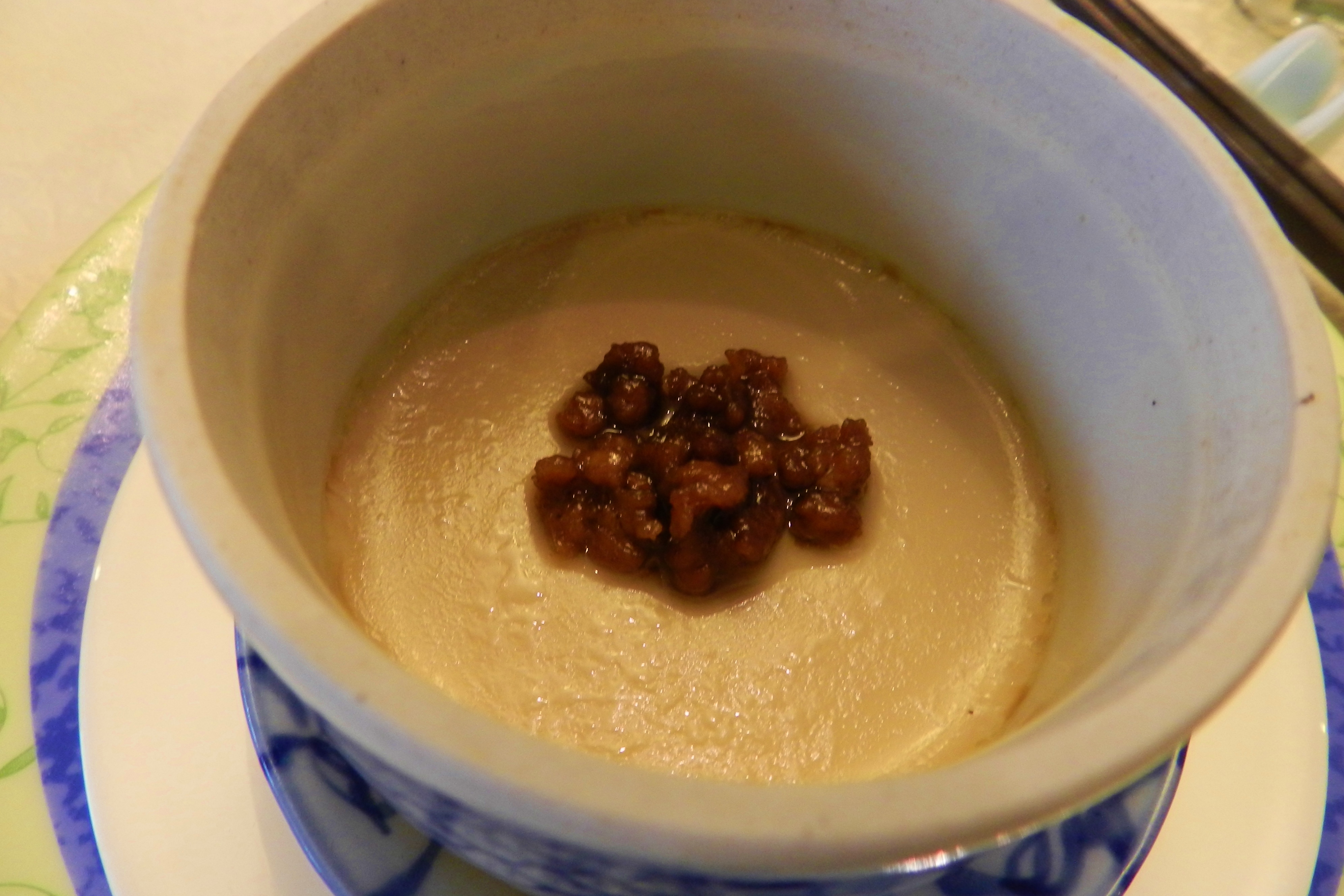
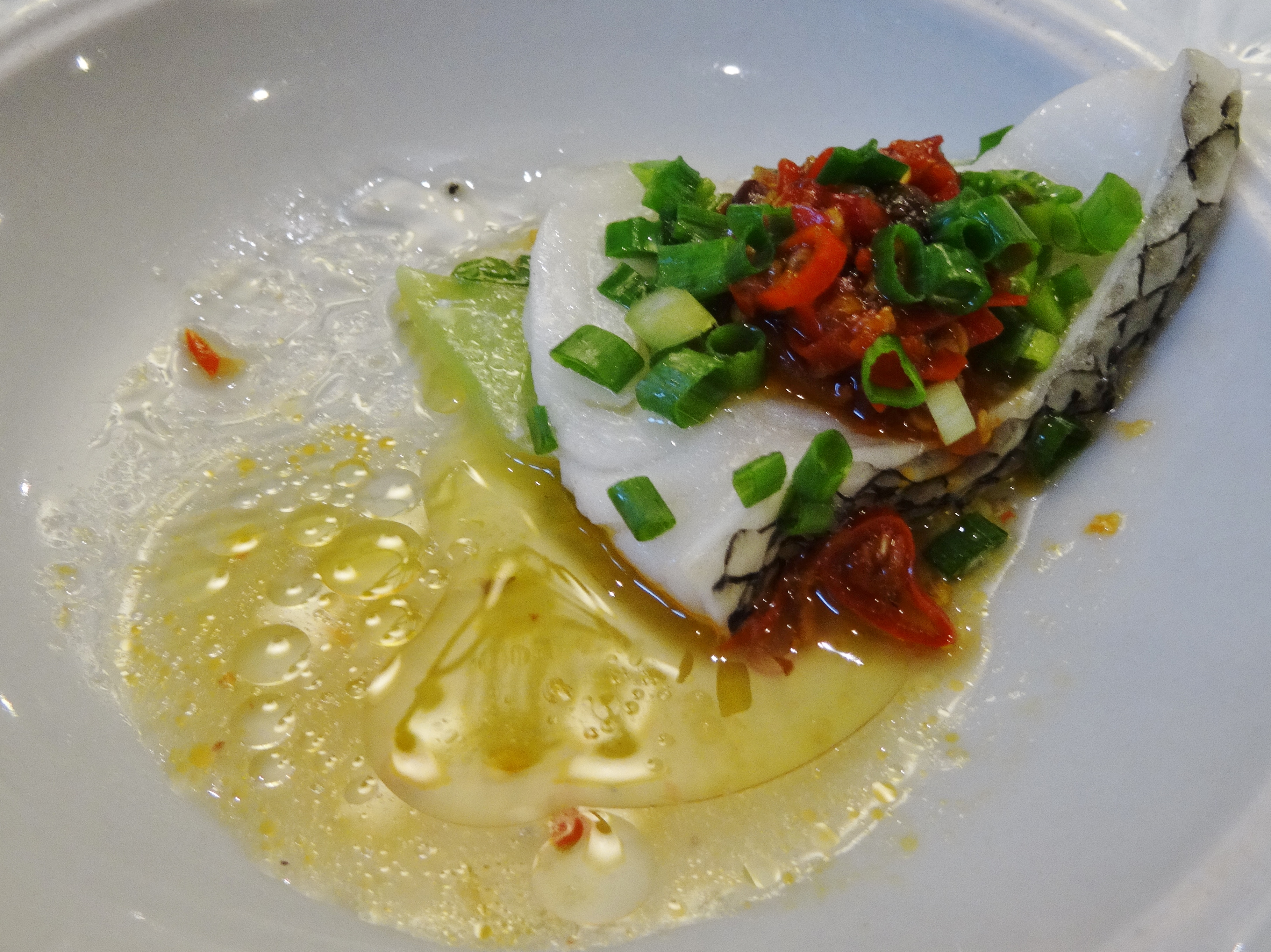
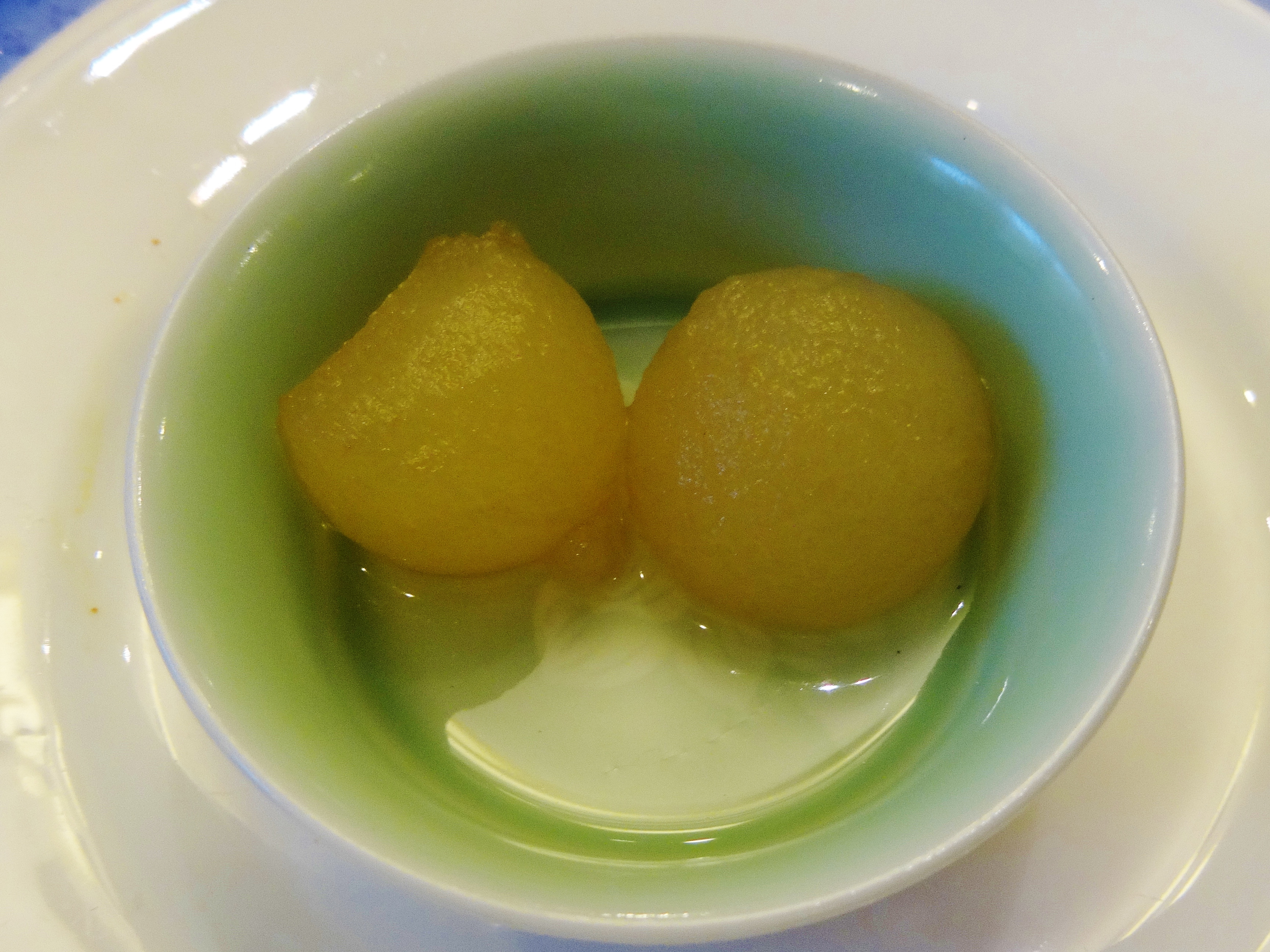
The meal was perfectly timed, but I knew we were running a little late. Xiaoyu asked them to speed things up a bit, but how much more could we have? I figured there would be pork (even though we had had the brushes with the pork inside) and I was surprised that we hadn’t yet had the classic ma-la flavor. And, sure enough, here came classically roast Sichuan chicken, perfectly cooked, and spiced with both numbing and fiery peppers. I felt that I was tasting the flavor for the first time, perhaps because it wasn’t swimming in oil. Immediately after the chicken, one of the most sublime dishes I’ve ever had: two little balls of pear that had been poached in a sugar syrup flavored with Sichuan peppercorns. Amazingly, the peppers did not numb in this dish, but their remarkable bouquet flowered in the fruit. What a perfect follow-up to the fiery chicken! I was also right about the pork. Though I forgot to take a photo of the final dish (we were actually served more than the 32 dishes they promised), it was a Chengdu classic that I had had once before: pork belly lines a bowl that is then filled with sticky rice and brown sugar. It is steamed and turned out and served as the final bit of decadence to a traditional feast. And now the clincher: this incredible banquet cost only $50/person!
We had a day of rest from the extravagant eating, but on Friday, Liu Jianzhong, whom everyone calls “Driver Liu,” prepared one of his amazing feasts at the Peace Corps office. His food is in many ways a polar opposite of Yu’s, but fundamentally, it is the same: fresh, local, in-season ingredients. An abundance of vegetable dishes. A respect for tradition. A great variety of flavors, aromas, textures, and colors. Driver Liu is younger than I am; I figure he’s in his mid to late fifties. He would have been pre-teen when the Cultural Revolution began. He was one of the lucky ones, because he was chosen for the army, where he became a cook. More is better in his book. I’ve eaten his food on several occasions and he is masterful. And though he makes lots of food, he does not have the typical Sichuan heavy hand, neither with oil nor spice. He has been working for the Peace Corps since the program began in 1993. He nearly always cooks his and his fellow employees’ lunch. He really pulled out all the punches for Carrie.
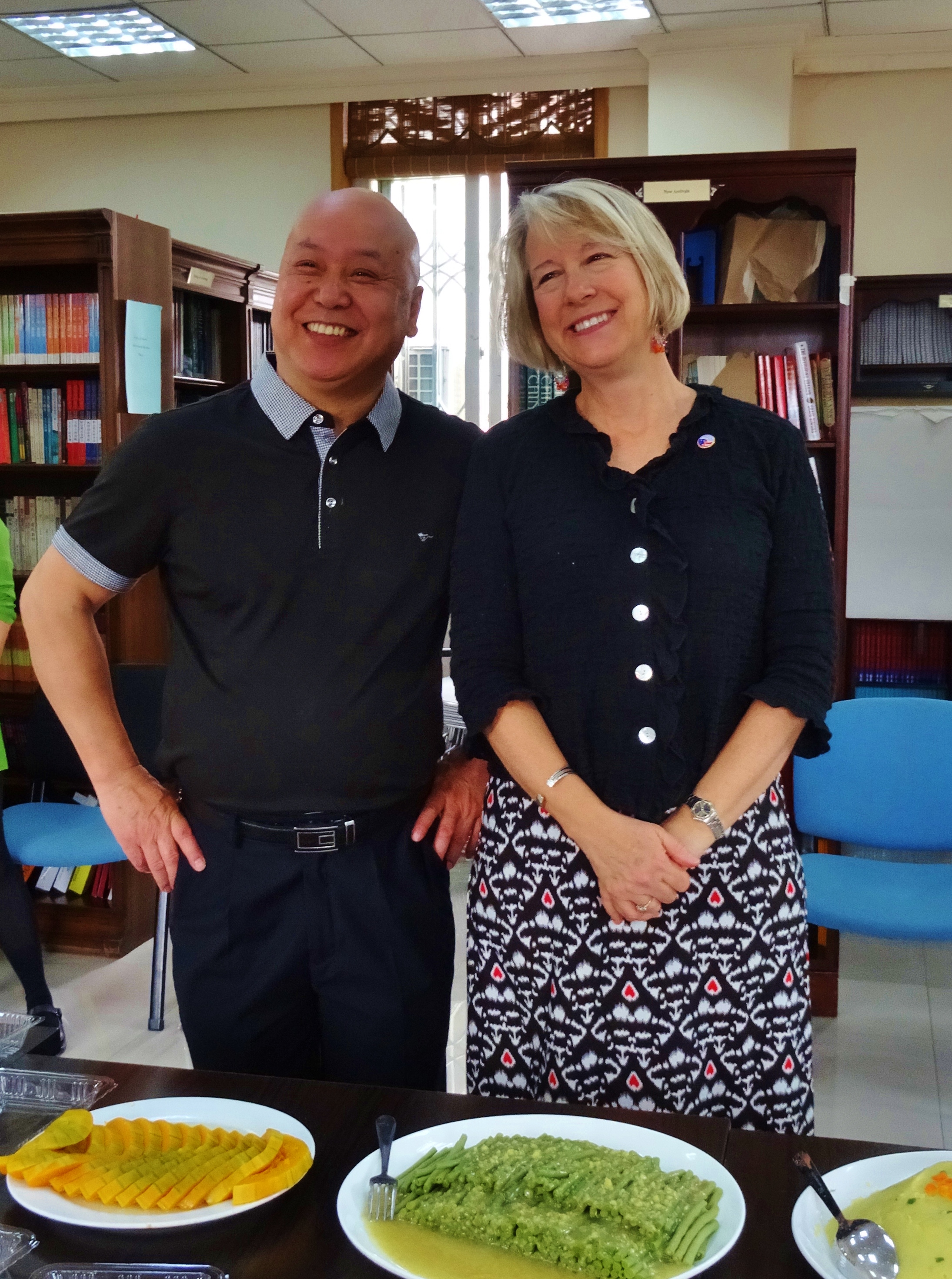
Liu Jianzhong’s Banquet
In 1984, I was the food editor of the French-language magazine, Ici New York. I had the great privilege of interviewing Karen Hess, the culinary scholar who was transforming culinary history into a respectable field, on the history of Thanksgiving. Her heavily annotated facsimile edition of Mary Randolph’s The Virginia House-Wife, originally published in 1824, had just been released by the University of South Carolina Press. The book, and my conversation with her (which lasted far beyond the hour-long cassette tape I had with me, wandering in and out of French and English, touching on linguistics, horticulture, animal husbandry, the Middle Ages, European court life, and American politics), had a profound influence on my career. Food, in Karen’s words, came alive in ways I had never considered. We became fast friends and colleagues, her guiding me toward primary sources that would inform my own culinary writing. After the interview, during which she encouraged me to continue researching the culinary history of the South Carolina lowcountry (a study which she would soon thereafter join – and surpass me – in), I read The Taste of America, a scathing diatribe that she wrote with her husband John. In it she attacked several of the icons of American food, and was ostracized by much of the food world for having done so. But her scholarship and her loyalty to her friends and acolytes never faltered. I am forever indebted to her. In The Taste of America, I first read about what the Hesses called “wok presence” or “wok signature.” Later, when Karen and I were researching lowcountry cooking in tandem, I was able to tell her that we similarly say of good cooks in the lowcountry, “She has an old hand.”
Recently, I was doing some research on fava beans (I will be blogging about them) and ran across this passage in Shiu-ying Hu’s amazing Food Plants of China: “A connoisseur of good Chinese food judges a dish by its huo-hou 火侯 (timing of cooking), and its se-xiang-wei (color, aroma, and taste). In rural China, instead of using huo-hou, people say huo-kou 火口 (fire mouth), which means to apply or to stop the fire according to the taste buds of the cook (= judgment). A good Chinese cook never uses a cookbook, but samples a tiny piece and stops the fire to judge by his or her taste. This ability calls for experience, and it is from such experience that a cook chooses a method of preparation, such as quick stir-frying, slow simmering, or steaming.” This is one aspect of wok presence and having an old hand, but both phenomena also include the woks (or, in the lowcountry, the well-seasoned cast iron pans) themselves. Grace Young has written extensively about “wok hay” (huò qì in Mandarin), which is another aspect of wok presence, according to friends here. (It has to do with cooking foods in a very hot wok so that dishes have a very special flavor. Qi can mean air or breath or spirit or vital essence, according to Anne Mendelson, a scholar of traditional Chinese writing as well as cuisine.) I thought about these terms as I watched Driver Liu prepare his amazing feast for Carrie. Again, I’m using photos to help me remember what all he prepared. There were two dozen dishes.
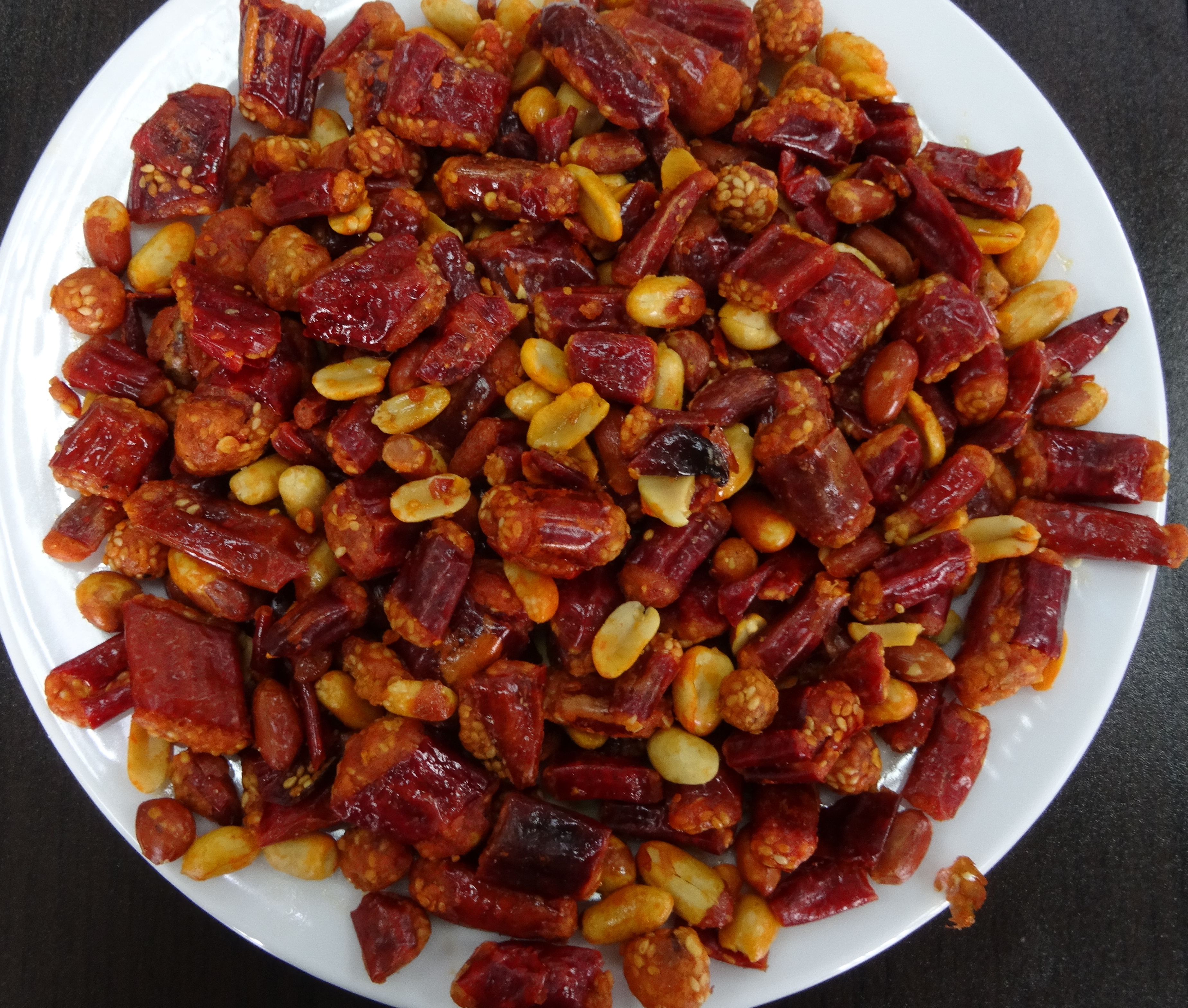
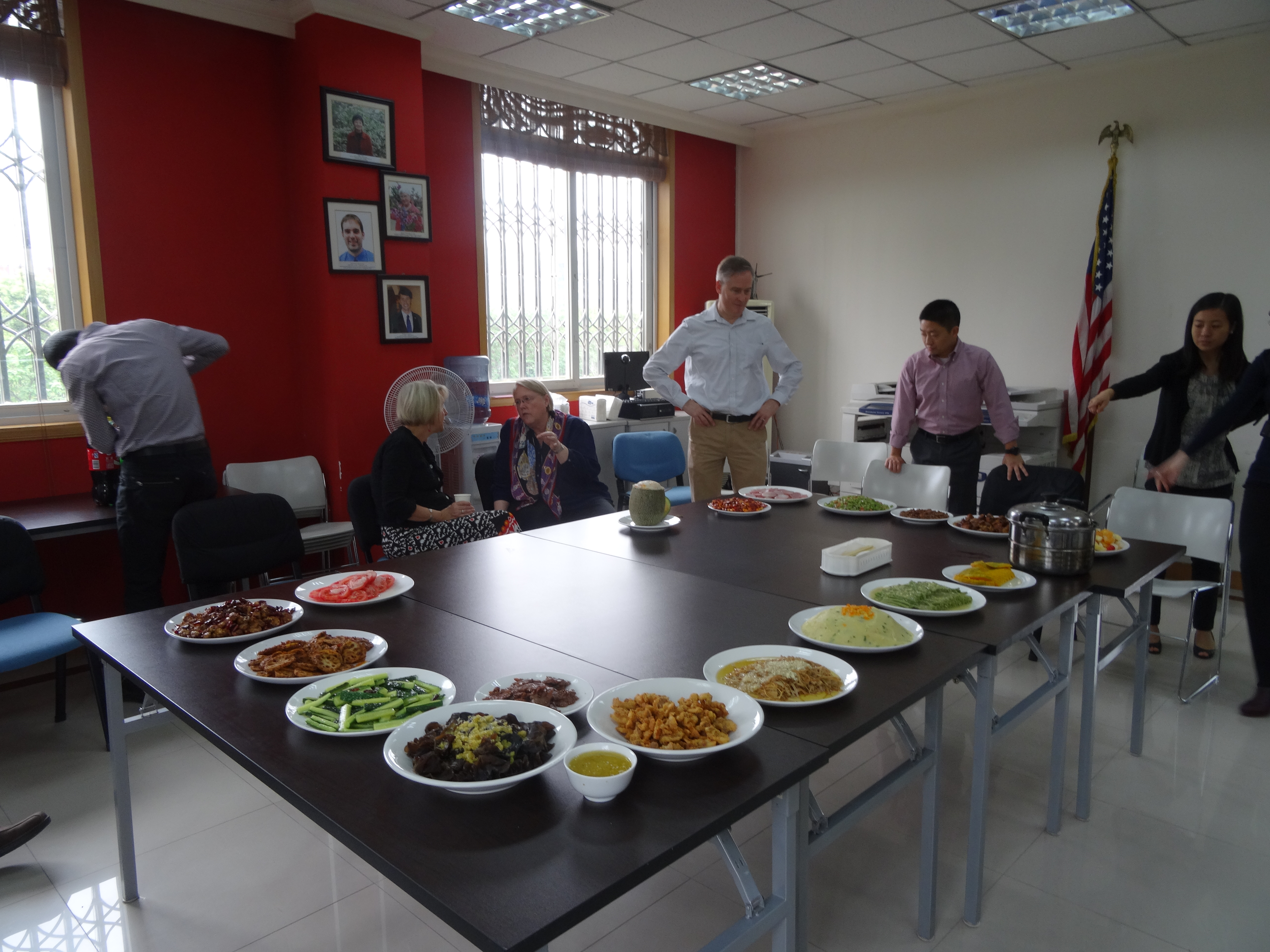
Like me, Driver Liu rarely plans meals until after he has shopped. He buys what’s fresh and in-season. For a feast like this one, he might cook for several days, and he might add a few already prepared items (such as the glazed walnuts, cured tofu, and spicy candied peanuts — see photo at left). For the most part, the food is cooked just before serving. The kitchen at the Peace Corps office is on the first floor (er, second floor, American style); the volunteer lounge, where we ate, on the fifth. Here, 20 of the dishes have been brought up to the buffet table.
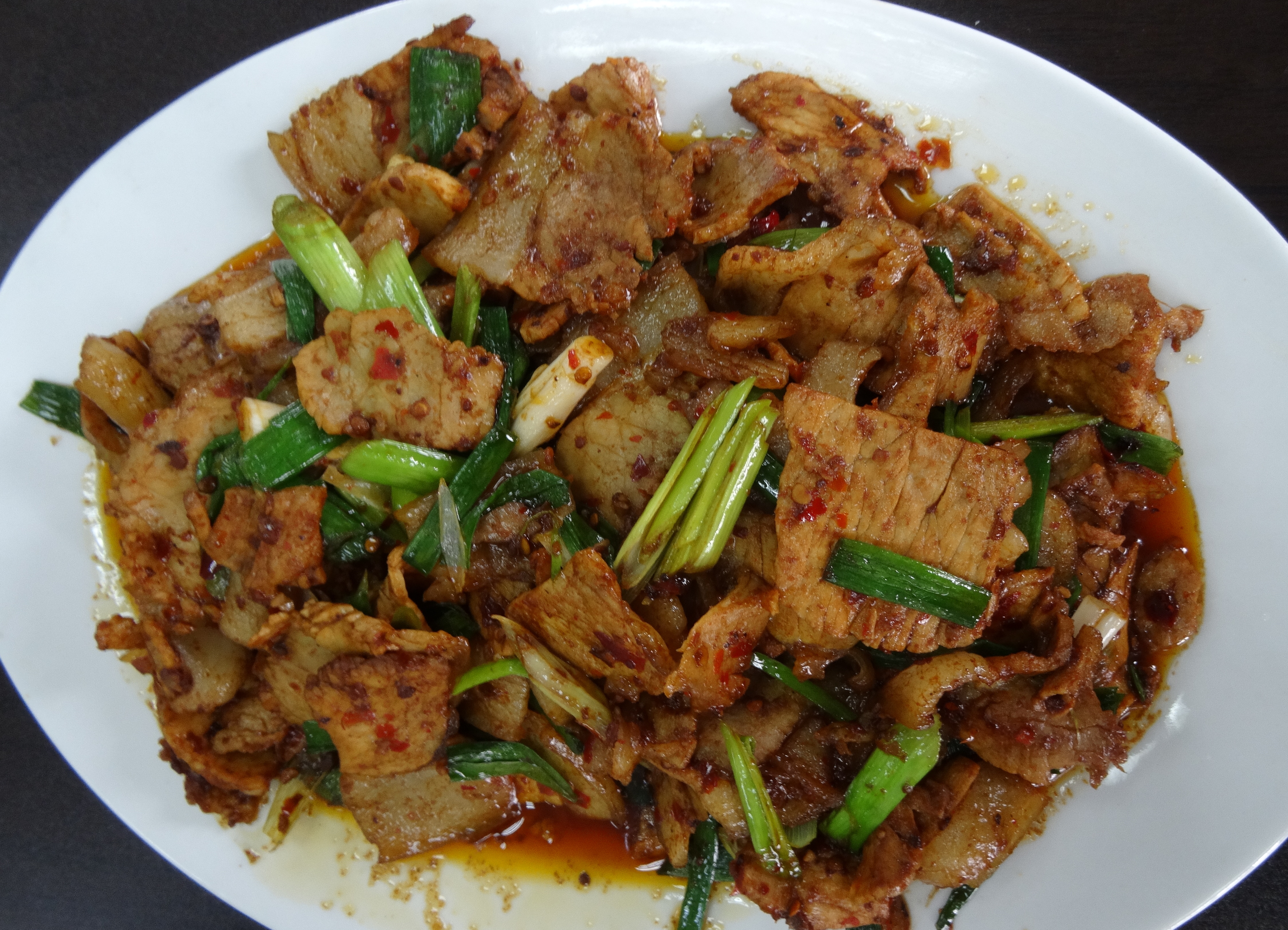
Driver Liu is a master of timing. Several of the dishes, such as Hui guo rou (so called “twice-cooked pork”), are best cooked several hours in advance of the main wok-frying. Fuchsia Dunlop notes, “Hui guo rou, which literally means ‘back-in-the-pot meat,’ is the most famous and profoundly loved of all the dishes of Sichuan.” Though its major preparation was done ahead of time, the dish was the last to arrive at table, perfectly “sizzlingly delicious,” as Dunlop says it should be. Often finished off with fermented black beans and leeks, Driver Liu’s version with Pixian chili bean paste and baby leeks was simply perfect. The bean paste is made with fermented chilies and fava beans in the nearby eponymous town. He insists that the pork have some skin still attached and that the inclusion of fermented beans is not traditional. His was the best I’ve had. (See photo, left.)
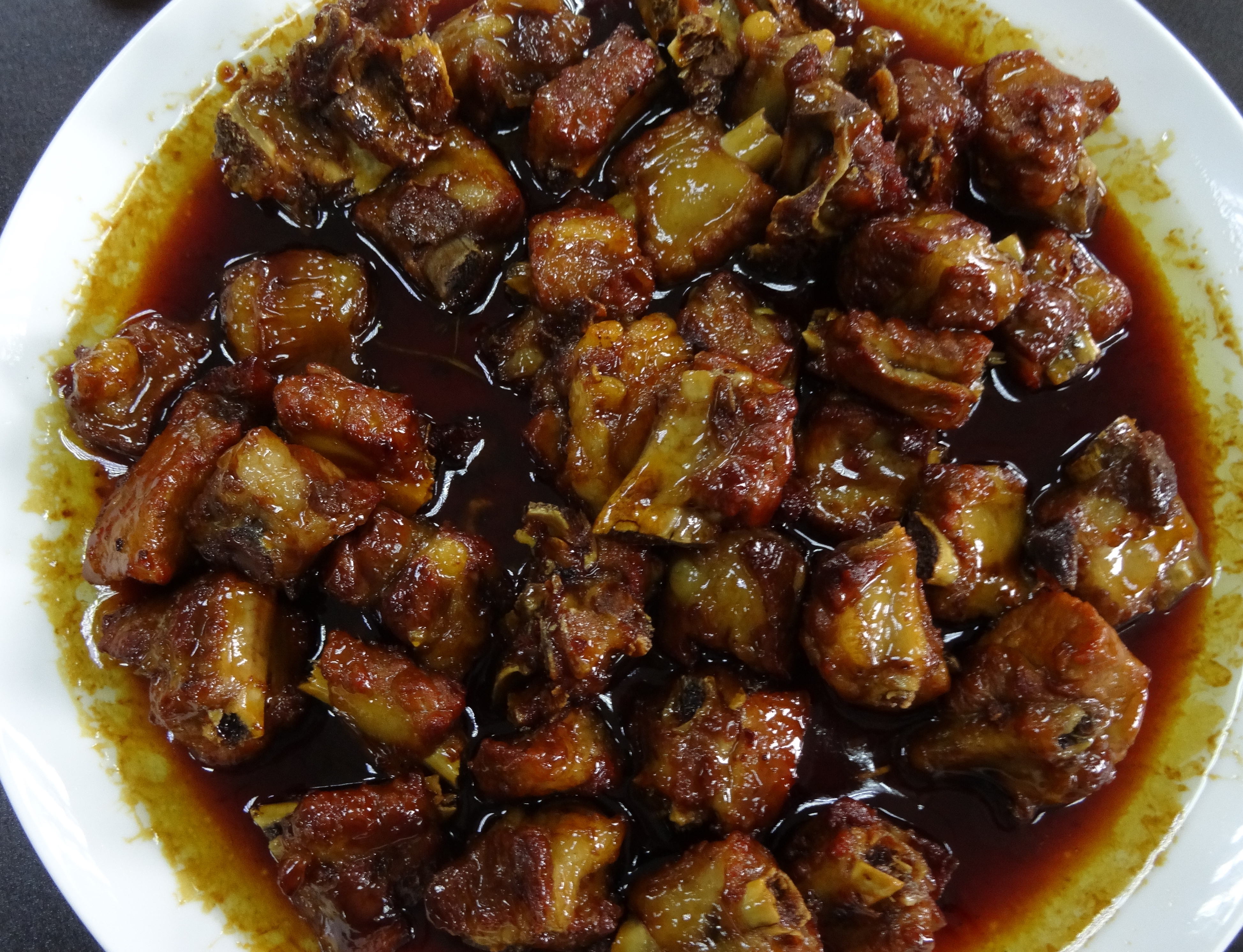
Pork is THE meat of Sichuan. Xiaoyu advised me ahead of time: “Grab some of the sweet and sour ribs first. They will be the first thing to go.” And, indeed, they were. I think it’s because the Chinese love sucking the deliciousness off bones – we all know that that’s the most flavorful piece of meat, but also because they have, in spite of their protestations to the contrary, an incredible sweet tooth. The staff is always telling me how they don’t like sweets, but if I bring cakes or cookies to the office, they’re gobbled down in seconds. And the stores here are filled with aisle after aisle of candies and cookies … and you pray to find western-style bread that isn’t fluffy and sweet. But I digress. The ribs were finger-licking good, but I personally prefer the hui guo rou. An Italian classmate here asked me to ask the staff where he could eat really good sweet and sour pork in a restaurant. Compared to Driver Liu’s? Nowhere. (See photo, right.)
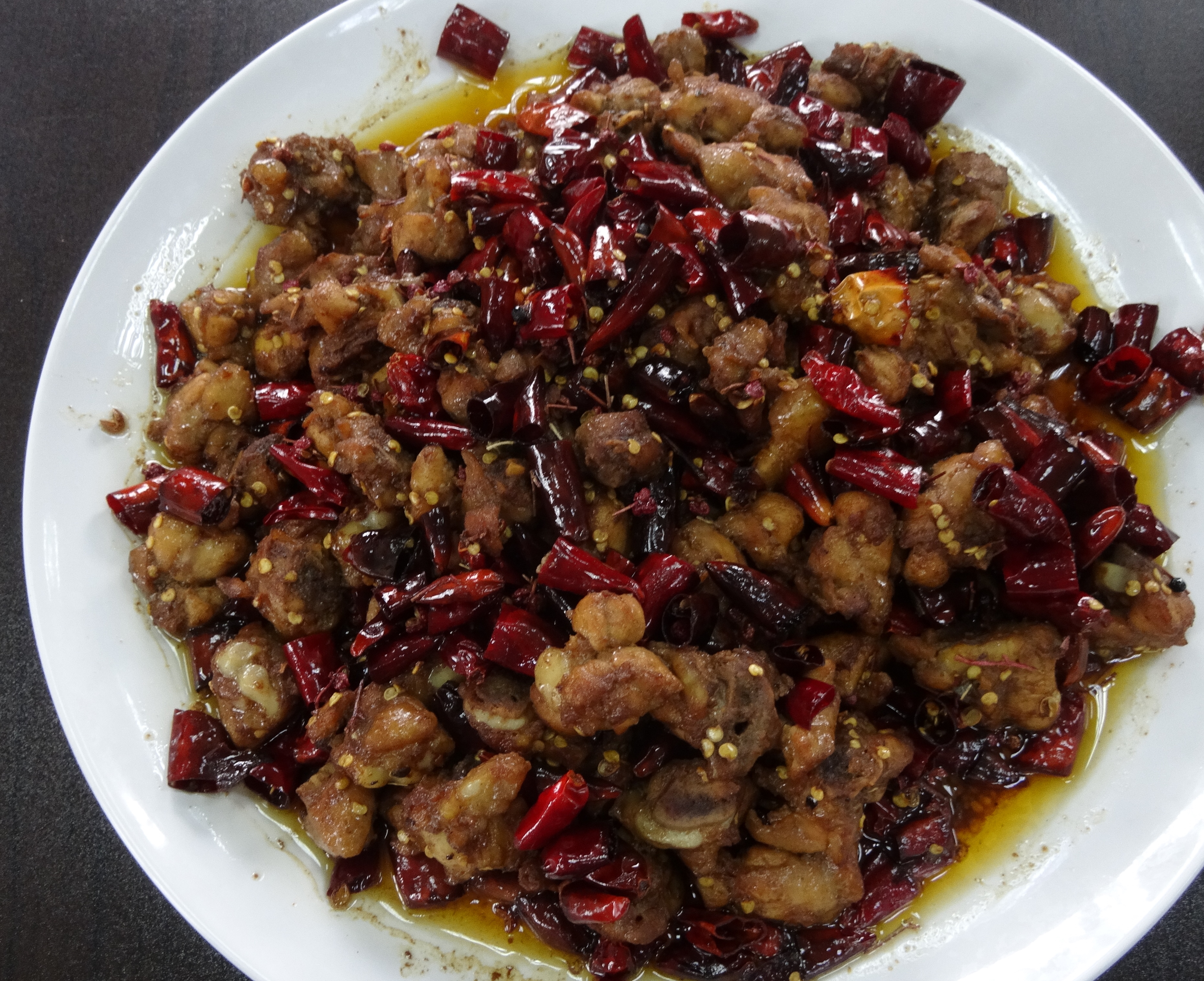 Fly restaurants all over Chengdu offer all sorts of fragrant stewed meats and poultry (lu rou) cooked in heavily seasoned broths then left to cool. You might mistakenly call the resulting sauce “sweet and sour,” because the broth invariably includes sugar, but the seasoning is more akin to medieval western spiciness – deep flavors of cinnamon, star anise, cloves, and anise seeds (in addition to New World chilies and Sichuan peppercorns). There’s no sour other than a bit of rice wine. I’ve read that most vendors have a “mother broth” that they use – a perpetual cauldron of their own blend, topped off daily with the broth, salt, sugar, wine, and spices as needed. The bronzed ducks and chickens you see hanging at food stands have been cooked in lu shui, this aromatic “water.” They are eaten at room temperature, with lots of chili peppers. Driver Liu chose to serve his own spicy chili chicken. It was lighter, and better, than most. (Photo at left.)
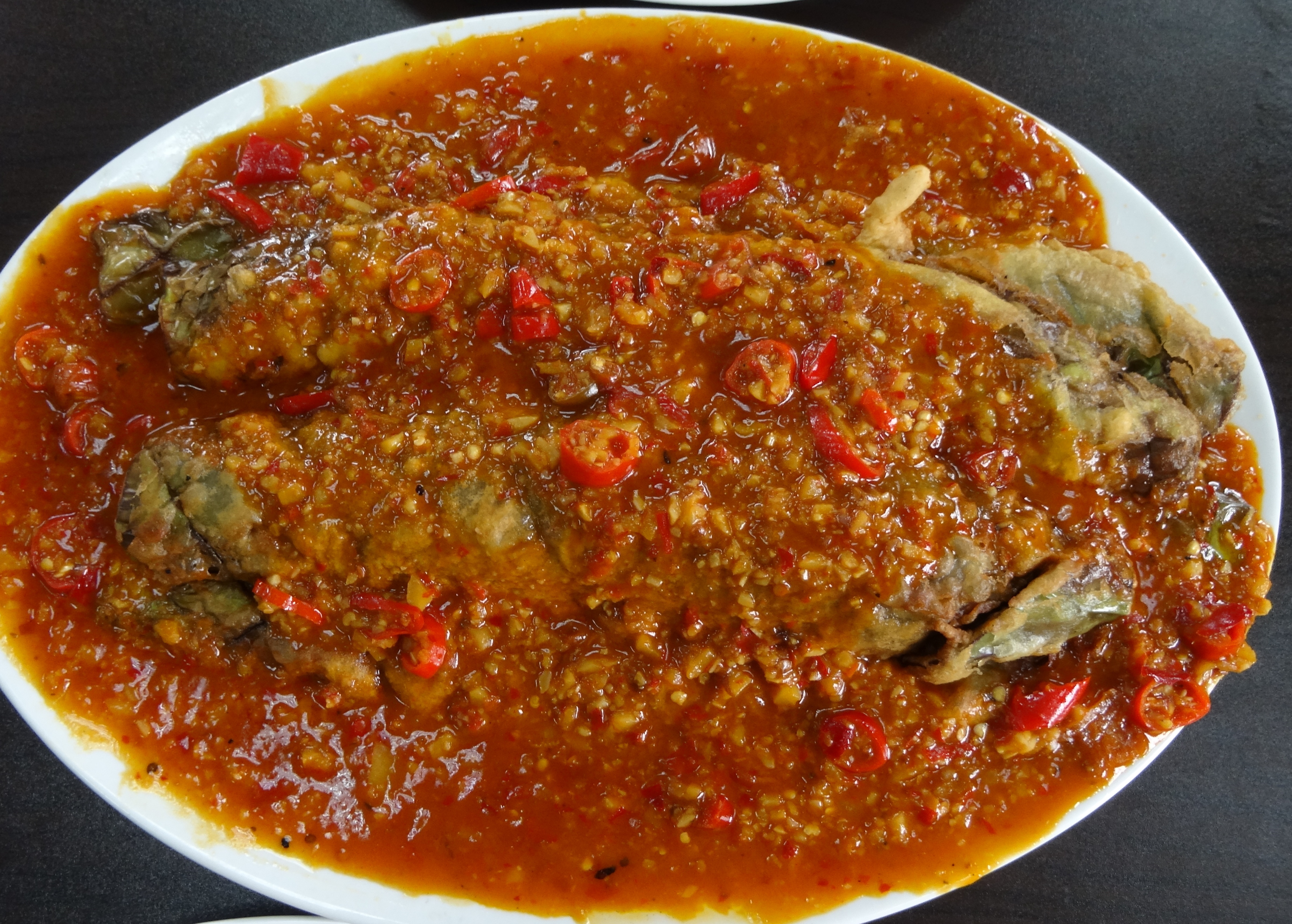
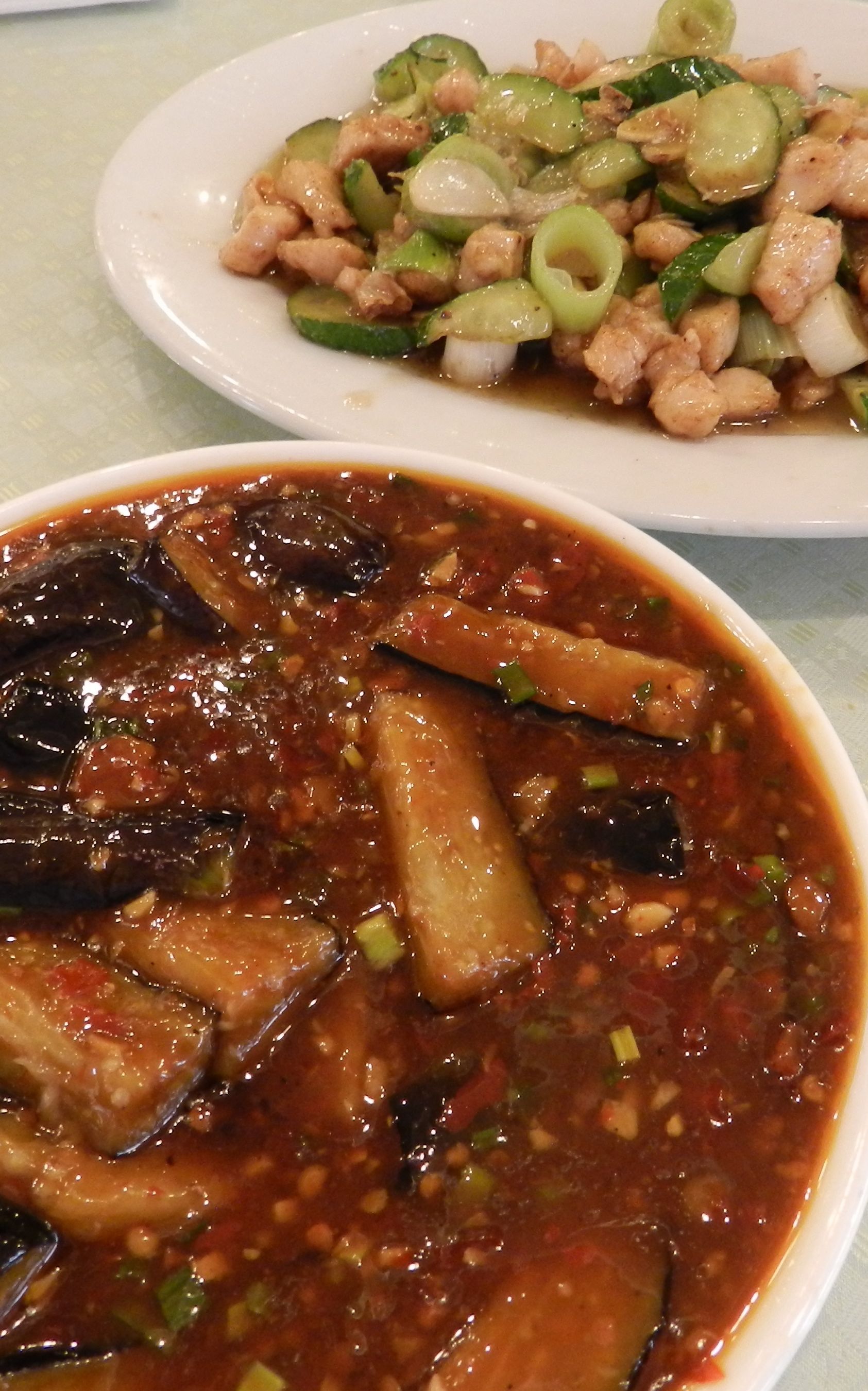
Before you come to Chengdu, learn these characters if you learn no others: 鱼香.They mean “fish fragrant” (yú xiāng). You will see them on nearly every menu describing vegetable, meat, and even fish dishes. Sometimes they are followed by 味型 (wèi xíng), meaning “flavor.” It’s another of Sichuan’s famous contributions to the culinary arts. “Fish fragrant eggplant” does NOT mean eggplant that tastes or smells like fish, but that it has been prepared using the traditional seasonings and cooking methods for fish. It’s one of my favorite dishes, but I have never had two versions that were the same. Driver Liu’s wins, hands-down. Not only did he manage to combine the salty, sweet, sour, and spicy flavors with the heavenly scents of pickled chilies, garlic, ginger, and scallions, but he also coated the eggplants before deep-frying them and adding them to the red sauce, making them resemble fish as well! (See photo.) The garnet color comes from another classic Sichuan invention, chili bean paste (a different version from the Pixian mentioned above). Driver Liu was quick to point out that the unique flavor of the dish comes largely from the variety of pickled peppers he uses, including one he called “wild mountain peppers.”
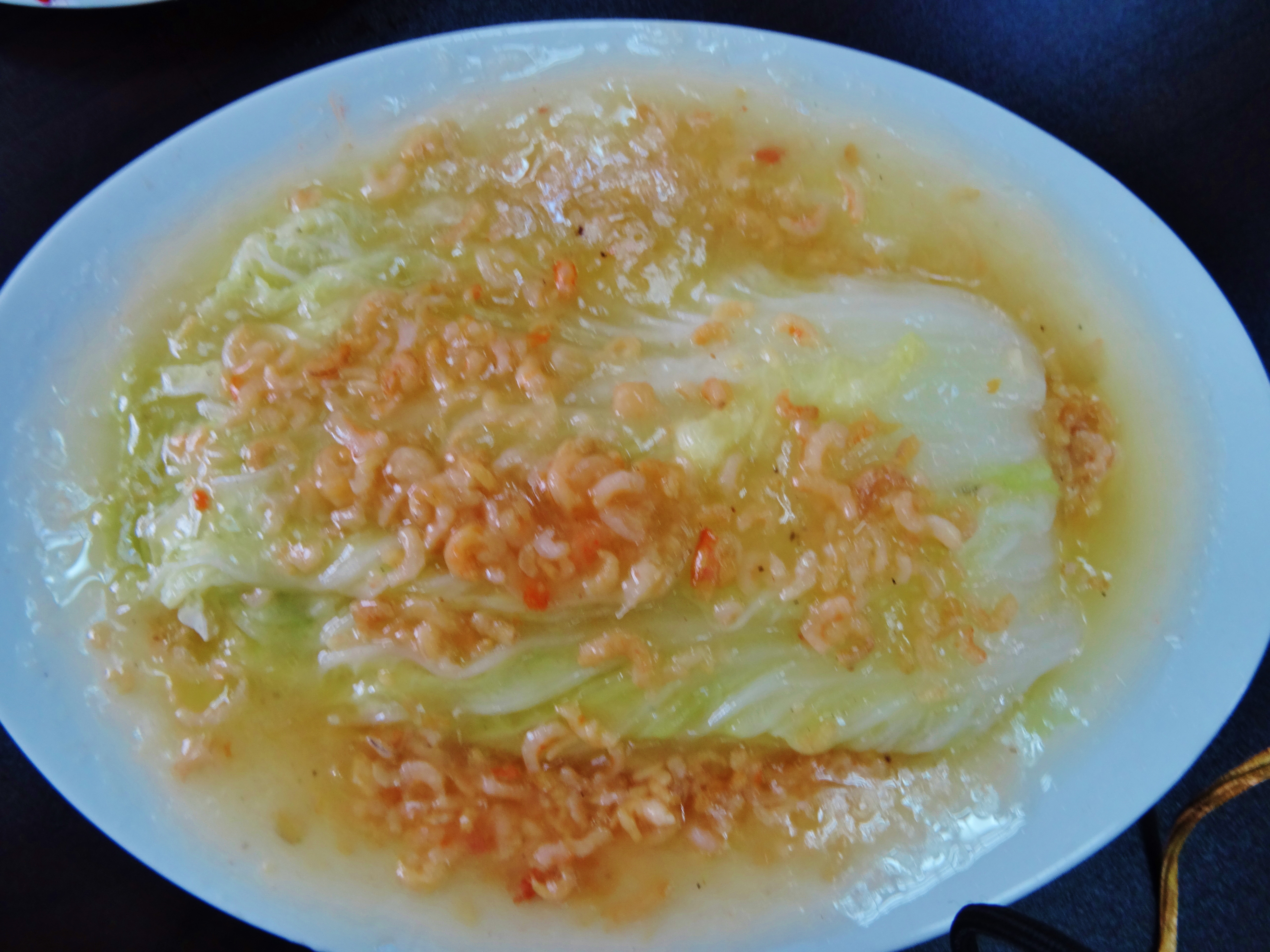 It has become sort of a joke with the Peace Corps staff with whom I often lunch. When someone asks what do folks want to eat, they all say “John wants something green.” It’s true. After two years in Bulgaria, where the only cooking greens were cabbage and spinach, I am reveling in the vast array of greens here in China. I always ask the servers what they have that is green. They look at me as though I’m crazy (that’s not how you ask that question, apparently), and then I start rattling off the names of the most common ones: xian cai (amaranth), weng cai (aquatic morning glory), jie cai (Chinese mustard greens), bai cai (Chinese cabbage), kui cai (mallow greens), you cai (rape greens), or qing cai (turnip tops), until they recognize something I’m saying. They always have at least one. You will note that I have not put the all-important tone marks on those words – there are four ways to pronounce any syllable. Depending on the tone, cai can mean a multitude of things: talent, just, gather, step on, and, most importantly, as cài (fourth tone, a sharp falling tone from sol on the musical scale quickly down to do on the scale, as though you were angry), it means not only “vegetable,” but also “food.” Tone is very important, but context even more so. Obviously when ordering in a restaurant, they will know I’m saying “amaranthus” when I say “xiàncài,” even though xian has as many meanings as cai. And those aren’t even my favorites. I love chrysanthemum greens (edible crown daisy greens, tong hao) tossed in sesame oil and pea shoots (wan dou miao) quickly wilted with garlic. But, again, I digress. What Driver Liu served us was one big bai cai (Chinese cabbage, literally, “white vegetable,” above). It was one of the best dishes, I thought, however difficult to grasp with chopsticks. When I asked him if he would let me watch the next time he cooks it, he seemed a bit disappointed that I chose a dish that, according to him, “is very easy.” Easy to him means carefully removing the leaves one by one and selecting only the finest ones to cook, one at a time. The cabbage is re-assembled to look whole, and is served with an elegant sauce made from the best dried shrimp, called “golden hook shrimp” from their appearance.
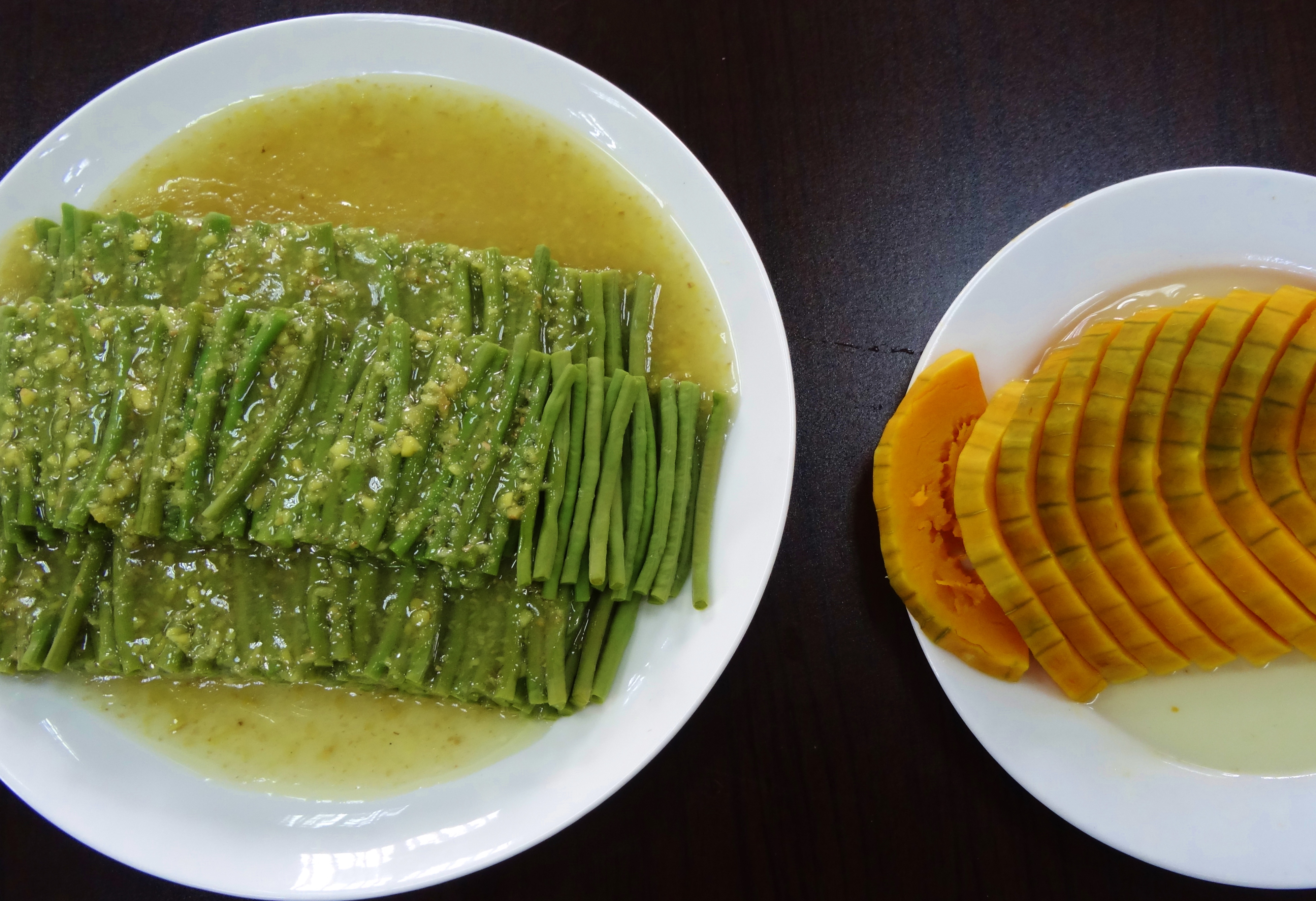
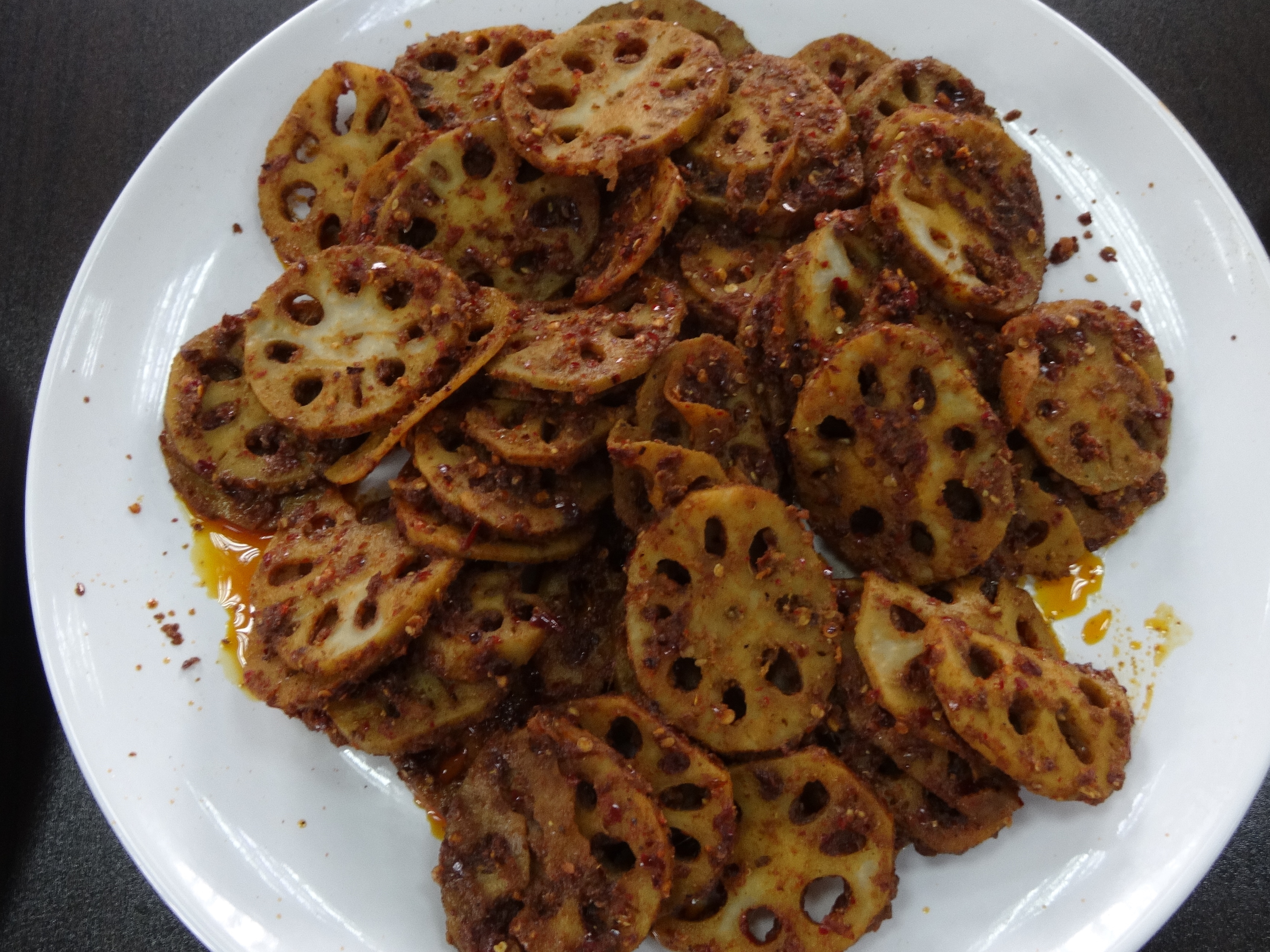
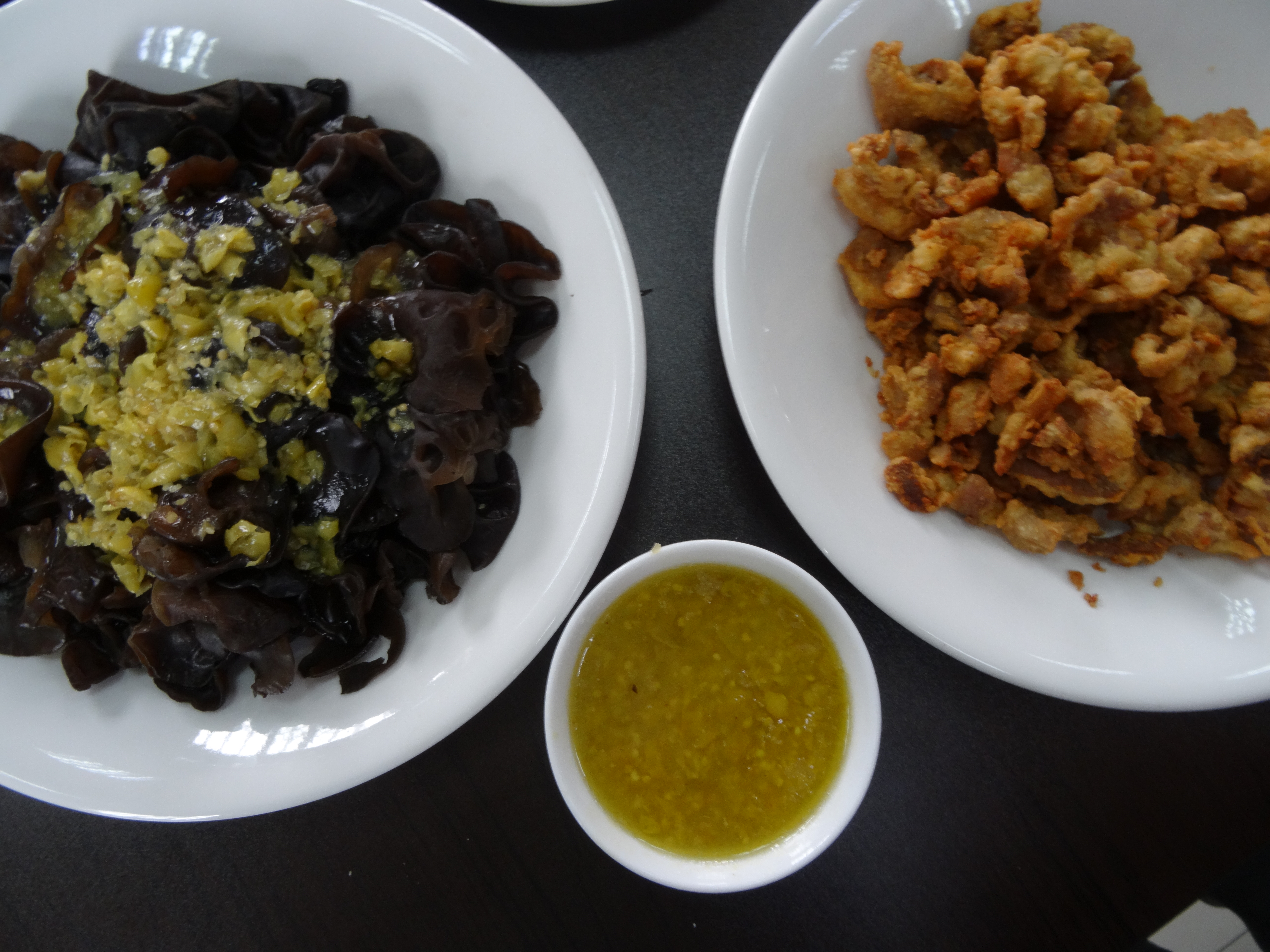
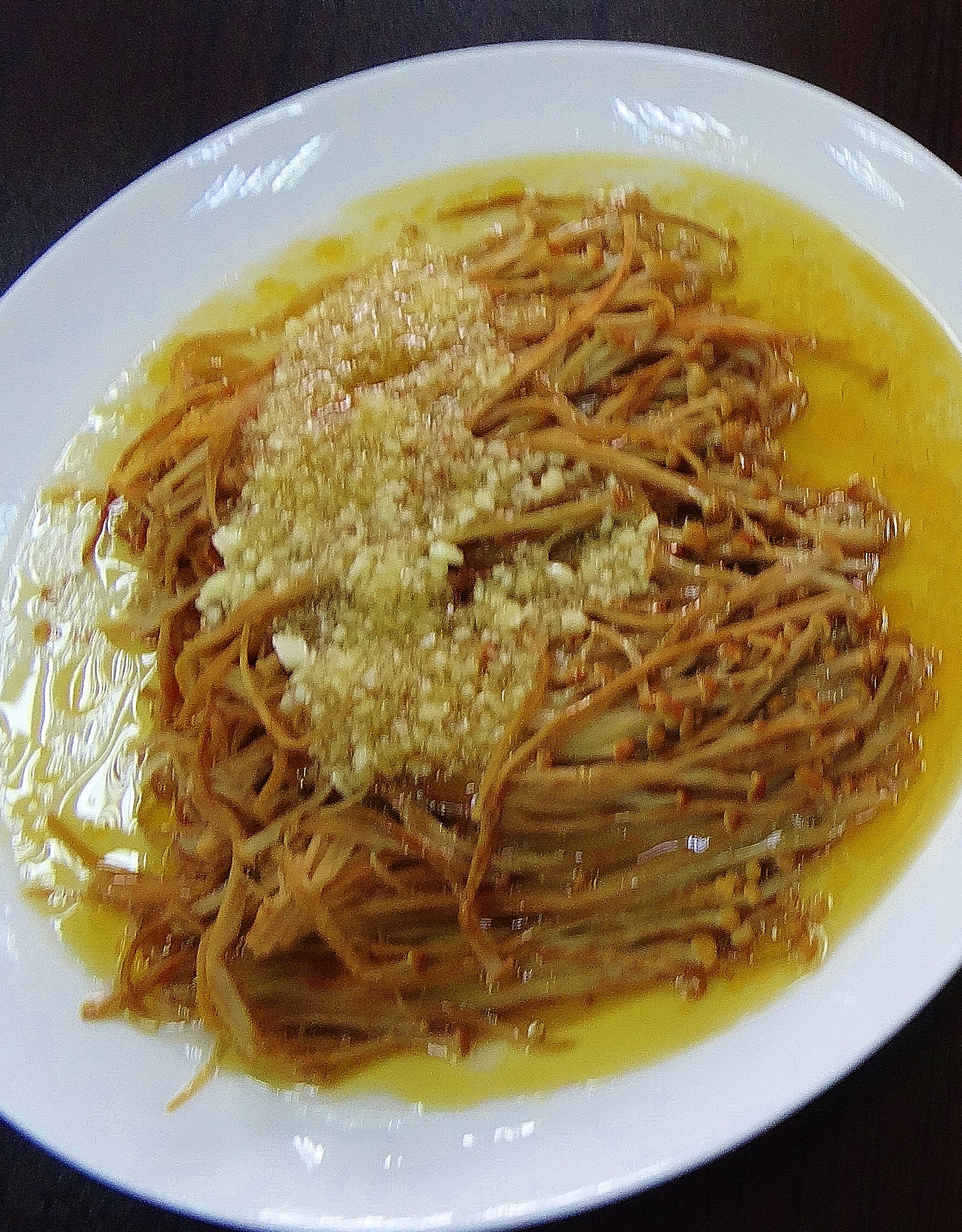
Yard long beans, which are neither related to string beans nor prepared like them, are actually closely related to blackeyed peas. Here, however, the pea is rarely allowed to form. Instead, the unripe pods are most often pickled (and served alongside bean dishes, the way I would serve piccalilli), or the beans are cut into tiny pieces and stir-fried. Driver Liu chose to cut the beans into 4-inch lengths and served them with a dressing of fresh ginger. String beans he cut into smaller bits and cooked with mushrooms and a finely textured hotdog-like sausage that is popular here. I didn’t taste that dish, but heaped my plate with the gingery yard long beans. Lotus root with cumin was a crowd-pleaser, pleasantly ma-la, with pinches of both sugar and MSG. Enoki mushrooms were prepared with roasted sesame oil; wood ears were served with a pickled green chili sauce. (Next to the sauce was a bowl of pork fritters, made from floured and spiced belly fat with no skin. I saw several people dipping them in the sauce as well.) A cucumber salad was refreshing (though even the salad vegetables are cooked first here, however briefly). Scallion-enhanced mashed potatoes were topped with candied fruit. And there was a fruit salad that included cherry plum tomatoes (which they are); peeled and sliced tomatoes were sugared, per tradition here.
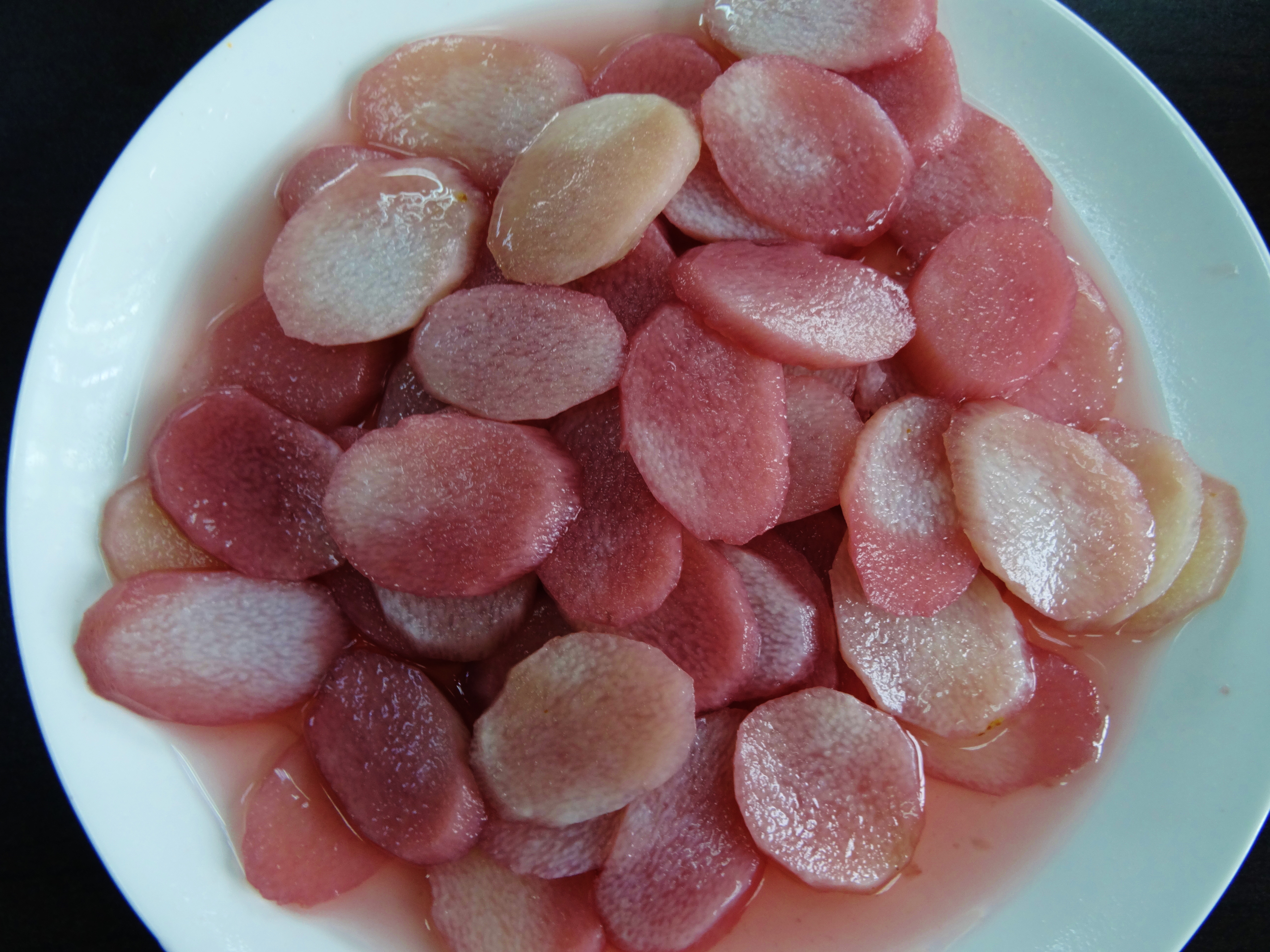
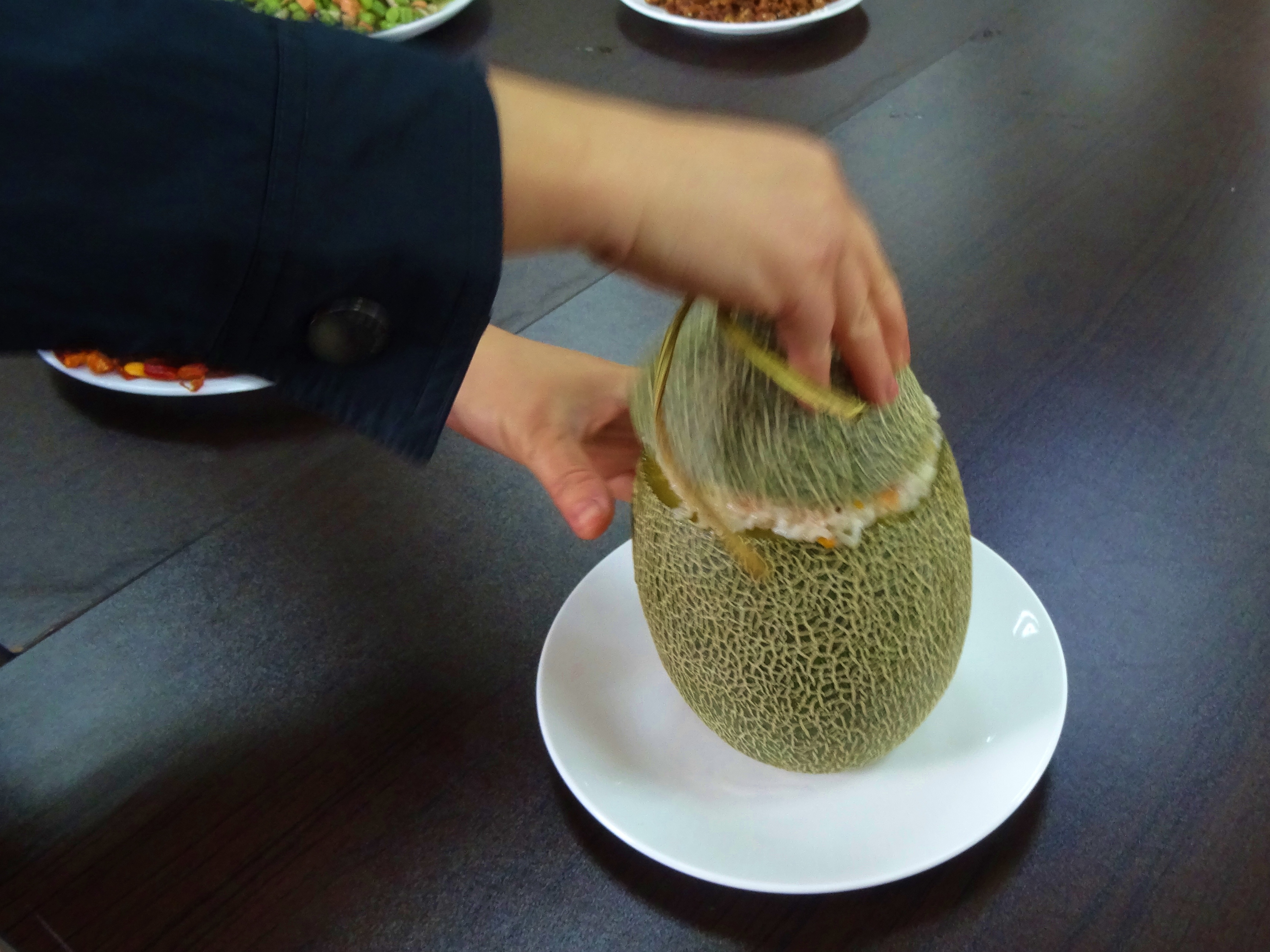
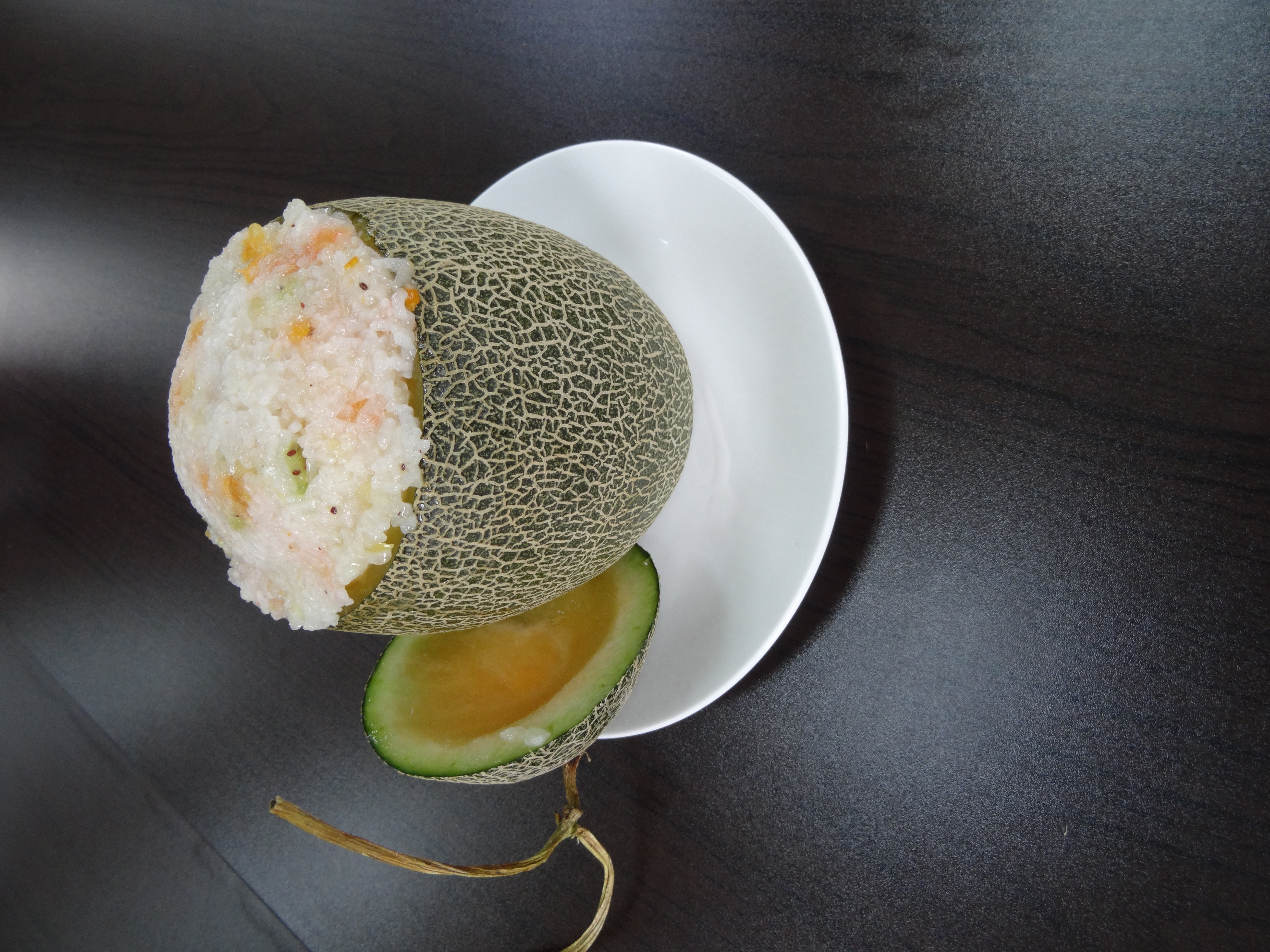 There were several sweet dishes. Mountain potato (shan yaò) is a type of yam (Dioscorea opposita) that he simmered in a sweet fruit syrup. I heard someone ask if they were pears. They were delicious. Pumpkin was also steamed with a topping of sugar until al dente, sliced, and served plain, much the way we might prepare an acorn squash in the west. There was his dramatic version of the classic Eight-Treasure Rice Pudding, sticky rice cooked with exotic dried fruits and served in a hollowed melon,with bits of the fresh melon included. It was gone before I got a taste.
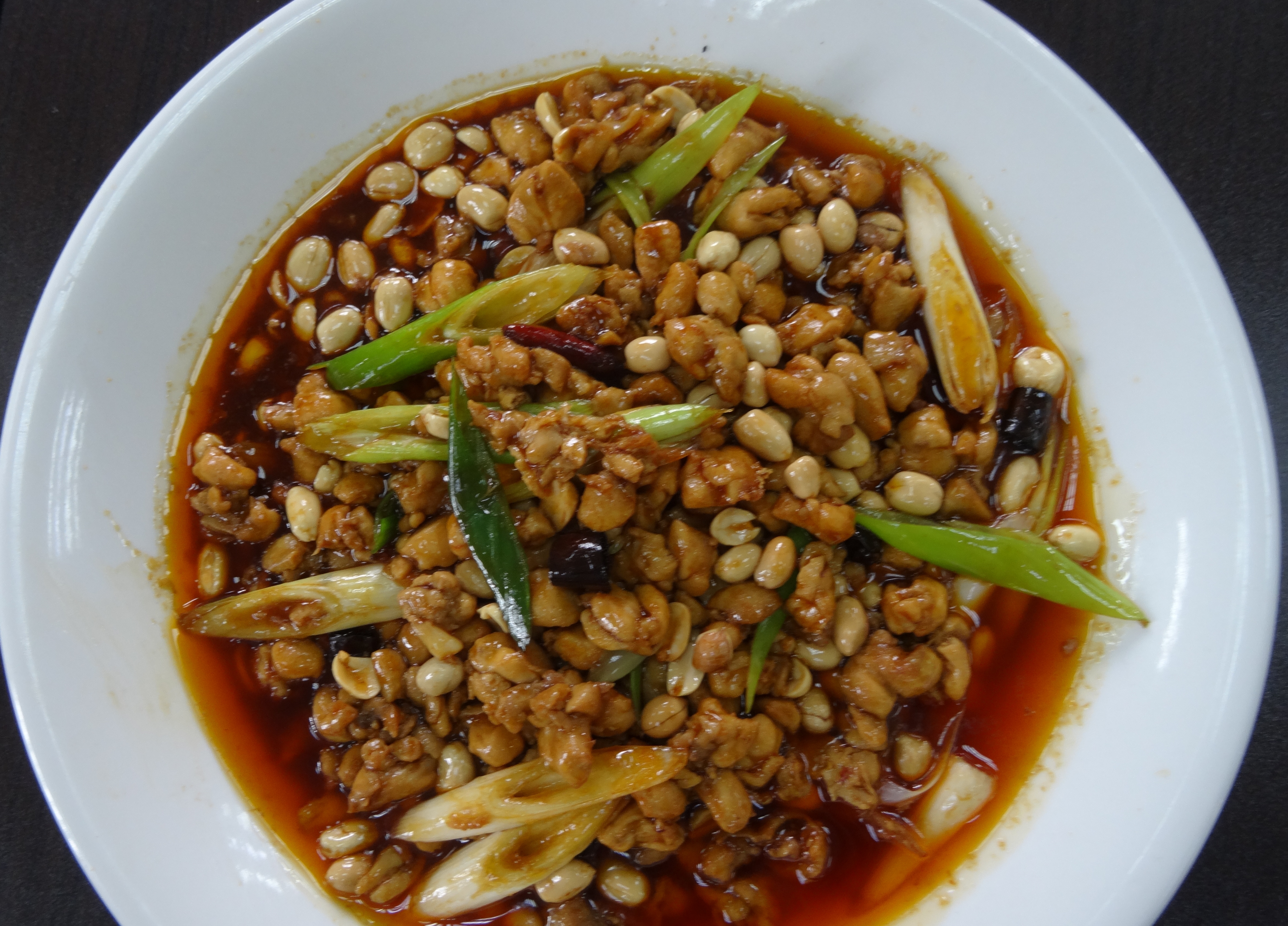 There was gong pao chicken (left), which, while found in Sichuan restaurants all over the world, rarely tastes right outside the region because the Sichuan peppercorns are often too old to bloom on the palate the way they do here. Oh, and there was, also per tradition, a soup pot, made with the broth from the pork bones, with cabbage added at the last minute. I was too full to try it. I’m sure it was delicious, like everything else. What’s really amazing about the meal was that Driver Liu did it all himself. At Yu’s Family Kitchen there were four or five people working in the kitchen. So here’s to you, Driver Liu!

That evening, I had invited Carrie and the rest of the American crew over for a casual dinner. I felt pretty ridiculous cooking after those two banquets, but I figured they might be hankering for a salad and something more familiar. We hadn’t had rice, other than the Eight Treasures, at either of the big meals, so I made it really easy on myself and made shrimp pilau (recipe appeared here on the blog) and cornbread. I harvested mesclun from my balcony and tossed it with roasted peppers and onions and made a bread pudding for dessert (recipe appeared on the blog on December 8, 2007). With Champagne, we had homemade gravlax (see July 22, 2008) and prosciutto and melon. Everyone was barefoot and relaxed. The next morning we went to see the pandas and put Carrie on a plane home. I know she had a great time here.