

Savannah, Georgia. September 15, 2015 The Nat Fuller Dinner piqued my interest again in all things lowcountry — especially since I have returned home after being away for 11 years. Recently I have been reunited with our stored goods, including my library and cookware. Among them I found this clay casserole that my mother bought in the Caribbean many years ago. My parents kept a sailboat on St Vincent in the Grenadines, and my siblings and I were lucky enough to sail with them to many islands, from the Bahamas to Grenada. I also lived in St Thomas for a year after graduate school, where I freelanced as a photographer, so I have long loved Caribbean fare. Prior to and after the ban on sea turtle meat in United States waters, I ate turtle steaks, soups, and stews, from Green Turtle Cay to Beguia. They were delicious.
It was in the Caribbean that I first began to understand the similar histories and cooking styles of island fare and lowcountry cooking. Living in Europe in the early 80s, I missed the food profoundly, even as I reveled in pesto in Genoa and morels in Paris. When I returned to Charleston in 1986 to open my culinary bookstore, I was already deeply immersed in researching the history of lowcountry cooking. Over and over again, turtles kept coming up in the older cookbooks and manuscripts. In Hoppin’ John’s Lowcountry Cooking (1992), I published the following:
Cooter Soup
Cooter, or turtle, soups are of three kinds: a rich turtle stock thickened with roux, a clear broth filled with floating pieces of the white flesh, and a thick chowder enriched with cream, wine, and eggs. All three follow the West Indian model, popular long before Carolina was settled, with hot pepper as seasoning. Cooter is from a West African word, kuta, for turtle. Recipes for turtle soup mean sea turtles. In the late eighteenth century, Charleston’s Henry Laurens sent sea turtles kept alive on purslane to clients in London. Purslane, or portulaca, is a common, low-lying succulent that is indigenous to the Lowcountry. It was widely used in salads during the time, but is as seldom seen today as these soups on the Lowcountry table.
The terrapin is the turtle of our brackish waters. Sometimes called Diamondback, it is the most common turtle found in soups. Farther inland, above the salt water line, chicken turtles, sliders, and snappers are all prized for their flavor by river folk. No matter which species is used, the female full of eggs is preferred for soups. The following Cooter Soup is from ORANGEBURG’S CHOICE RECIPES of 1948. Though Orangeburg, 70 miles inland, was never rice-growing country, it sits on the edge of one of the largest virgin cypress swamps in the world. A few people still grow small plots of rice for personal consumption in the low-lying corners of fields that abut those swamps. The lack of red pepper is geographical: away from the African influence of the coastal plantations, the Sandlapper palate is never as fiery.
Select a large, live, female terrapin — the rice fields variety being the best. Cut off head and remove shell. Dress by removing skin, intestines, and sand bag. Cut meat into cubes and place together with the eggs from the terrapin into a large pot. Add four quarts of water and bring to a boil. While slowly boiling, add two tablespoons salt, one-fourth pound of cubed salt meat and two tablespoons of whole allspice. Cook slowly for two hours. Just before serving, add one tablespoon black pepper, two tablespoons butter, one cup cream and one-half cup sherry wine. Thicken with two tablespoons browned flour. Strain and serve soup clear. Place one thin slice of lemon and one teaspoon sherry wine in each soup plate.
In the 80s when I was doing my culinary research, it was a new field and there was no internet. Now, it seems, everyone is a food blogger. Many bloggers and food writers claim to be historians and anthropologists. Though I’ve never thought that Googling was research, search engines are convenient tools for seeing what’s out there. Many sites have excellent recipes and practical information; others are scribed by widely respected historians, both academics and not. Some home cooks and gardeners share wisdom learned through years of practice. Victoria Rumble’s excellent Soup Through the Ages: A Culinary History with Period Recipes (2009), for example, has a thorough overview of turtle soup throughout history. Dr. Charles R. Foy of Eastern Illinois University is a scholar of Early America and the Atlantic with particular interest in the history of race and the maritime world. His Black Mariner Database (“BMD”) contains data on more than 25,000 18th century black mariners and maritime fugitives from throughout the Atlantic basin. He has written extensively about turtle soup on his blog. And there are other consummate researchers like my friend David S. Shields, who tirelessly shares his culinary finds from rare heirloom seeds to his in-depth analyses of the historical evidence. So midst the rants and porn and graffiti and politics online, there is also a wealth of information, some of it very-well researched. There are in-depth databases that are very helpful in sorting out complicated taxonomy, such as this one, which is one of my favorites, for Phaseolus names. There are remarkable videos and how-to instructions from practiced artisans. The Canned Quilter is the name of a self-proclaimed “farmwife” in Tennessee whose Hickory Holler blog shows explicit instructions for killing, butchering, and canning turtle meat.
Knowing I was researching turtle soup, David earlier today offered me a source for snapping turtles, highly esteemed for soup. Here’s how I replied:
Thanks, but I have no desire to clean a snapping turtle. I cooked some yellow-bellied sliders when I was working on my first book and it was a nasty job. I guess a snapper would be much easier, given that one snapper should do the job. Macky Hill and I always talked about making a turtle soup at Middleburg but it never happened. Too late for that now. I’m sure all I’d have to do is go to Richard Schulze’s alligator pond to find one… or, for that matter, to my mother-in-law’s pond in the PeeDee. The Nat Fuller dinner of course piqued my interest in all things lowcountry again, and then my treasure trove of books and papers and personal belongings arrived — most of which had been in storage for 4+ years — and I am finding all sorts of unfinished research. Of course what I really want to cook are diamond back terrapins, which are supposed to be the best tasting. The hunting regulations are vague, though.
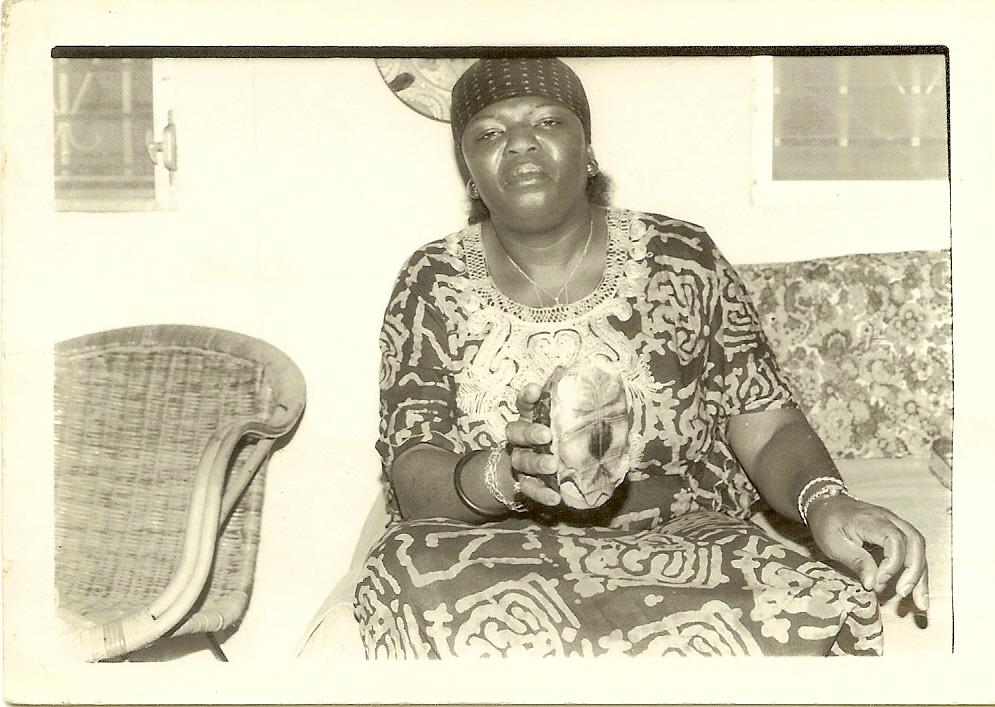
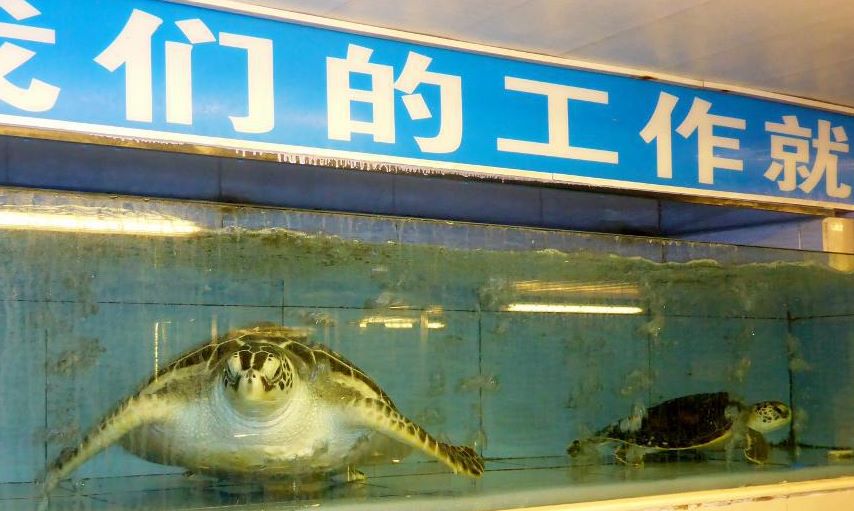 I saw every kind of turtle you can imagine in the Chengdu seafood market, including green sea turtles, which are protected worldwide. The World Wildlife Fund has an office in Chengdu and I reported them, but nothing was done. Also, here’s a photo of some turtles awaiting their fate at the world-renowned (justly so) Yu’s Family Kitchen….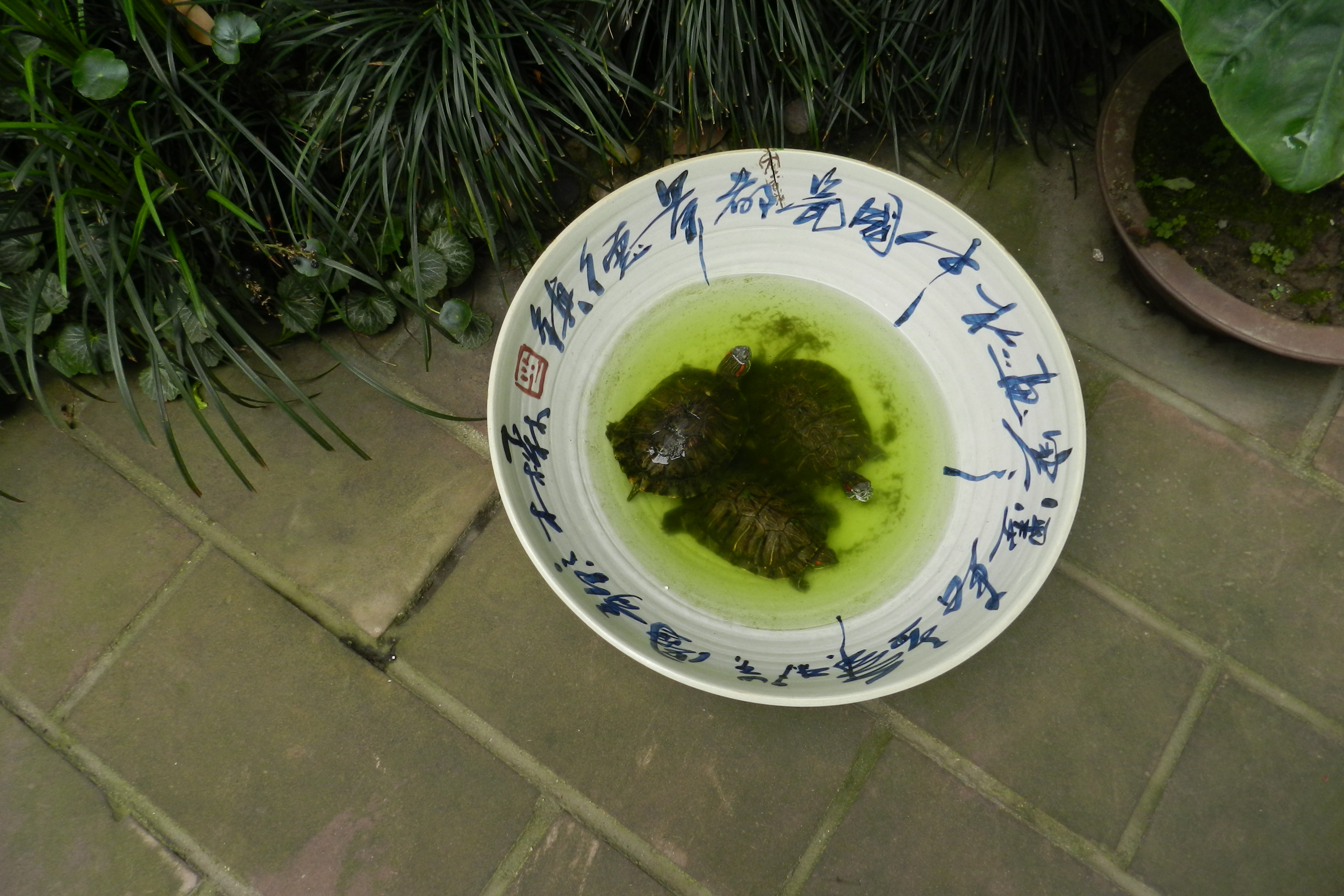
My major interest in food is very personal, not historical. I am amazed, however, at all that I can find online now — scholarly papers, practical information, recipes. I don’t consider online research as valid, but it does often reveal work that has already been done. So different from when I first started doing this.
_____________________________________________________________
Mama collected cookbooks from wherever she went. I inherited hundreds from her, many from the islands. There are versions of hoppin’ john on nearly every island. And recipes for sea turtle soups, stews, and steaks, though the turtles are now protected. It is said that each part of the turtle tastes different. Neck meat was the most desired; flippers were used for steaks. Its flavor is most often compared to veal. In the US Virgin Islands, the stew contained lime juice and sherry. A Bahamian soup contained tomatoes and salt pork. The Key West Cook Book, from 1949, has a turtle soup made with the meat from two flippers; it includes both potatoes and barley. Another is seasoned with ham, cloves, allspice, thyme, bay, and cayenne. Key West was a center for canned soup production. Turtle eggs were prized not only for food, but for cosmetics.
Cornelia Walker Bailey, on Sapelo Island on the coat of Georgia, has written, “When I was growing up sea turtle was not an endangered species. Sea turtle has a taste of every sort of meat there is. Part of it taste like a goat, part of it taste like a chicken, part of it taste like pork, all in one thing. And even the meat was different colors inside there, different textures. And they say the turtle carries around the meat of all different animals.”
In The Foods of Georgia’s Barrier Islands, she also wrote that the terrapin is a delicacy, a stew of which has “everything in it.” The terrapin of the salt marsh was one of the glories of the entire eastern seaboard. Soup Through the Ages, cited above, gives an excellent overview of the favored turtle soups of the English and American aristocracy through the ages; most of the recipes are similar, seasoned with sherry or Madeira. But some of Mama’s more contemporary books offer some surprises, such as 1958’s Food Favorites of Olde St. Augustine, which offers a “Soft Shelled Turtle Soup,” garnished with hard boiled egg, and lemon slices “sprinkled with nutmeg.”
I was a bit surprised by the great Alan Davidson’s statement in North Atlantic Seafood (1979): “It was a tempting idea to include the diamond-back terrapin of the eastern seaboard of the United States, but this is a creature of the salt marshes rather than the sea.” In a later printing of his earlier Mediterranean Seafood (originally published in 1972), he wrote, “In general, sea turtles require and receive protection….So one should not think of catching it for food. In the first edition of this book I indicated that a limited dispensation might be made for any of my readers so unfortunate to suffer simultaneously from dandruff, chronic toothache and shortness of breath. I commented that: ‘Such a one would command understanding and sympathy if, in accordance with the prescription of the elder Pliny, he first helped himself to a small quantity of the sea turtle’s blood, smearing some on his scalp and some on his teeth and consuming the rest with barley to improve his breathing.’ However, circumstances and attitudes change, and sufferers from the afflictions mentioned should no longer even think of seeking remedies in this way.” Lastly, in his Seafood of South-East Asia (1976), while recommending conserving the creatures rather than eating them, he wrote, “their eggs are prized as food and the calipee (that part of the flesh which is next to the lower shell) of the Green turtle is in demand for turtle soup, so they must have a place in this book. Besides, there are developments in turtle ‘farming’ which may lead to a situation in which we could eat at least some sea turtles and their eggs with a clear conscience.”
Farming of sea turtles has not been successful. The Cayman Turtle Farm was supposedly the last on earth farming them for human consumption. It is now a conservation facility and tourist attraction but it is still pressured to close by conservation groups. There were two others; one closed, the other became and aquarium. With all the turtle farming in Asia, I would be surprised that there aren’t other facilities raising sea turtles, particularly along the coasts of Vietnam and Cambodia.
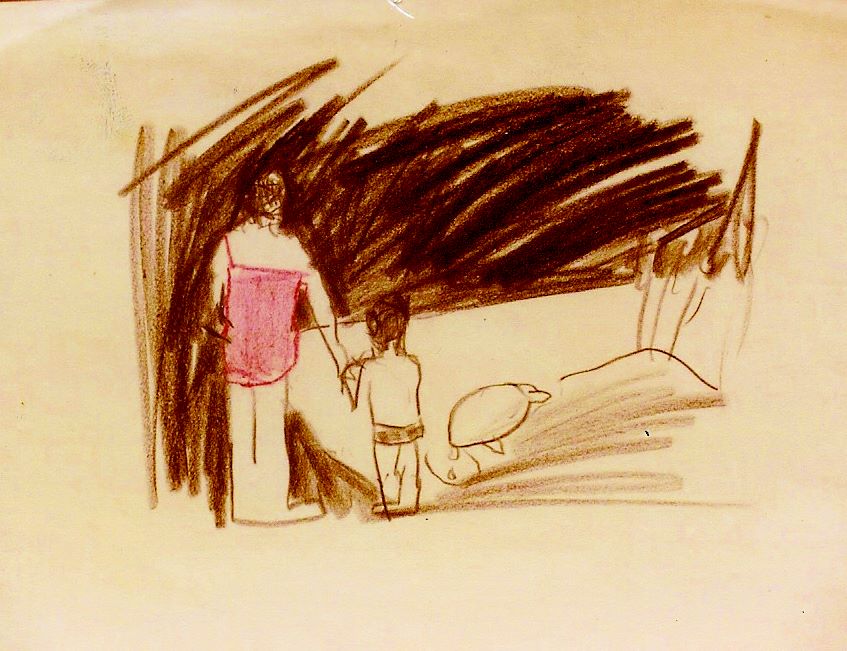
My mother worshiped sea turtles. She didn’t buy that pot to cook turtles in. She bought it because she loved turtles and bought anything that was turtle-shaped or -themed: books, jewelry, flower pots, place mats. As she lay dying in 1982, she gave me her copy of Time of the Turtle, by Jack Rudloe. I remember staying up all night reading about the magnificent sea turtles that have, for 175 million years, somehow managed to rise up from the sand, crawl to the sea, migrate thousands of miles and return years later, when mature, to lay eggs again in the same sand. Once when I was very young, she took me on the beach at Edisto and showed me a female turtle laying her eggs. We watched her with a flashlight for what seemed like hours to me at the time. The poor mother turtle looked exhausted when she finally laid the last egg and she lumbered back to the sea. I remember Mama telling me that raccoons would probably get most of the eggs. Years later, I was talking to a friend and I illustrated my story with this drawing. By then, I had helped hatchlings rush to the sea, scaring away the gulls that swoop down and pick them up like so many bread crumbs.