
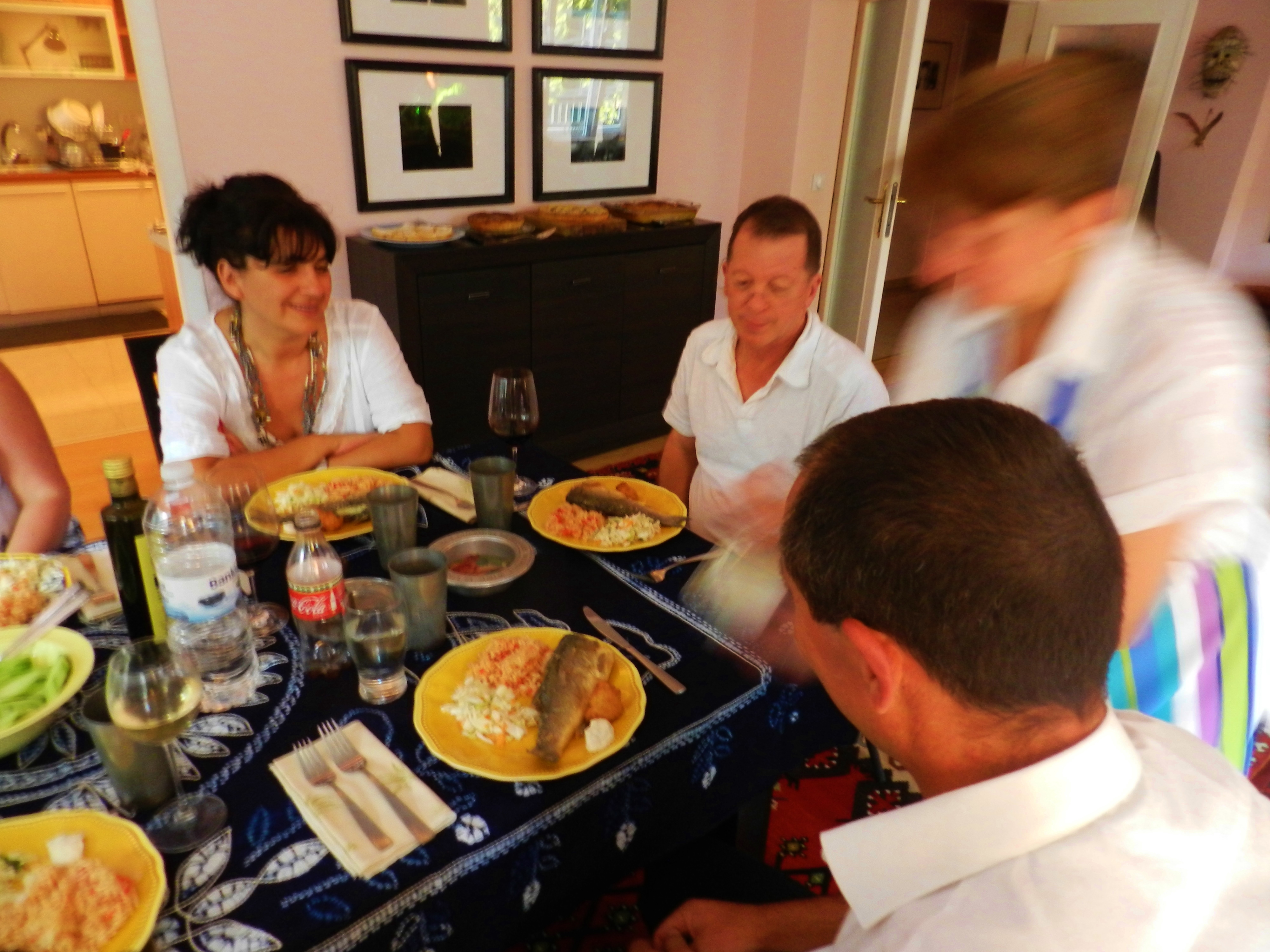
June 16, 2014 Chengdu, China It’s been five years since I last posted a fish fry — ironically, on Father’s Day! The recipes stay the same, but they bear repeating. The results are never the same. When I worry that I might be repeating myself on the blog after so many years, I am reminded of Andy Warhol, who made tons of money repeating images over and over. He’s often quoted about repetition and many of his quotes contradict earlier ones attributed to him. He once said, “Isn’t life a series of images that change as they repeat themselves?” I know this fish fry here in China was very different from ones I’ve had before. In Bulgaria, the first big dinner party I did was for the Peace Corps drivers and their wives. I had the brilliant Emilia Tsvetanova to help me, and I am amazed when I look back at the photos and see groaning boards of appetizers and desserts. (Of course, that was prior to my knee surgery!) I also had a Greek fishmonger who had someone drive the fresh fish up from Thessaloniki (only three hours away) the morning of the meal. Here in China I buy live, farm-raised fish from a reputable farm, and have them clean the fish for me (scaled, gutted, the gills removed, but the heads intact). I can see in this photo from Bulgaria three years ago that the menu is basically the same thing I served to the Peace Corps staff here on Saturday: fish and hushpuppies, Moravian cole slaw, red rice, and cornbread.
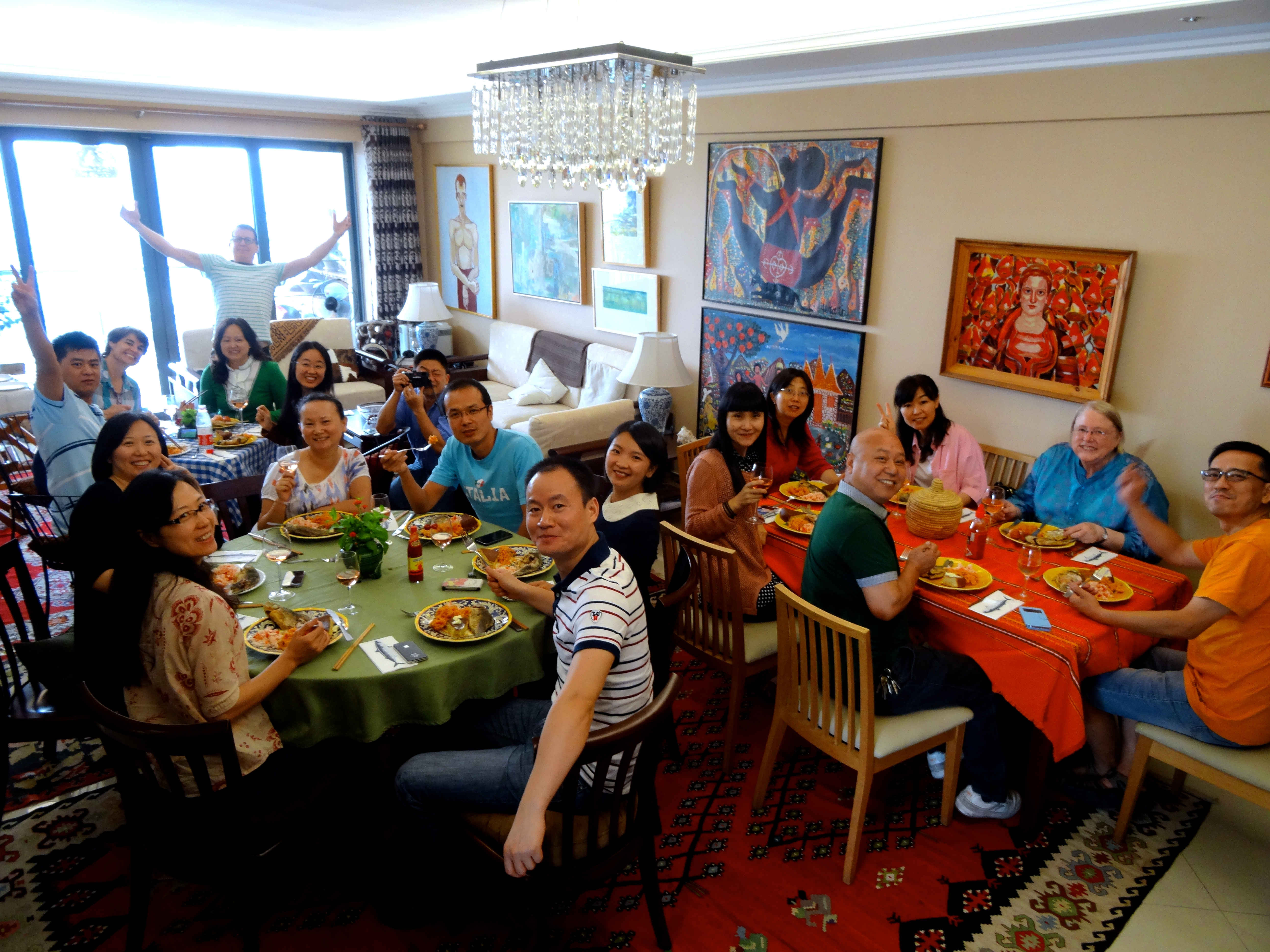
I wondered if they would like the red rice; it’s so different from the plain white rice that is ubiquitous here. I shouldn’t have worried: they are NOT picky eaters and they are very interested in American culture, especially our culinary traditions (though many of them have some very stereotyped views of us as a nation of McDonald’s eaters). They are not, as a rule, wine drinkers, but you never would have known it to see them down a case of Provençal rosé! They went wild over the hushpuppies, but it was the peach cobbler that they kept putting in doggie bags (“for my granddaughter”… “for my son”… yeah, right!). They refuse to admit that they have a sweet tooth, but it’s a profound one. It’s true that dessert is not a regular feature of meals here in Sichuan, but they eat amazing amounts of candy and cookies and even their “whole wheat bread” and yogurt are sugared.
They are a lovely group of people and we had a blast, but I have to admit that I think that I’m getting a little old for this sort of affair! The shopping is the worst part, because I have to go to several different places to find the ingredients I need. I only just this week found yogurt with no sugar for the cornbread. Though I rarely pay more than $2 for lunch, a 500ml carton of yogurt (it’s liquid) cost 30 kuai ($5)! Worth every penny not to have sweet (what I call “Yankee”) cornbread.
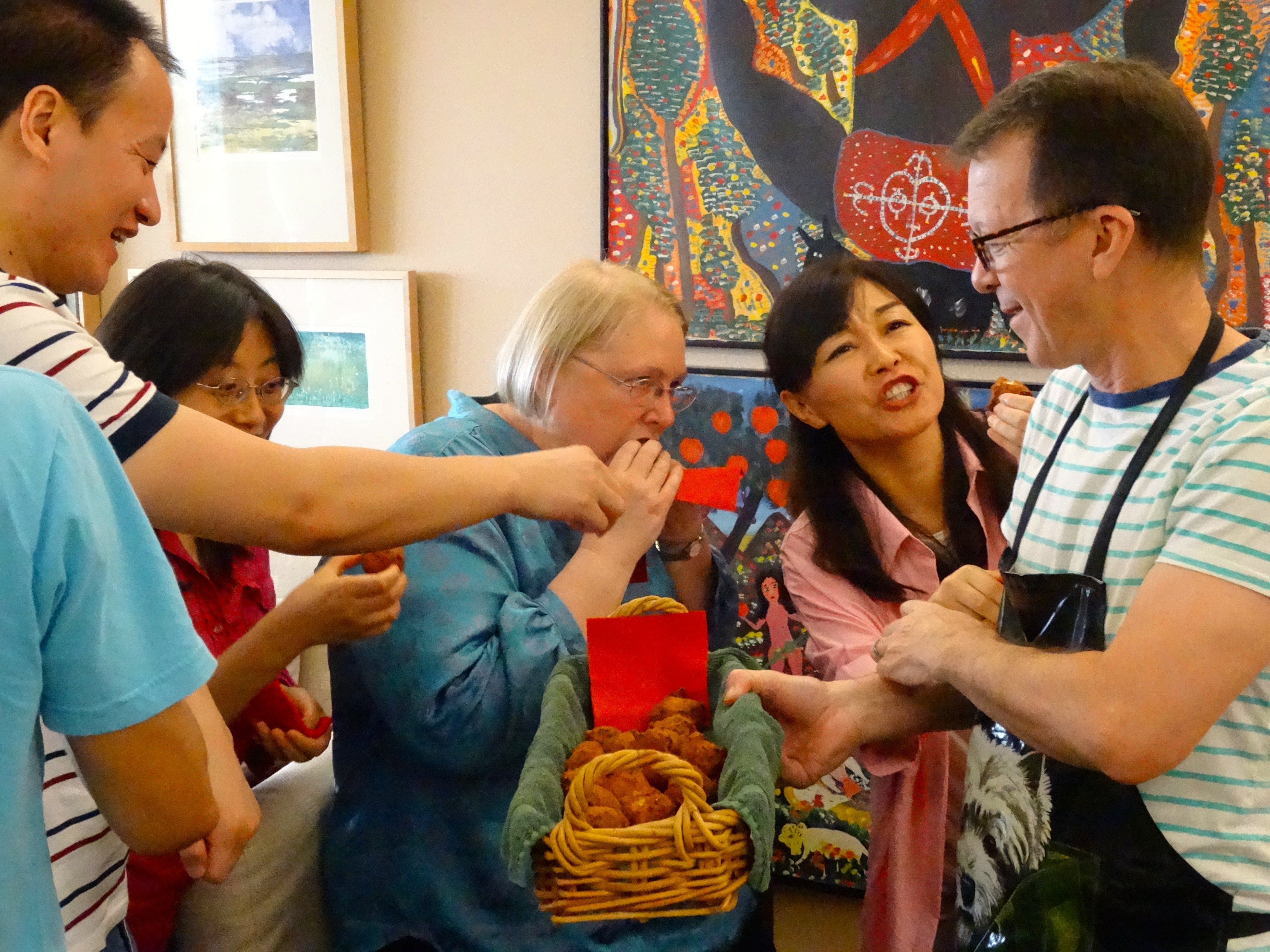
To make this meal, I suggest that you begin several days in advance. Our party was on Saturday, so I made the cole slaw on Wednesday (it lasts forever). On Thursday I went to several fish markets to check out the best selection for what I wanted to do. I also bought the wine that day and put it in the refrigerator to get cold. I went ahead and set the tables up (I had to use some of the patio furniture). That alone took a couple of hours. On Friday I hired a driver to take me shopping. I took a cooler with me and had them put the cleaned fish on ice in it. I set up the bar with glasses and corkscrews and water containers and made the peach cobblers. I also did a test run of heating oil in a big pot on a hot plate, because I wanted to fry the fish outdoors. So far, so good.
On the day of the party, I began heating the oil outdoors, but it would never get hot enough, so I tried another pan that conducts heat better. No go. I had to move the frying indoors, which meant rigging a system to keep the pot of two gallons of hot oil from moving around on one of the two burners I have, both of which are designed for woks, not flat-bottomed pots! What a nightmare! On the second burner, the red rice. 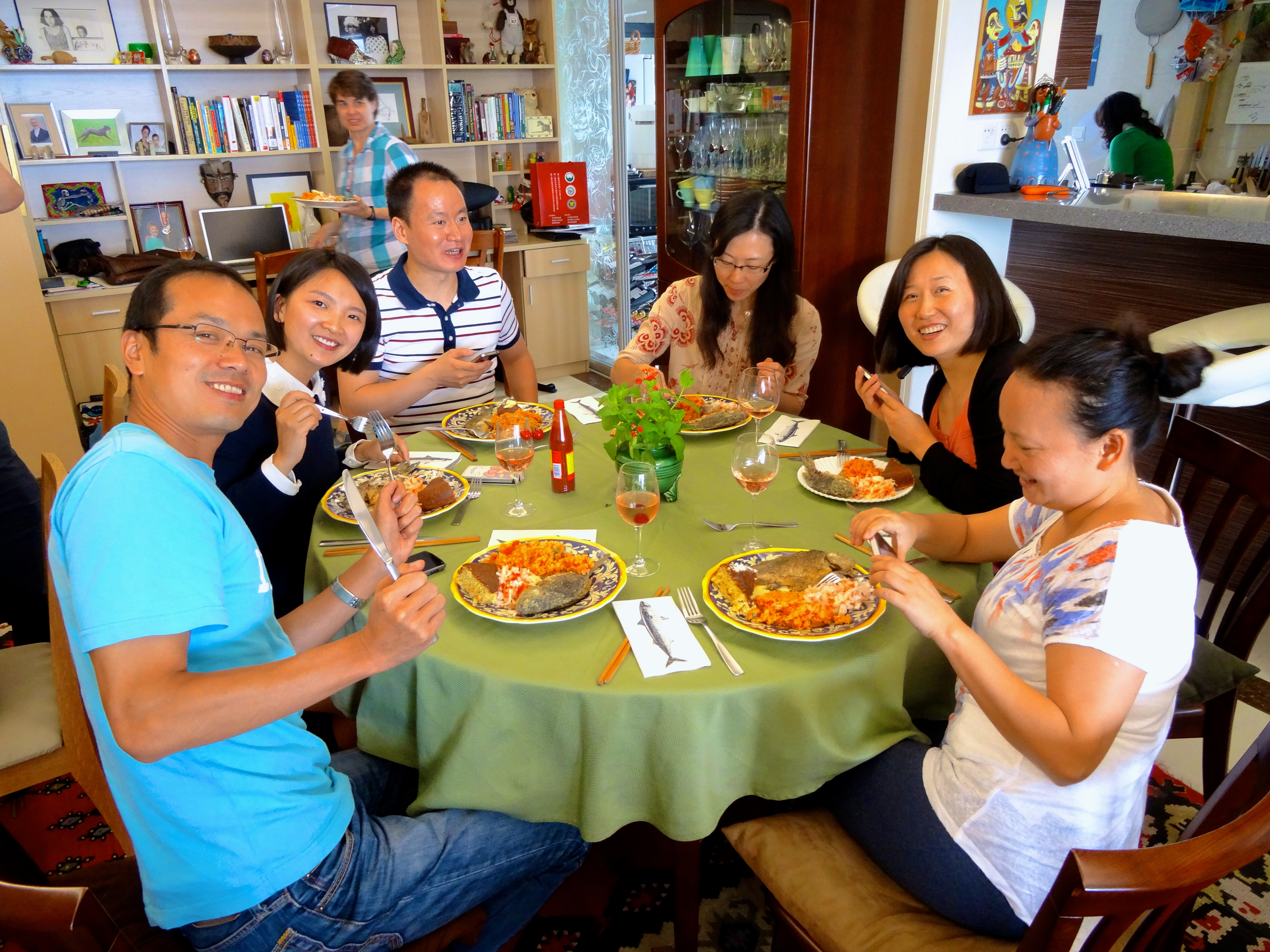 The fish came out of the cooler, new ice went in, and the wine went in the cooler.
As I fried the fish, I removed them to racks in a portable electric oven to keep warm. It was time for my guests to arrive. I began making the cornbread in the oven, and frying hush puppies to keep the hungry mob at bay. When the cornbread and rice were ready, I turned off the ovens and slipped the three cobblers in to warm up while we had lunch. Everyone had a great time and even Driver Liu, an accomplished chef (whom I have written about before here), not only took cell phone photos, but also asked for a doggie bag! I knew I had
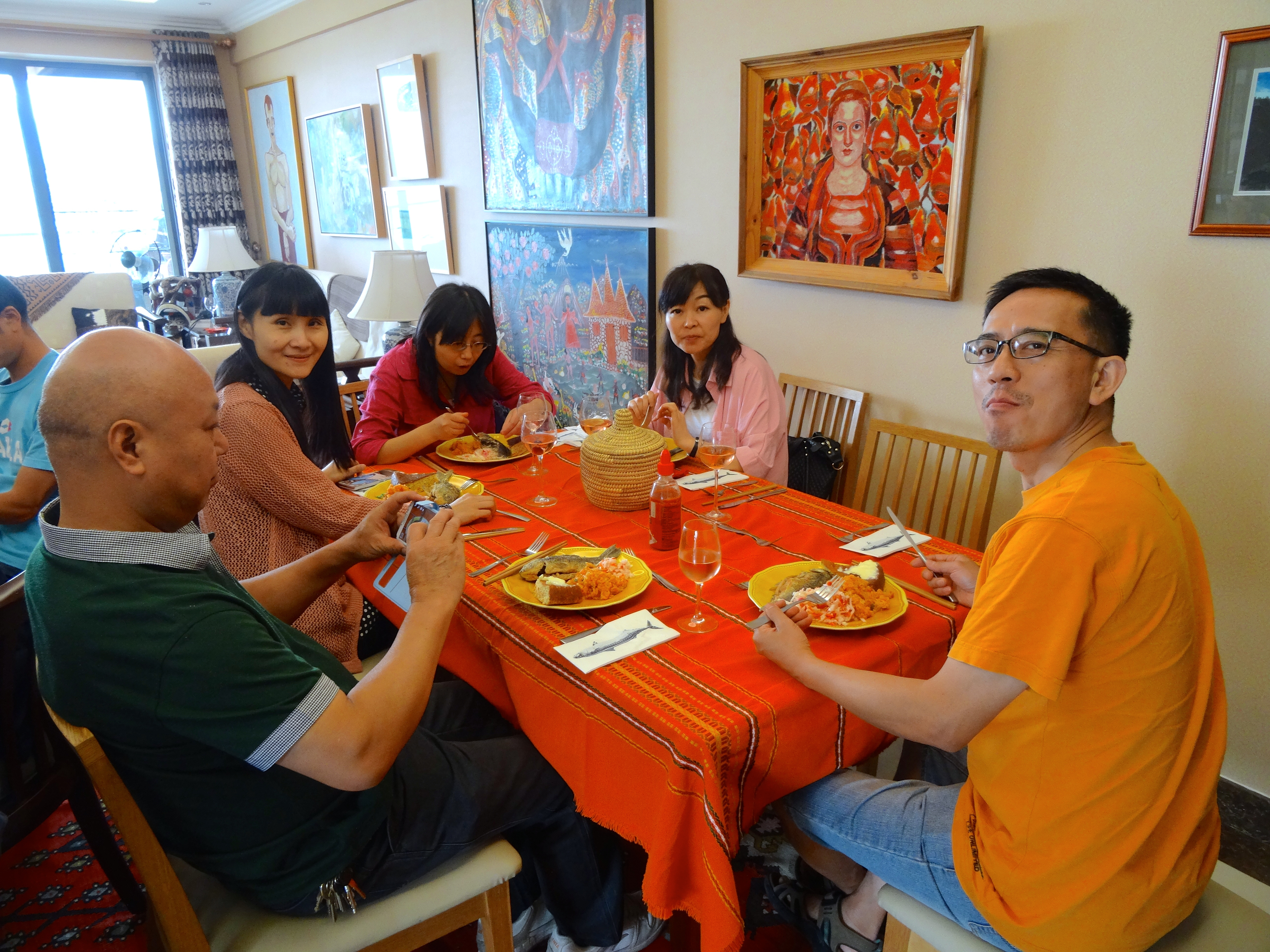
done well when that happened!
They stayed 5+ hours. I never sat down. I really am too old for this!
Here are the recipes. Most have appeared on the blog before, but Andy and I think they bear repeating, again:
Southern Fried Fish and Hushpuppies
This is one of the easiest and most basic of all fried fish recipes. What makes it southern is the the use of corn flour – a very finely ground cornmeal — and the addition of hushpuppies. In West Tennessee and throughout the Mississippi River delta, catfish are prepared like this. Throughout the region, other freshwater fish such as bream (pronounced “brim”), bass, and crappie are fried with this simple dusting of seasoned corn flour, which produces the crispest crust. Saltwater fish such as whiting are also fried in this manner, but wheat flour is usually used. Along the Gulf of Mexico, the fish is likely to be dipped first into an egg wash before coating, but there’s always some cornmeal or corn flour close at hand for hushpuppies. This is the southern version of a fish fry. It serves 8 people.
Corn flour is the finest grind of cornmeal; in Louisiana it’s called “fish fry.” If you can’t find it, you can make your own by grinding cornmeal more finely in a blender or food processor. I have whole-grain cornmeal and corn flour ground for me in the mountains of Georgia. (See link above.)
For the fish:
Peanut oil for frying
1 1/2 cups corn flour, more or less, preferably stone-ground (see above)
1 teaspoon salt
1/2 teaspoon freshly ground black pepper
1/4 teaspoon cayenne, or to taste
3 pounds small cleaned fish or fillets, preferably freshwater catfish or sunfish
For the hushpuppies:
1 large egg
2 cups buttermilk
1-3/4 cups stone-ground whole-grain cornmeal (see above)
1/2 cup minced onion
1 teaspoon salt
Pour oil to a depth of at least 1 1/2 inches in a stockpot or Dutch oven and heat over medium-high to 375°. Preheat the oven to 200°. Place a wire racks on 2 baking sheets and set aside.
In a wide bowl, mix the corn flour, salt, pepper, and cayenne. In a medium-size bowl, prepare the hushpuppy batter. Mix the egg and buttermilk well, then stir in the cornmeal until well blended. Add the onion and salt and stir in. Set aside while you fry the fish.
Dip each fish or fillet in the seasoned corn flour, coating it all over but shaking off any excess. Carefully lower each piece into the hot oil. Fill the pot, but do not crowd it. The oil should bubble up around each piece of fish. Monitor the temperature closely so that it stays between 365° and 375°. Fry the fish until it is golden all over, turning the pieces if necessary. It will take 2 or 3 minutes on each side, depending on the size of the pieces. Set aside the remaining cornflour.
Remove the fish from the oil in the same order that they were immersed, using a wire mesh strainer, tongs, or any tool that will allow you to hold it over the pot as excess grease drains back into the pot. When the fish stops dripping, immediately place the pieces on the prepared baking sheet, then place in the oven.
Always wait for the oil to reach the proper temperature again before adding more food to the pot. Continue frying until all of the fish is fried, then proceed with the hushpuppies:
Add the remaining seasoned corn flour to the hushpuppy batter a little at a time, mixing well as you go, until the batter is thick enough to be spooned. You will have added about 1/4 to 1/2 cup of the corn flour.
Make sure that the oil has returned to 375°, then drop the batter by spoonfuls into the hot oil, using 2 teaspoons: one to scoop up the batter and the other to scrape it off and into the oil. Fry the hushpuppies until golden brown all over, about 3 minutes, again carefully monitoring the temperature of the oil. Drain each pup well over the pot as it is removed from the oil, then place on the prepared sheet pan. You’ll probably not have to put the hushpuppies in the oven with the fish to stay warm because your guests will be picking at them. Besides, they stay warm a fairly long time, and there are plenty to go around. Repeat the process until all the batter is fried. Serve the fish and hushpuppies immediately with cole slaw.
48 hushpuppies
Red Rice
It has been said that to know Charleston is to know rice, and this simple tomato pilau — pronounced PERloe, PiLOE, and PERloo — is one of the classic dishes of the old city of rice planters. Charleston cooks make this with beautiful, local vine-ripened tomatoes, available throughout the summer and fall. In winter months, you may be better off using canned. An adulterated version including tomato paste appeared in the Junior League’s Charleston Receipts of 1950. This older, simpler version is truer to the original “receipt,” as recipes are still called in Charleston, with olive oil replacing the traditional bacon.
3 tablespoons olive oil
2 cups long-grain white rice
2 cups vine-ripened tomatoes, peeled and chopped, or 1 can crushed tomatoes (14 1/2-ounces)
1 1/2 teaspoons salt
1 quart chicken stock, preferably homemade
2 to 3 tablespoons fresh chopped parsley
Place the oil in a stockpot over medium-high heat, add the rice and sauté, stirring constantly. It will begin to turn white after a few minutes; do not let it scorch or brown. Add the tomatoes and continue to sauté until most of the liquid has evaporated. Add the salt and the stock and simmer slowly, covered, for 30 minutes or until the rice is tender. Remove from the heat and allow to sit for a few minutes. Just before serving, fluff the rice with a large fork as you fold in the chopped parsley. Serve immediately.
Serves 8
Moravian Cole Slaw
The lowcountry has as many recipes for cole slaw as it does for shrimp. This one, with no mayonnaise, can be made well in advance. It will keep for a long time and should be made at least 24 hours before you plan to serve it. Serve the slaw with a slotted spoon to drain off the liquid. If you want it to include mayonnaise or other seasonings, add them just before serving. It’s delicious as is.
1 1/2 cups water
1 1/2 cups white vinegar
1 cup sugar
1 head of green cabbage (2 to 3 pounds), grated
2 medium red onions, finely chopped
1 bell pepper, finely chopped
1 carrot, peeled and grated
1 tablespoon salt
1 tablespoon mustard seed
Bring the water, vinegar, and sugar to boil in a saucepan, then set aside to cool. Pour over the remaining ingredients, mix well, and refrigerate for at least 24 hours before serving.
Serves 12
Peach Cobbler
This is a favored southern dessert, often called “cup o’, cup o’, cup o’,” for its simple batter of 1 cup milk, 1 cup sugar, and 1 cup flour. It is utter simplicity to make. Use perfect summer peaches, or, as we did for this springtime luncheon, frozen ones. If you use frozen peaches, you can thaw them in a microwave, adding a little sugar and lemon juice to encourage juiciness.
You can serve this cobbler hot from the oven, warm, or at room temperature. Offer some heavy cream, crème fraîche, or vanilla ice cream with the dish if you wish.
1/4 pound (1 stick) unsalted butter
2 to 4 cups peeled and sliced peaches with juice
1 cup sugar
2 teaspoons baking powder
1 cup all-purpose flour
1 cup milk
Put the butter in a 2-quart casserole dish, place in a cold oven, and preheat to 350°. If the peaches aren’t juicy, sprinkle them with some of the sugar and set aside.
Sift the sugar, baking powder, and flour into a mixing bowl, add the milk, and mix until well blended. When the butter has melted and the oven has reached 350°, pour the batter evenly into the casserole. Add the peaches and their juice, distributing them evenly but keeping an outer edge of batter. Return to the oven and bake for about 1 hour or until the top is golden brown.
Serves 4 to 8
Cornbread
This is the best cornbread you’ll ever eat — truly southern, with no wheat flour or sugar, baked in a sizzling hot cast iron skillet seasoned with a little bacon fat for that golden brown crust. It will be infinitely better if you use whole-grain, stone-ground cornmeal (see Source for corn flour, above).
You will need a 9- or 10-inch, well-seasoned, never-washed cast iron skillet for this recipe.
1 1/2 to 2 teaspoons strained bacon grease
1 large egg
2 cups buttermilk at room temperature
1 3/4 cups cornmeal, preferably whole-grain, stone-ground
1 scant teaspoon salt
1 scant teaspoon baking powder
1 scant teaspoon baking soda
Add enough bacon grease to the skillet to coat the bottom of the pan, then put it in a cold oven and preheat to 450°. In the meantime, mix the egg into the buttermilk, then add the cornmeal and mix well.
When the oven has reached 450°, after about 10 minutes, the grease should be just to the smoking point. Quickly stir the salt, baking powder, and soda into the batter and add the batter all at once to the hot pan. Bake for 15 to 20 minutes, or until the top just begins to brown. Turn the bread out onto a platter and serve hot with lots of butter.
Makes 8 to 10 slices to serve 6