
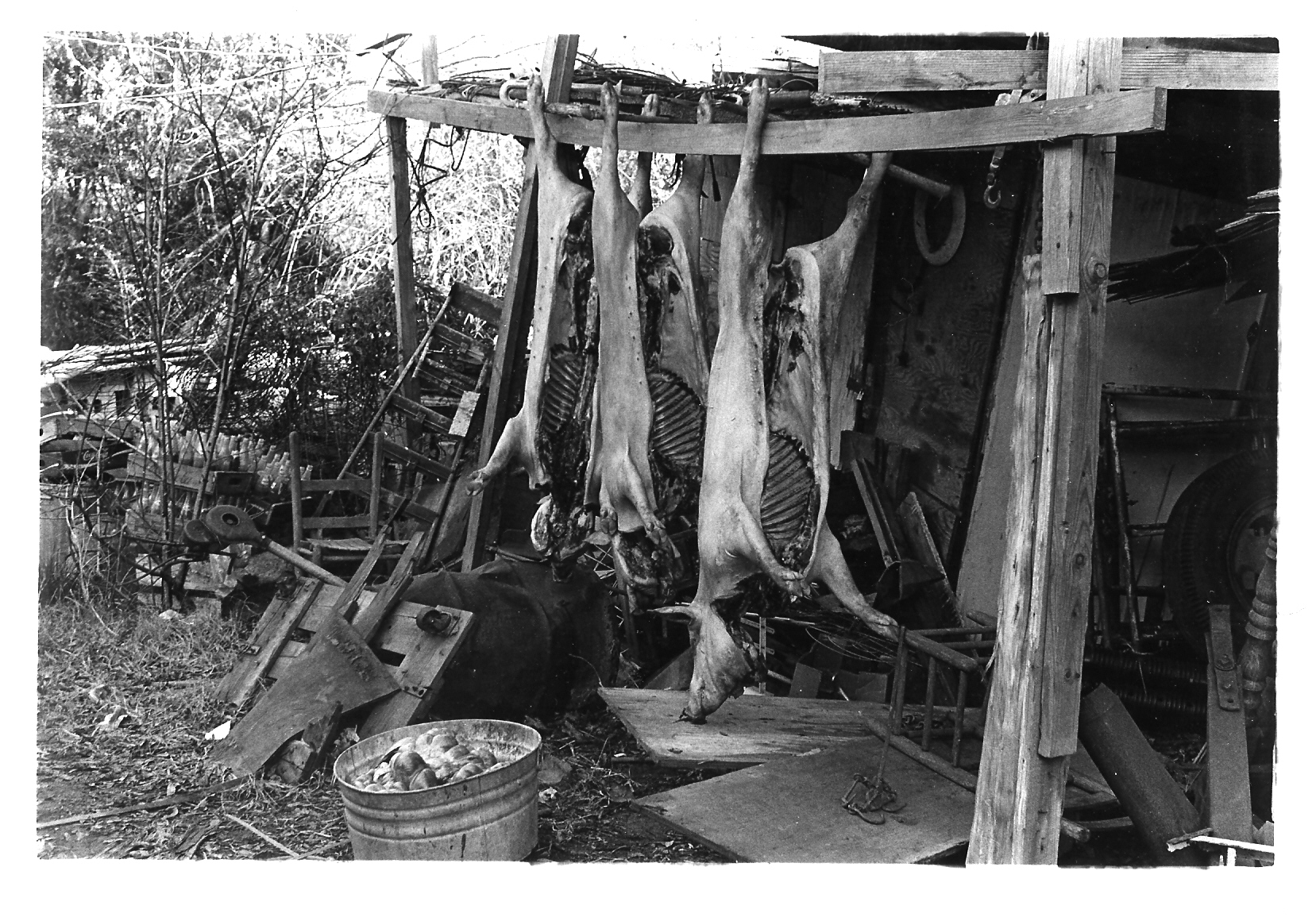
In 1975, some of my photos were chosen to be included in an exhibition at the University of Mexico that was entitled “December 5, 1974.” All of the photos in the show were taken in the United States on that date. I was working on my Masters in Film at the time at the University of Georgia, but I had long found my true love to be still photography, which I taught as a graduate assistant. The photo above is one of the series that was published.
It was a typical cool winter’s day in north Georgia, and as I drove through the foothills north of Athens, there was the pervasive, beguiling smell of wood fires throughout the rolling landscape, Georgia red clay peeking through the fields of harvested corn and cotton. I knew that it was the traditional hog killin’ weekend, and I hoped that I would find some roadside butchering going on. I scored not far from home. I have written extensively about whole-hog cookery and charcuterie in the past 30 years. In my first book in 1992, I gave recipes for blood pudding, sausage, duck breast hams and pâté, hog head stew, liver pudding, souse, and country ham. In 2006, I worked on the English translation of the French chef Stéphane Reynaud’s master work, Cochon & Fils.
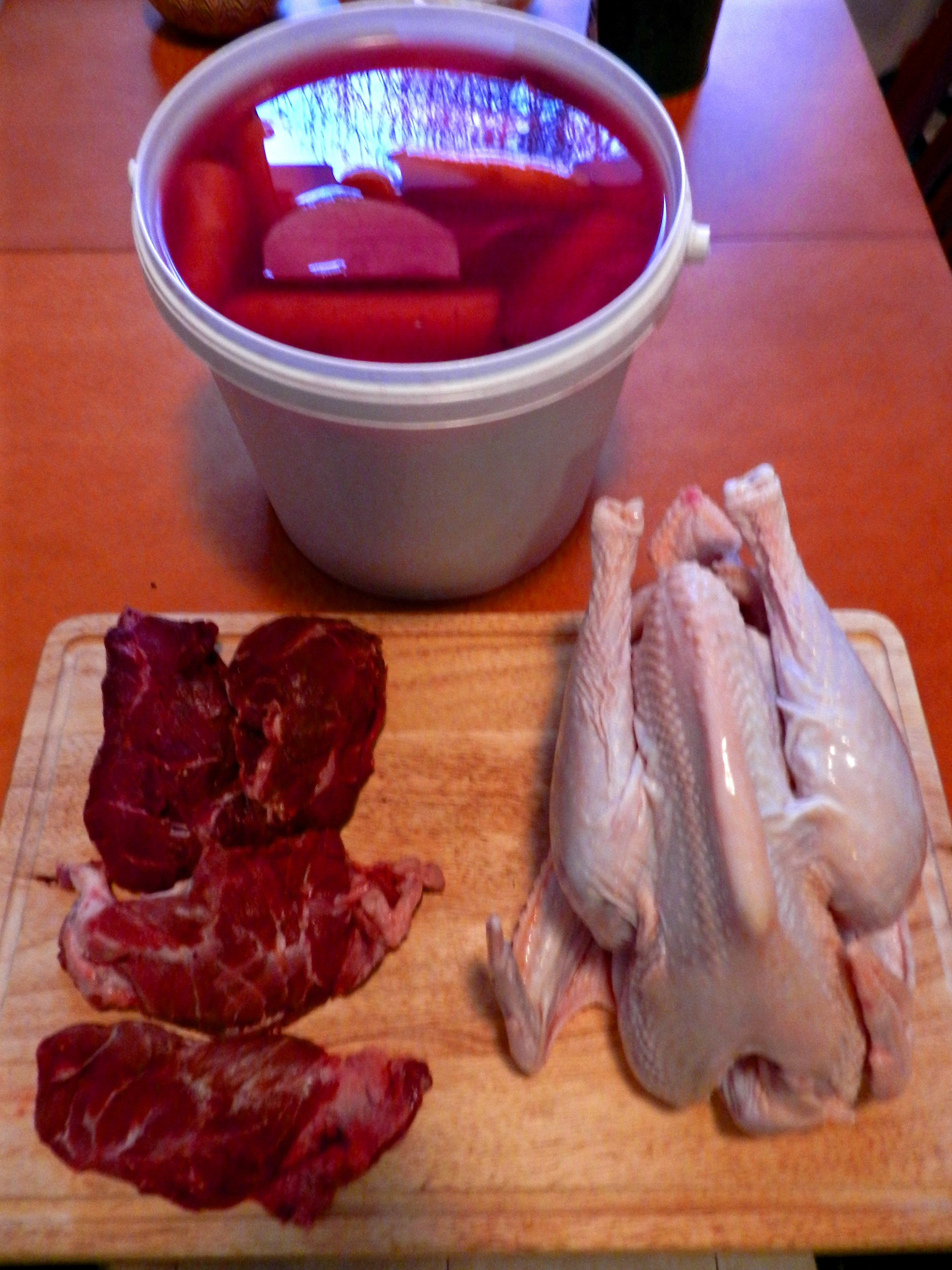
I was thrilled to return from out of town (and a nasty drive through freezing rain) yesterday to find my winemaker/farmer/publisher friend Philip Harmandjiev bearing gifts of pickled carrots, a freshly killed rooster, and pig cheeks. The deep-red cheeks of hogs, imbedded in the fatty jowls, are stronger-tasting and tougher than other cuts of pork, as the rooster is to young hens. They require long, gentle cooking in order for the flesh to be tender. 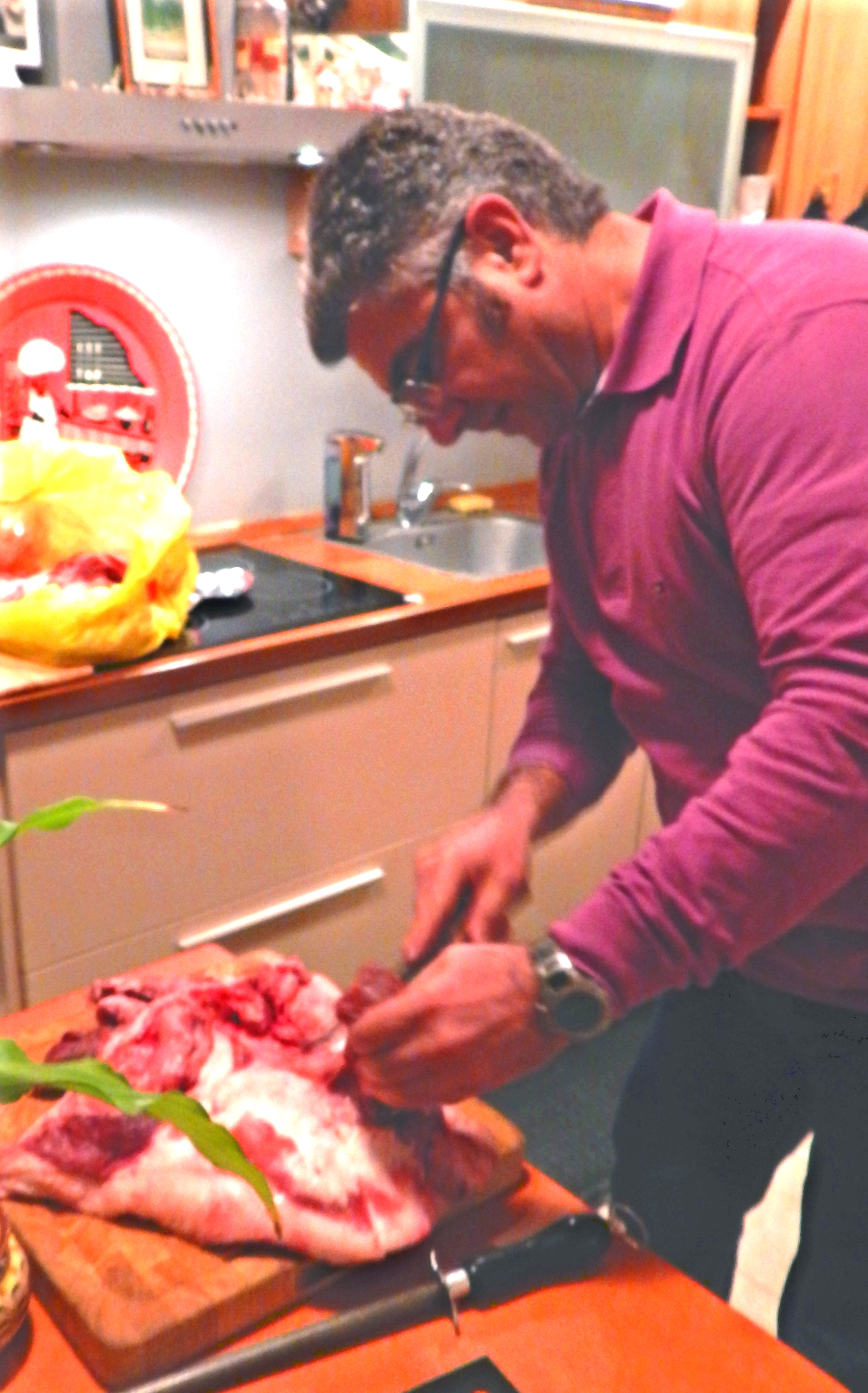
Here’s a shot of Philip removing the cheeks from the jowls.
Today, I removed the silver skin and any fat still connected to the cheeks and tossed them in a big enamel-lined dutch oven to brown and render out the fat. Though the fat (and meat) of a hog’s head is more stongly flavored than the fat from elsewhere on the body (leaf lard, rendered from the soft fat around the kidneys and loin, is the most delicate), I wanted to accent the very pigginess of the cheeks. Why eat this obscure cut if you’re not going to let it be what it is? I removed the scraps of meat and discarded them, then proceeded to brown the cheeks.
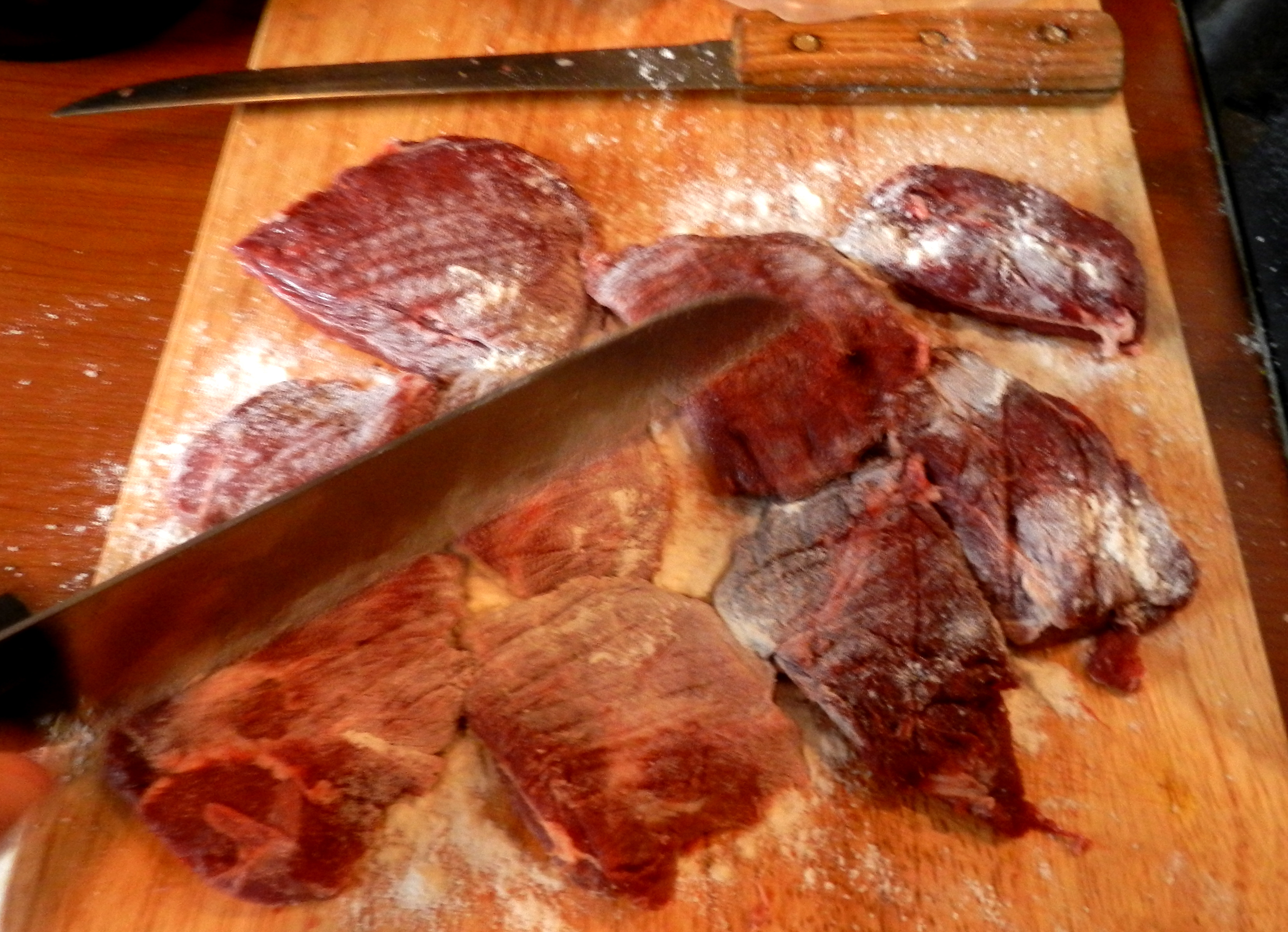
I cut the meat into smaller, basically uniform pieces, then put a very small amount of flour on my work surface and pounded it into the cuts with a knife. On cutlets I would use the dull side of the knife, but I used the “sharp” side of a fairly dull knife with the cheeks, because I wanted to tenderize the meat as well.
I then browned the meat well in the fat in the Dutch oven, carefully cooking all sides of the meat. I removed the morsels to a plate, then added chopped onions, celery, and bell peppers, tossing them well and wilting them evenly. When they were totally wilted and the onions were becoming transparent, I deglazed the pan with a splash of red wine vinegar. I then added tomato puree and and, after about five minutes, my own secret weapon: an herbal mix. This combination of fresh herbs, several cloves of garlic, dried herbs (I used herbes de Provence) and salt is chopped at the last minute then added after all other flavors have blended well. 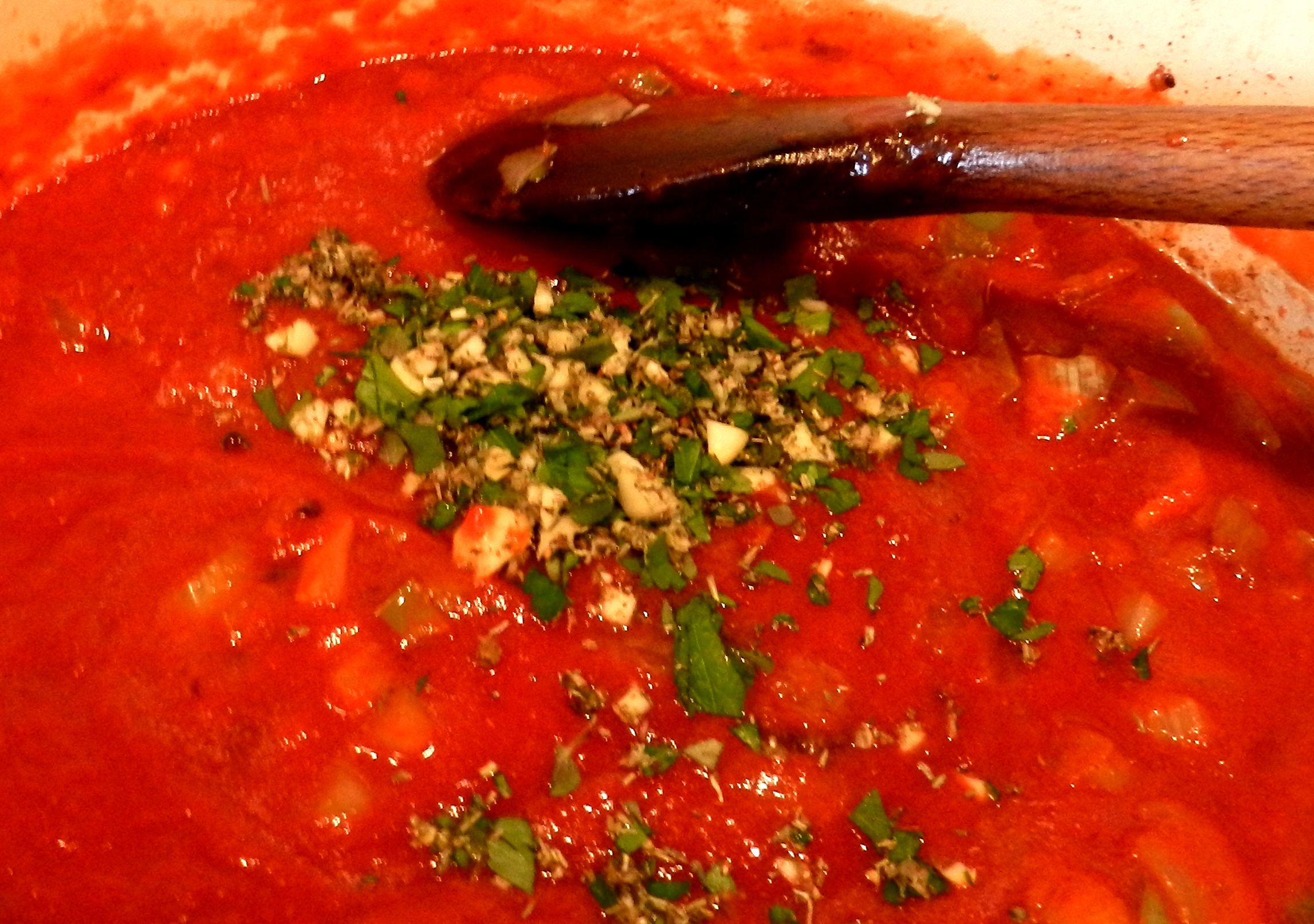
I then added the browned cheeks, a dozen or more grinds of black pepper, the lid to the pot, and popped it in the oven that was preheated to a very low temperature (about 225 degrees F). At the same time, I put a skillet with the pureed fat from the rest of the head in the oven to render. If figured that if I played my cards right, I could set the rendered lard outside in the snow so that it would be well chilled in time for me to make the biscuit topping for the chicken pie, below.
The cheeks stayed in the oven for several hours — about 4. I checked the pot occasionally to make sure that the tomato sauce was just barely simmering, and each time, I poked the meat to see if it were yet tender. Finally, it gave to the touch of the spoon and I pulled a morsel out of the pot to taste… HEAVEN! Pork cheeks are similar to slow-braised beef ribs in texture, but the powerful taste of the pork — especially from Philip’s naturally raised, heritage breeds (I think one of the hogs was a cross with a feral pig) — resembles beef in no other way. The lard is now rendered as well and is outside in the snow. The pork cheeks I’ll wait and serve tomorrow night. Probably with grits, but perhaps with a parsnip and potato mash.
Chicken Pie from The New Southern Cook
No recipe so illustrates the regional differences within the South as chicken pie. There are pies with no crusts, those with bottom crusts only, and those with only a top crust. Some are merely chicken enriched with cream or sour cream; others are filled with peas and mushrooms. In this south Georgia version, celery is the predominant flavor, and the pie is covered with a simple biscuit dough — a variation on chicken and dumplings. This is one of my favorite comfort foods.
Tonight, I had a rooster to work with, so I let the rooster and stock cook a lot longer, at a much lower tempertaure: the pot just barely simmered for several hours. After two hours, I added 4 additional ribs of celery to use in the pie. I also cut the rooster up into pieces so that it would cook more evenly. When the rooster meat was tender and I removed it from the bones, I chopped the bones with a cleaver and returned them to the stock to cook further.
For the stock and filling:
1 3-1/2 to 4-pound chicken
3 quarts water
4 large ribs celery
1 large onion, quartered
2 carrots, broken into pieces
2 bay leaves
a few fresh thyme sprigs and other fresh herbs of your choice
4 large eggs
Rinse the chicken well, then put it in a stockpot and cover with the water. Cut the tops and bottoms off the celery, but leave the main part of the stalks intact. Add all the celery, the onion, carrots, and herbs to the pot, bring almost to a boil, and allow to simmer until the meat is evenly cooked, about 1 hour. While the chicken is poaching, hard-boil the eggs, cool them, peel them, chop them, and set them aside.
Remove the chicken and the trimmed celery stalks from the pot and strain the rest of the solids out of the stock and discard. Refrigerate the strained stock. When it is cool enough to handle, remove the skin from the chicken and discard, then pull the chicken meat from the bird and chop into uniform pieces, discarding any fat. You should have four cups of meat. Chop the cooked celery into small pieces. You should have about a cup of celery. Set the celery and chicken aside.
For the biscuit crust:
2 cups sifted soft southern flour or cake or pastry flour, plus a little for dusting
2 teaspoons baking powder
1 teaspoon salt
5 tablespoons shortening of your choice (butter, lard, or vegetable shortening)
1/2 cup milk
Sift the dry ingredients into a bowl, then cut the shortening into the flour mixture with a pastry blender or 2 knives until it is uniformly incorporated into the flour and there are no large clumps. Working swiftly, fold in the milk a little at a time with a rubber spatula until it is just blended in smoothly.
Dust a countertop lightly with some flour and scoop up the dough onto the countertop with the spatula. Lightly work the dough, working only with the fingertips, until it is evenly blended. Roll it out about 1/4″ thick into the shape and size of the 2-quart casserole dish in which you will bake the pie (Mine is rectangular, about 11″ by 8″). Cover with a dish towel while you prepare the filling.
For the filling and final assembly:
4 tablespoons butter
3 tablespoons flour
2 cups reserved chicken stock
1/2 cup milk
salt and pepper
1-1/4 cups finely chopped onions
reserved chicken, celery, and hard-boiled eggs
2 tablespoons melted butter or cream
Preheat the oven to 425 degrees F.
In a sauce pan over medium high heat, melt the butter, then add the flour, stirring constantly until you have a smooth paste. Gradually add the stock and milk and continue cooking until the mixture is the consistency of thick cream, about 5 to 10 minutes. Season to taste with salt and pepper. Add the onions, chicken, and celery, and toss well together. Remove from the heat and turn into a 2-quart baking dish.
Add the eggs, then top with the biscuit dough. I cut biscuits out with a 2-inch metal biscuit cutter dipped in flour, then cover the top of the pie with the biscuits and the scraps. Brush with cream or butter, then bake in the preheated oven for about 15 minutes. If the biscuits are not browned, you can run them under the broiler for a moment. Serve hot.
Serves 6-8 as supper or 8-10 as part of a larger meal.
Debbie recommends an oaky and rich chardonnay from Napa or Monterey, but we’ll have Philip’s chardonnay.